
Researchers at deCODE genetics have developed a groundbreaking DNA map, revealing the intricate process of genetic recombination during reproduction.
This map highlights areas of DNA that undergo minimal reshuffling to maintain genetic stability and explains why some pregnancies fail. The insights gained may lead to advancements in fertility treatments and better understanding of genetic diversity’s role in health and disease.
Mapping Human Genetic Diversity
Scientists at deCODE genetics, a subsidiary of Amgen, have created a comprehensive map of how human DNA is mixed and passed down during reproduction. This achievement marks a significant milestone in understanding genetic diversity and its effects on health and fertility. The new map builds on 25 years of research at deCODE genetics, exploring how genetic variation arises and its connection to health and disease.
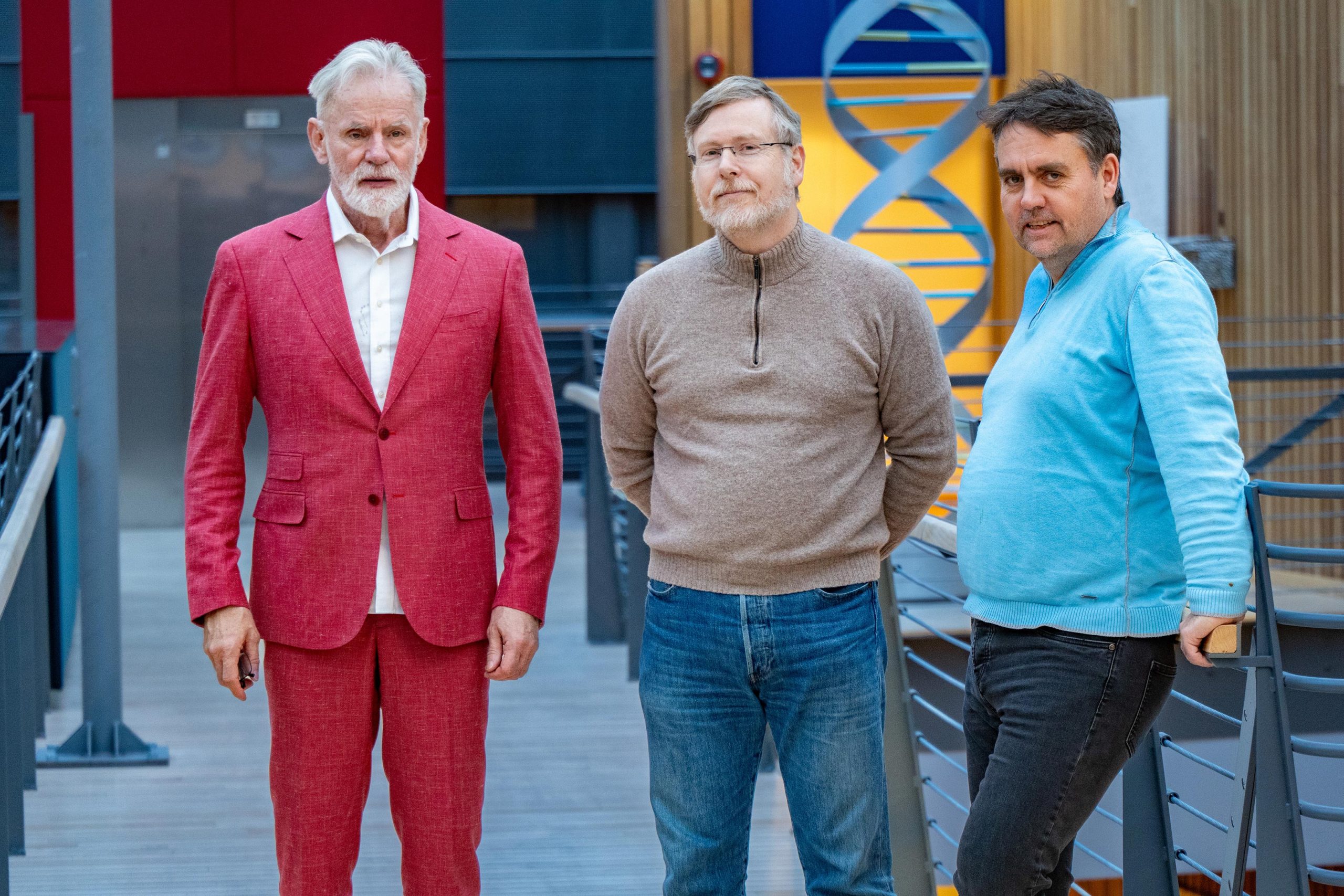
Kari Stefansson CEO of deCODE genetics talks to Bjarni V. Halldorsson, scientist at deCODE genetics about the paper, complete recombination map of the human-genome. Credit: deCODE genetics
Decoding DNA Shuffling in Reproduction
Published today (January 22) in the online edition of Nature, this map is the first to capture the finer-scale mixing of grandparental DNA, known as non-crossover recombination. This type of shuffling has been challenging to detect due to the high similarity between DNA sequences. The study also identifies specific regions of DNA that remain largely unchanged, likely serving to protect essential genetic functions and prevent chromosomal issues. These findings provide valuable insights into why some pregnancies do not succeed and how the genome maintains a balance between diversity and stability.
Implications for Fertility and Reproduction
While this shuffling, known as recombination, is essential for genetic diversity, errors in the process can lead to serious reproductive issues. These failures can result in genetic errors that prevent pregnancies from continuing, helping to explain why infertility affects around one in ten couples worldwide. Understanding this process offers new hope for improving fertility treatments and diagnosing pregnancy complications.
Gender Differences and Evolutionary Insights
The research also reveals key differences between men and women in how and where, the genome recombination occurs. Women have fewer non-crossover recombinations, but their frequency increases with age, which may help explain why older maternal age is associated with higher risks of pregnancy complications and chromosomal disorders of the child. Men, however, do not show this age-related change, although recombination in both sexes can contribute to mutations passed to offspring.
Understanding the recombination process is also important in understanding how humans evolved as a species and what shapes individual differences, including health outcomes. All human genetic diversity can be traced to recombination and de novo mutations, DNA sequence present in the child but not in the parents. The map shows that mutations are elevated near regions of DNA mixing and consequently that the two processes are highly correlated.
Reference: “Complete human recombination maps” by Gunnar Palsson, Marteinn T. Hardarson, Hakon Jonsson, Valgerdur Steinthorsdottir, Olafur A. Stefansson, Hannes P. Eggertsson, Sigurjon A. Gudjonsson, Pall I. Olason, Arnaldur Gylfason, Gisli Masson, Unnur Thorsteinsdottir, Patrick Sulem, Agnar Helgason, Daniel F. Gudbjartsson, Bjarni V. Halldorsson and Kari Stefansson, 22 January 2025, Nature.
DOI: 10.1038/s41586-024-08450-5
deCODE genetics, headquartered in Reykjavik, Iceland, is a global leader in human genome research. With its specialized expertise and access to extensive population data, deCODE has identified genetic risk factors for numerous common diseases. By understanding the genetic basis of these conditions, the company aims to develop better methods for diagnosis, treatment, and prevention. deCODE genetics operates as a wholly-owned subsidiary of Amgen.
Never miss a breakthrough: Join the SciTechDaily newsletter.
Follow us on Google and Google News.