

Tests show the recombinant vaccine outperforming existing vaccines in some areas.
Recombinant protein vaccines, like the Novavax vaccine used to fight COVID-19, offer several advantages over conventional vaccines.
They’re easy to precisely produce. They’re safe, and potentially more effective. And they could require smaller doses.
Because of these traits, there is much interest in developing recombinant influenza vaccines. To date, however, the Food and Drug Administration has approved only one such vaccine.
Development of a New Flu Vaccine
A University at Bufalo-led research team hopes to add to that number. It is developing a new recombinant flu vaccine – described in a study published on February 23 in the journal Cell Reports Medicine – that has the potential to compete with existing vaccines.
“Because of the variable nature of the viruses that cause influenza, current vaccines are not optimally effective among the overall population. We believe our vaccine candidate has the potential to improve upon this by inducing stronger and broader immunity, and reducing the likelihood of illness and death,” says study senior co-author, Jonathan Lovell, PhD, SUNY Empire Innovation Professor in the Department of Biomedical Engineering at UB.
Conventional flu vaccines contain either deactivated microbes that cause influenza or are based on weakened forms of the disease. They are made using fertilized chicken eggs or, less commonly, through cell culture-based production.
Innovative Vaccine Technology
The vaccine the UB-led team is developing is based on a nanoliposome – a tiny spherical sac – that Lovell and colleagues created called cobalt-porphyrin-phospholipid, or CoPoP. The CoPoP platform enables immune response-promoting proteins to be displayed on the surface of the nanoliposome, resulting in potent vaccine efficacy.
(While not part of this study, the CoPoP vaccine platform underwent phase 2 and phase 3 clinical trials in South Korea and the Philippines as a COVID-19 vaccine candidate. This is a partnership between UB spinoff company POP Biotechnologies, co-founded by Lovell, and South Korean biotech company EuBiologics.)
Alone, these nanoliposomes do not fight disease. But when combined with recombinant influenza proteins that can be generated based on genetic information from viruses, they enhance the immune system’s response to disease.
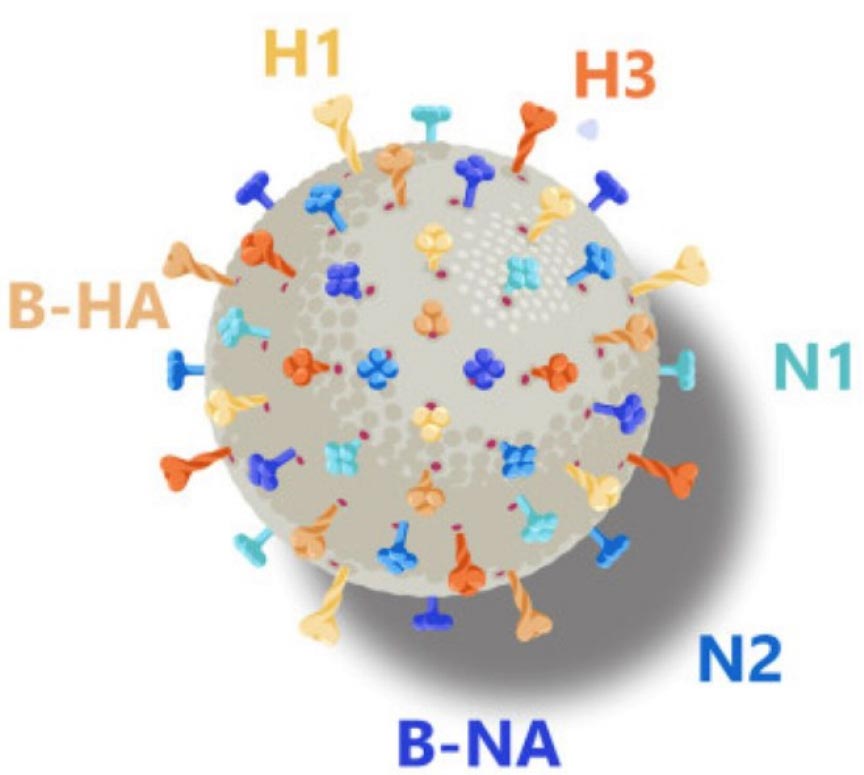
In the new study, the team attached to the nanoliposome a total of six proteins – three each from two different protein groups, hemagglutinins, and neuraminidases. The team also added two adjuvants (PHAD and QS21) to boost immune response.
Study Findings and Future Potential
Researchers evaluated the resulting “hexaplex” nanoliposome in animal models with three common flu strains: H1N1, H3N2, and type B.
Even when administered in low doses, the hexaplex nanoliposome provided superior protection and survival from H1 and N1 when compared to Flublok, which is the sole licensed recombinant influenza vaccine in the U.S., and Fluaid, an egg-based vaccine. Tests showed comparable levels of protection against H3N2 and type B viruses.
The tests were performed via vaccination and through blood serum transfer from vaccinated mice into non-vaccinated mice.
“The combination of the two groups of proteins led to synergistic effects. In particular, the adjuvanted nanoliposomes excelled in the production of functional antibodies and the activation of T cells, which are critical to fighting off serious infection of the flu,” says lead author Zachary Sia, a PhD candidate in Lovell’s lab.
Bruce Davidson, PhD, research associate professor of anesthesiology in the Jacobs School of Medicine and Biomedical Sciences at UB, is a senior co-author of the study.
He says “Using not only hemagglutinin but also neuraminidase antigens to create vaccines is important because it translates into broader immunity and companies will be able to create more doses with less materials. That’s critical for not only the flu but also potential outbreaks like what we saw with COVID-19. There is still much work to be done in fully testing and validating this flu technology, but at this point, these early results are quite promising.”
Reference: “Adjuvanted nanoliposomes displaying six hemagglutinins and neuraminidases as an influenza virus vaccine” by Zachary R. Sia, Jayishnu Roy, Wei-Chiao Huang, Yiting Song, Shiqi Zhou, Yuan Luo, Qinzhe Li, Dominic Arpin, Hilliard L. Kutscher, Joaquin Ortega, Bruce A. Davidson and Jonathan F. Lovell, 23 February 2024, Cell Reports Medicine.
DOI: 10.1016/j.xcrm.2024.101433
In addition to UB, study co-authors include scientists from McGill University.
Patents related to this work have been filed with The Research Foundation for the State University of New York. Lovell and study co-author Wei-Chiao Huang, postdoctoral scholar in Lovell’s lab, are employed by POP Biotechnologies.
The study was funded, in part, by the National Institutes of Health.
Never miss a breakthrough: Join the SciTechDaily newsletter.
Follow us on Google and Google News.