

Close Menu
    Facebook X (Twitter) Instagram
    SciTechDaily
    • Biology
    • Chemistry
    • Earth
    • Health
    • Physics
    • Science
    • Space
    • Technology
    Facebook X (Twitter) Pinterest YouTube RSS
    SciTechDaily
    Home»Biology»Unraveling Proteins’ Shape-Shifting Secrets With Cutting-Edge Crystallography
    Biology

    Unraveling Proteins’ Shape-Shifting Secrets With Cutting-Edge Crystallography

    By Advanced Science Research Center, GC/CUNYJanuary 12, 20241 Comment3 Mins Read
    Facebook Twitter Pinterest Telegram LinkedIn WhatsApp Email Reddit
    Share
    Facebook Twitter LinkedIn Pinterest Telegram Email Reddit
    Biochemistry Protein Art Concept
    A study by CUNY ASRC researchers, using X-ray crystallography under different conditions, revealed various shapes of a disease-related protein, offering new avenues for drug development. Credit: SciTechDaily.com

    New crystallography experiments using high pressure and heat to reveal how proteins change shape could advance the development of novel drugs.

    Proteins do the heavy lifting of performing biochemical functions in our bodies by binding to metabolites or other proteins to complete tasks. To do this successfully, protein molecules often shape-shift to allow specific binding interactions that are needed to perform complex, precise chemical processes.

    Research on Protein Structures

    A better understanding of the shapes proteins take on would give researchers important insight into stopping or treating diseases, but current methods for revealing these dynamic, three-dimensional forms offer scientists limited information.

    To address this knowledge gap, a team from the Advanced Science Research Center at the CUNY Graduate Center (CUNY ASRC) designed an experiment to test whether performing X-ray crystallography imaging using elevated temperature versus elevated pressure would reveal distinct shapes. The results of the team’s work will be published today (January 12) in the journal Communications Biology.
    Protein Flexibility
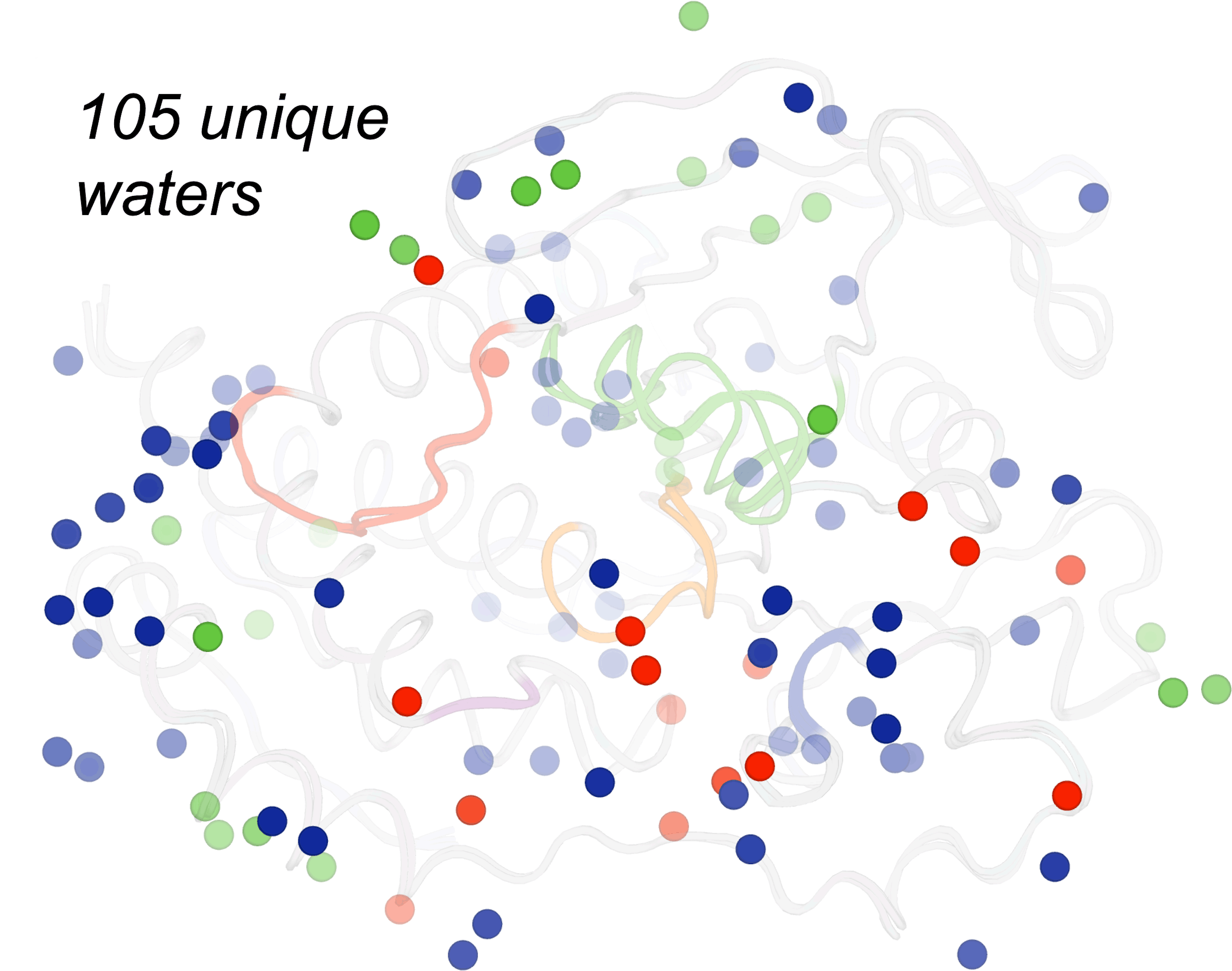
    The positions of these water molecules are often important for understanding protein flexibility and the ability of drug-like molecules to influence protein structure and function. In this study, different unique waters appeared at the surface of the protein under different experimental perturbations such as high temperature (red), high pressure (green), or default conditions (blue), offering complementary insights into these questions. Credit: Ali Ebrahim & Liliana Guerrero

    Study Insights by Dr. Daniel Keedy

    “Protein structures don’t sit still; they shift between several similar shapes much like a dancer,” said the study’s principal investigator Daniel Keedy, Ph.D., a professor with the CUNY ASRC’s Structural Biology Initiative and a chemistry and biochemistry professor at The City College of New York and the CUNY Graduate Center. “Unfortunately, existing approaches for viewing proteins only reveal one shape, or suggest the presence of multiple shapes without providing specific details. We wanted to see if different ways of poking at a protein could give a us a more detailed view of how it shape-shifts.”

    Experimentation and Observations

    For their experiment, the team obtained crystals of STEP, also known as PTPN5—a drug target protein for the treatment of several diseases, including Alzheimer’s—and agitated them using either high pressure (2,000 times the Earth’s atmospheric pressure) or high temperature (body temperature), both of which are very different from typical crystallography experiments at atmospheric pressure and cryogenic temperature (-280 °F, -173 °C). The researchers viewed the samples using X-ray crystallography and observed that high temperature and high pressure had different effects on the protein, revealing distinct shapes.

    Implications for Drug Development

    While high pressure isn’t a condition that proteins experience inside the body, Keedy said the agitation method exposed different structural states of the protein that may be relevant to its activity in human cells.

    “Having the ability to use perturbations such as heat and pressure to elucidate these different states could give drug developers tools for determining how they can trap a protein in a particular shape using a small-molecule drug to diminish its function,” Keedy added.

    Reference: “Pushed to extremes: distinct effects of high temperature versus pressure on the structure of STEP” by Liliana Guerrero, Ali Ebrahim, Blake T. Riley, Minyoung Kim, Qingqiu Huang, Aaron D. Finke and Daniel A. Keedy, 12 January 2024, Communications Biology.
    DOI: 10.1038/s42003-023-05609-0

    Never miss a breakthrough: Join the SciTechDaily newsletter.
    Follow us on Google and Google News.

    Advanced Science Research Center Molecular Biology Protein Structural Biology
    Share. Facebook Twitter Pinterest LinkedIn Email Reddit

    Related Articles

    Scientists Finally “See” Key Protein That Controls Inflammation

    Yale Researchers Create a 21st Amino Acid

    New Analysis on Iceman Ötzi Opens Up New Research Possibilities for Mummies

    A Closer Look at the Antifreeze Protein That Allows Siberian Beetles to Survive

    Enzyme’s Essential Role in Long-Term Memory Refuted

    SSRL Validates Anti-Flu Protein Design

    “Arsenic-Life” Bacterium Prefers Phosphate Over Arsenate

    New Design Makes Previously Inaccessible Proteins Vulnerable to Drugs

    Sirtuin Protein SIRT6 Linked to Longevity in Mammals

    1 Comment

    1. vimalzubaa on January 12, 2024 4:37 am

      The researchers viewed the samples using X-ray crystallography and observed that high temperature and high pressure had different effects on the protein, revealing distinct shapes.

      Reply
    Leave A Reply Cancel Reply

    • Facebook
    • Twitter
    • Pinterest
    • YouTube

    Don't Miss a Discovery

    Subscribe for the Latest in Science & Tech!

    Trending News

    Scientists Uncover Potential Brain Risks of Popular Fish Oil Supplements

    Scientists Discover a Surprising Way To Make Bread Healthier and More Nutritious

    After 60 Years, Scientists Uncover Unexpected Brain Effects of Popular Diabetes Drug Metformin

    New Research Uncovers Hidden Side Effects of Popular Weight-Loss Drugs

    Scientists Rethink Extreme Warming After Surprising Ocean Discovery

    Landmark Study Links Never Marrying to Significantly Higher Cancer Risk

    Researchers Discover Unknown Beetle Species Just Steps From Their Lab

    Largest-Ever Study Finds Medicinal Cannabis Ineffective for Anxiety, Depression, PTSD

    Follow SciTechDaily
    • Facebook
    • Twitter
    • YouTube
    • Pinterest
    • Newsletter
    • RSS
    SciTech News
    • Biology News
    • Chemistry News
    • Earth News
    • Health News
    • Physics News
    • Science News
    • Space News
    • Technology News
    Recent Posts
    • Early Warning Signals of Esophageal Cancer May Be Hiding in Plain Sight
    • Researchers Have Discovered a THC-Free Cannabis Compound That May Replace Opioids
    • Common Blood Pressure Drug Shows Surprising Power Against Deadly Antibiotic-Resistant Superbug
    • Students Build Dark Matter Detector and Set New Experimental Limits
    • Scientists Discover Caffeine Can Repair Key Memory Circuits After Sleep Loss
    Copyright © 1998 - 2026 SciTechDaily. All Rights Reserved.
    • Science News
    • About
    • Contact
    • Editorial Board
    • Privacy Policy
    • Terms of Use

    Type above and press Enter to search. Press Esc to cancel.