
Close Menu
    Facebook X (Twitter) Instagram
    SciTechDaily
    • Biology
    • Chemistry
    • Earth
    • Health
    • Physics
    • Science
    • Space
    • Technology
    Facebook X (Twitter) Pinterest YouTube RSS
    SciTechDaily
    Home»Health»Visualization Tool: See How Your Congressional District Has Handled COVID-19
    Health

    Visualization Tool: See How Your Congressional District Has Handled COVID-19

    By University of ChicagoNovember 3, 2020No Comments3 Mins Read
    Facebook Twitter Pinterest Telegram LinkedIn WhatsApp Email Reddit
    Share
    Facebook Twitter LinkedIn Pinterest Telegram Email Reddit
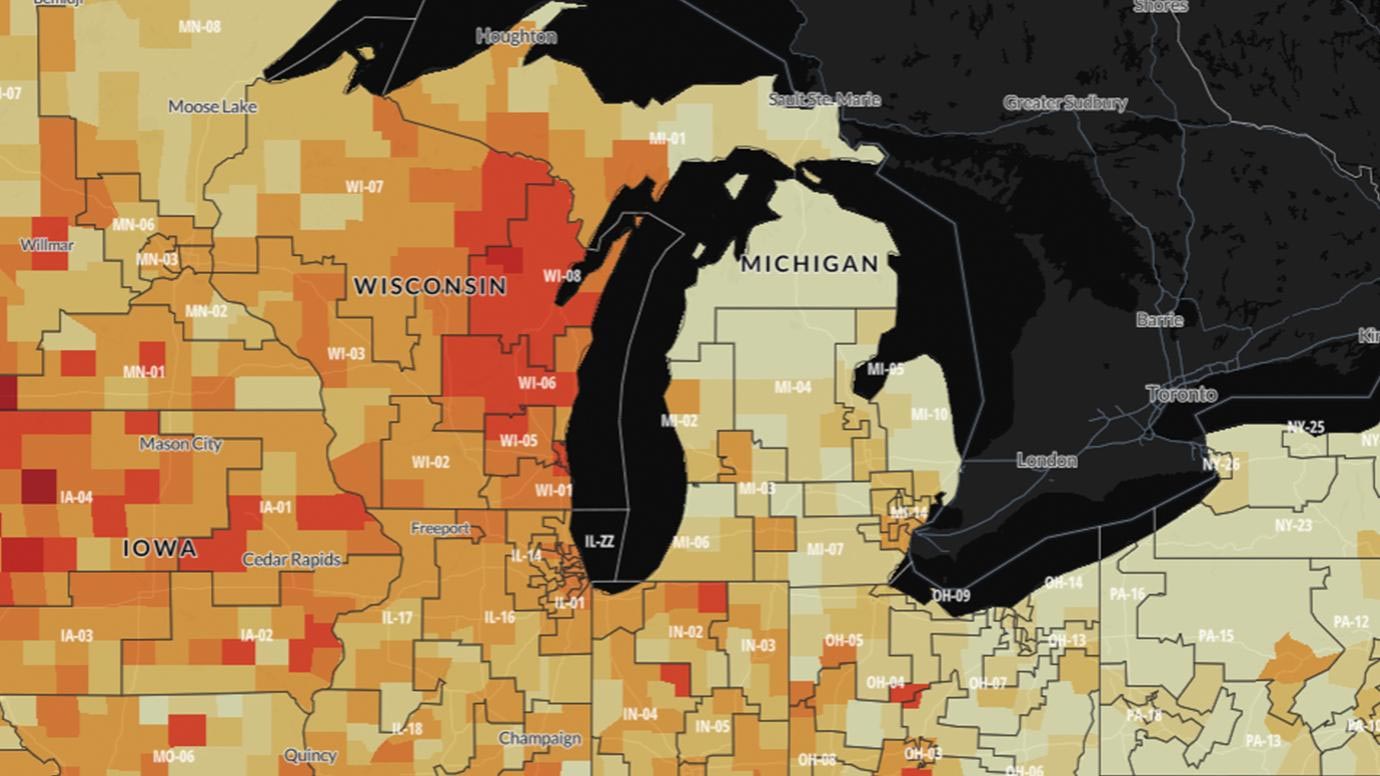
    COVID-19 Chicago Heat Map
    A heat map as of October 30, showing confirmed cases of COVID-19 per 100,000 people, with darker colors indicating higher case counts. Credit: Center for Spatial Data Science

    University of Chicago researchers add district map to COVID Atlas visualization tool.

    Citizens and voters can now track their congressional districts alongside the coronavirus pandemic, thanks to a new tool from the University of Chicago’s Center for Spatial Data Science.

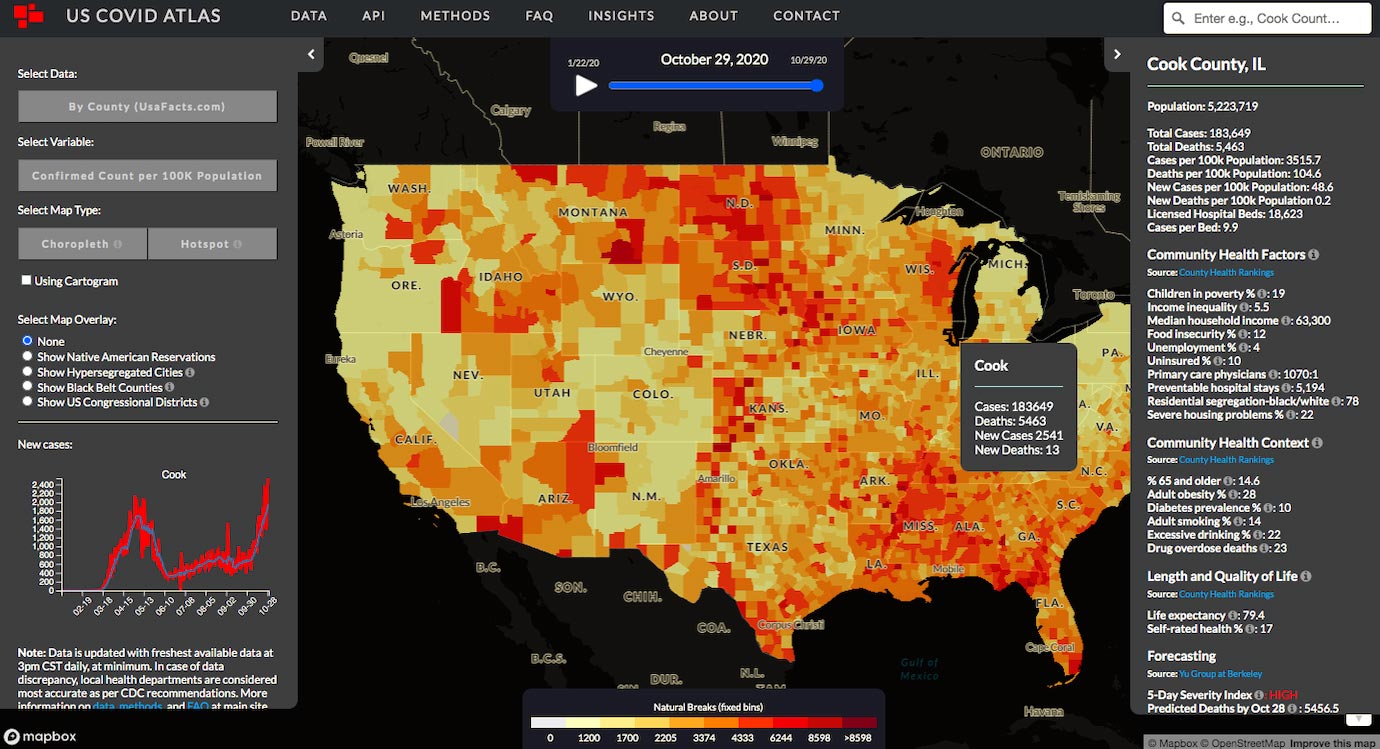
    Launched earlier this year, the COVID Atlas interactive visualization compiles county-level case numbers, generates daily hotspot statistics, and displays them on an easy-to-read map. Now, the online resource also includes a congressional district overlay—a new feature that allows users to see how the impacts of COVID-19 might differ according to local government responses.

    “Because there’s been no federal, coordinated response, we’re seeing that the context of hotspots is dependent on the patchwork of local policies that has emerged,” said Marynia Kolak, who co-leads the Atlas as the assistant director of health informatics at the Center for Spatial Data Science. “Since all politics are local—and COVID-19 is a very local experience—it seemed responsible to add congressional districts.
    COVID-19 US Heat Map
    Credit: Center for Spatial Data Science

    “Obviously, the coronavirus is a complicated and multidimensional disease. But as the pandemic progresses, it’s also true that policy is part of that, so we thought we should add this piece of information to support people’s decision-making.”

    Kolak’s previous work included analyzing the spread of the opioid epidemic, where she found local data and meaningful statistics to be crucial. As the coronavirus began to spread rapidly, she and colleagues at the Center for Spatial Data Science quickly applied the approach to better identify and track COVID-19 hotspots on a daily basis. Early in the pandemic, they called attention to rural hot spots that were overlooked in state-level data. The team also linked over a dozen community health factors and highlighted regions of excess risk, like hypersegregated cities and the Black Belt.

    As time passes, she said, more narratives emerge.

    “For example, the Great Plains are being really hard hit right now, but those hotspots started a long time ago—weeks,” Kolak said. “We’ve watched and seen that once it starts to spread across multiple counties, it becomes really difficult to control. So one lesson from the Plains spread is trying to contain it before it happens.”

    In rural areas, there are fewer hospitals and fewer ventilators, so spread becomes deadly more easily, she added: “It’s a reminder not to look at just the [case] numbers themselves, because they don’t tell the full story.”

    To learn more, visit the interactive COVID Atlas online.

    Never miss a breakthrough: Join the SciTechDaily newsletter.
    Follow us on Google and Google News.

    COVID-19 Political Science Public Health University of Chicago
    Share. Facebook Twitter Pinterest LinkedIn Email Reddit

    Related Articles

    Innovative Approaches to COVID-19 Vaccine Taken by Molecular Engineers

    How Far Does COVID-19 Spread Through Air? Researchers Monitor Virus Transmission in Hospital Rooms

    Handheld COVID-19 Test Could Deliver Results in 5 Minutes – For Just $10

    Scientists Explore Digital Saliva Testing for COVID-19

    How to Balance Using Contact Tracing for COVID-19 and Privacy

    Why Time Outdoors Is Crucial to Your Health, Even During the COVID-19 Pandemic

    Why Quarantines Are So Difficult to Implement: Lessons From the 1800s

    What the Ebola Outbreak Could Teach Us About Containing COVID-19

    Coronavirus Attack Rate Increases With City Size. How Should Large Cities Respond?

    Leave A Reply Cancel Reply

    • Facebook
    • Twitter
    • Pinterest
    • YouTube

    Don't Miss a Discovery

    Subscribe for the Latest in Science & Tech!

    Trending News

    Scientists Call for a Complete Rethink of Alzheimer’s Treatment

    Scientists Identify Molecular Switch That Lets Exercise Reverse Muscle Aging

    Why Your Most Vivid Dreams Might Be the Key to Deep, Restful Sleep

    A Bright Star Hid a Massive Secret for 50 Years: Mystery of Gamma Cassiopeiae Finally Solved

    Scientists Identify Protein That Slows Key Effects of Aging

    Revolutionary Submarine Mysteriously Disappears Without a Trace – Scientists Are Now Preparing for a Bold Return

    Why Drinking More Water Isn’t Enough To Stop Kidney Stones

    New Study Reveals Surprising Effect of Drinking Coffee at Night

    Follow SciTechDaily
    • Facebook
    • Twitter
    • YouTube
    • Pinterest
    • Newsletter
    • RSS
    SciTech News
    • Biology News
    • Chemistry News
    • Earth News
    • Health News
    • Physics News
    • Science News
    • Space News
    • Technology News
    Recent Posts
    • 3.5-Billion-Year-Old Rocks Rewrite the Story of Plate Tectonics
    • “These Wrinkles Shouldn’t Exist” – A Geologist’s Hike Uncovers a 180-Million-Year-Old Mystery
    • Why Aging Lungs Turn Mild Infections Into Life-Threatening Illness
    • Lost Bronze Age Mines Unearthed in Spain Transform Bronze Age History
    • First New Dinosaur Species Found in Korea in 15 Years Surprises Scientists
    Copyright © 1998 - 2026 SciTechDaily. All Rights Reserved.
    • Science News
    • About
    • Contact
    • Editorial Board
    • Privacy Policy
    • Terms of Use

    Type above and press Enter to search. Press Esc to cancel.