
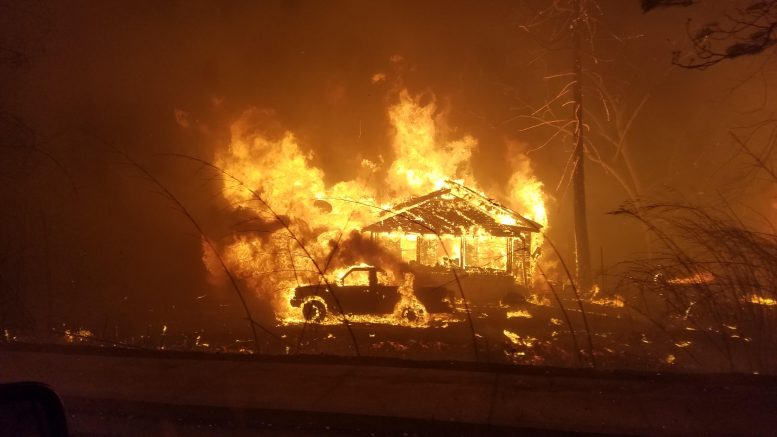
Are wildfires getting worse?
Yes, unfortunately, they are. We’re seeing increases in the intensity and the severity, the overall burned area of wildfires and the duration of fire across the fire season. And while fire is a natural part of ecosystems, what’s really driving this change is we’re seeing a lot of changes in our climate. We’re seeing increases in global temperature as well as more extreme weather events, so longer droughts. And so we have these hot and dry conditions, which makes vegetation, forests and grasses more available to burn because they’re drier.
And so with these drier conditions and these drier fuels, we’re likely to see more fires. And this is happening in many locations all across the world. This can be really detrimental to the ecosystem, but also to human health, where we’re seeing people going to the hospital with respiratory issues and smoke can just travel many thousands of miles with these fires.
Changes in our climate, along with other factors, have led to wildfires increasing in intensity, severity, size, and duration. NASA climate and wildfire expert Liz Hoy explains how and why NASA studies these events from the ground, air, and space to better understand the impacts they have on both a local and global scale. Credit: NASA
How can we help? What can we do? One thing that I find really hopeful is that NASA continues to study wildfires around the globe. We have people going out on the land to make measurements. We have airborne campaigns that fly around to better understand wildfires from the air, how it’s impacting smoke, where wildfires are burning. And then, of course, we have satellite imagery, which gives us a global picture of wildfires all around the world all the time.
So are wildfires getting worse? Yes, they are. But there are ways that we can all think about this together. And I think just learning about these issues and being able to share that with other members in our community is a way we can all go forward and think about climate change and wildfires.
We Asked a NASA Expert Video Series
- Why is Venus Called Earth’s Evil Twin?
- Is NASA Really Crashing a Spacecraft Into an Asteroid?
- Is NASA Aware of Any Earth-Threatening Asteroids?
- When Was the Last Time an Asteroid Hit Earth?
- How Did Perseverance Mars Rover Pick Its Landing Spot?
- What if an Asteroid Was Going To Hit Earth?
- Did Mars Ever Look Like Earth?
- What Are Lagrange Points?
- What Are the Trojan Asteroids?
- Is There Oxygen on Mars?
- Does NASA Know About All the Asteroids?
- Do Aliens Exist?
- Is There Weather on Mars?
- Will an Asteroid Ever Hit Earth?
- Is Mars Habitable?
- Could Microbes Survive a Trip to Mars?
Never miss a breakthrough: Join the SciTechDaily newsletter.
Follow us on Google and Google News.
4 Comments
I thought this text was AI generated. It’s actually a transcript of the video, hence the weird phrasings and non-sequiturs.
“Are wildfires getting worse? Yes, unfortunately, they are.”, wildfires are natural, so it’s like saying mountains are getting worse. Mountains are getting worse, yes unfortunately they are growing in area, intensity, and duration. “Worseness” only becomes a problem for homes, commerce, industry, and other non-environmentalist causes, really getting in the way of our emitting more CO2.
“we can all go forward and think about climate change and wildfires”, I’m sorry, who built the disposable Saturn V rockets and launched them over a dozen times? It burned over four and a half million pounds of rocket/jet fuel every time. Who put the space junk in space? Who is still doing it now? Would you mind cancelling the entire NASA rocket launch calendar and stop paying for SpaceX’s and BlueOrigin’s too, or at least swapping the rocket fuel for trillions of batteries before telling us what to think? Maybe NASA should go backward and think about it.
Why did she not mention increasing population and a tendency for people to move out of cities into the wildlands margins. Why no mention of the introduction of exotic species like cheatgrass? Why does the ODF fire graph not support the claim of increases in frequency and severity?
https://wattsupwiththat.com/2023/03/07/setting-senator-whitehouse-straight-on-climate-and-wildfires/
It doesn’t fit the narrative. No mention of water usage/redirection even.
It’s sad because I love NASA. Even with the evidence against them, to even consider this narrative, the first thing to be done is stop everything to do with space. Exploration, satellites, tourism, ISS, axe the lot. Next, demand your government’s itemized “carbon footprint” (especially including the military’s), then cut branches/programs/institutions until carbon emissions are eliminated (without fake “carbon-offsets”). Then, with NASA gone and the government not emitting carbon, they have standing to lecture us with this narrative.
“We’re not buying it.” Is that the “Royal We,” or are you speaking on behalf of some organization?
When you decide to buy a book, do you do it based on who the publisher is or, rather, who the author is? The person who wrote the article I linked to is an emeritus-professor from San Francisco State University. He provided evidence for his claims, unlike you.
It is generally thought that when someone resorts to personal attacks, instead of responding to the claims and evidence, it is because they don’t have any substantive evidence to use. I asked some questions, which you didn’t respond to. You sound like you are upset because your belief system is being attacked. That is not science, it is politics.
I am offended that you would call me a liar. I would consider that to be libelous. How could I be lying if all I did was to ask questions? If you can’t even defend yourself here, how would you defend yourself in court? Even though you didn’t completely spell out the crude and vulgar words in your comment, everyone knows what you meant. That means you are being crude and vulgar and that certainly doesn’t put you in good stead with readers.
One of the questions I asked was, “Why does the ODF fire graph not support the claim of increases in frequency and severity?” Why does it not comport with your unsupported assertion that forest fires are “more severe, bigger, larger and even hotter then before humans changed the climate. Can you offer anything besides insults?