
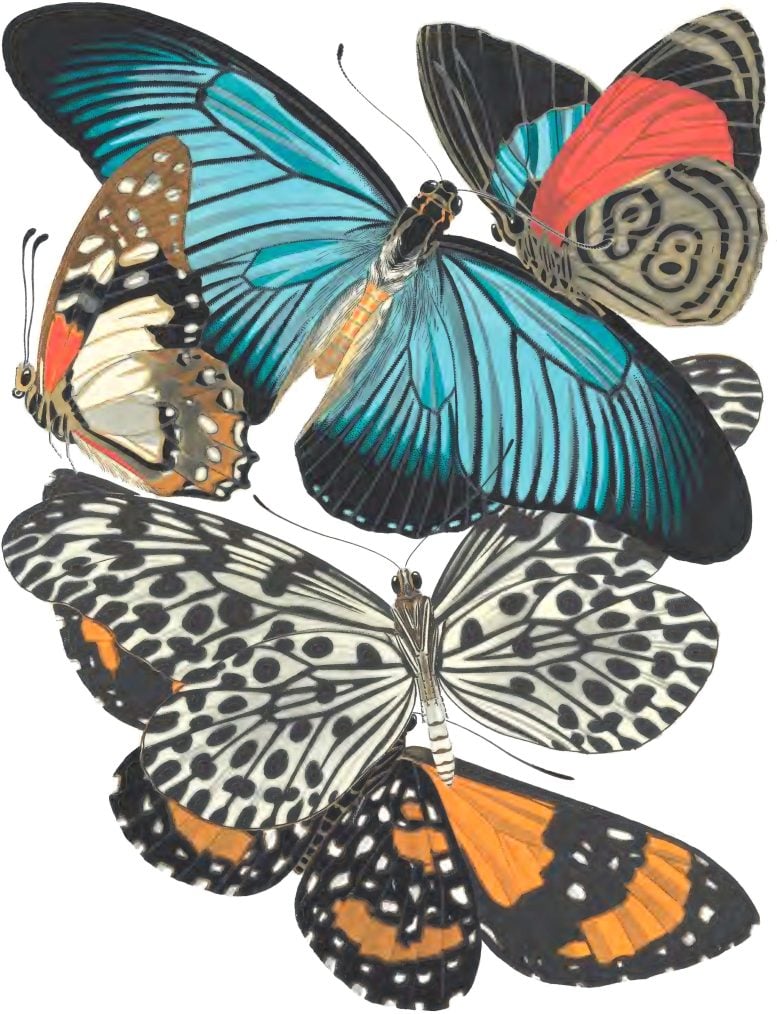
Extreme weather events are altering insect lifespans, impacting ecosystems and disease transmission. Scientists warn of long-term adaptation limits.
With greenhouse gas emissions causing Earth’s climate to steadily heat up, we’re seeing an increasing number of extreme and anomalous weather events. But predicting and analyzing the effects of what is, by definition, an anomaly can be tricky.
According to scientists, museum samples could provide some answers. In a first study of its kind, a team from the University of Florida utilized specimens from natural history to demonstrate that abnormal hot and cold days can extend the activity span of butterflies and moths by almost a month.
“The results are not at all what we expected,” said lead author Robert Guralnick, curator of biodiversity informatics at the Florida Museum of Natural History.
Most studies view climate change and its consequences through a periscope of average temperature increases. As the temperature goes up over time, the plants and animals in a particular region become active earlier in the spring, delay dormancy until later in the fall, and slowly shift their ranges to align with the climate in which they’re best suited to survive.
Erratic weather adds a layer of complexity to these patterns, with unknown consequences that erect an opaque screen ahead of scientists attempting to predict the future of global ecosystems.
“There had been hints in the scientific literature that weather anomalies can have cumulative effects on ecosystems, but there wasn’t anything that directly addressed this question at a broad scale,” Guralnick said.
This omission, he explained, was due primarily to a lack of sufficient data. While climate data has been reliably collected in many areas of the world for more than a century, records documenting the location and activity of organisms are harder to come by.
Natural History Museums: A Hidden Data Source
Natural history museums have been increasingly regarded as a potential solution. The oldest museums have accumulated specimens for hundreds of years, and recent efforts to digitize collections have made their contents widely available. But digital museum records come with their own unique pitfalls and drawbacks.

In 2022, study co-author Michael Belitz constructed a dataset of moths and butterflies from museum collections to chart a course for other researchers hoping to use similar data. The result was a comprehensive instruction manual for how to gather, organize and analyze information from natural history specimens.
With this robust resource at their disposal, Belitz and his colleagues wanted to see if they could detect a signal from aberrant weather patterns. Restricting their analyses to the eastern United States, the authors used records for 139 moth and butterfly species collected from the 1940s through the 2010s.
Weather Anomalies Shape Insect Behavior
Their results were unequivocal: Unusually warm and cold weather has significantly altered insect activity to a greater extent than the average increase in global temperature for the last several decades.
The location and timing of extreme weather events influenced how insects responded. In higher latitudes, warm days in winter meant moths and butterflies became active earlier in the spring. Unusually cold days kept insects at all latitudes active longer, and the combination of exceptionally high and low temperatures had the strongest effect.
“If you have a succession of abnormally cold and warm days, it limits the ability of insects to function at peak performance,” Guralnick said. “If the cold doesn’t kill you, it slows you down, and it might force insects into a torpor. Insects can recover from the cold snaps pretty quickly and go on to have longer lifespans as a direct result of sudden temperature declines.”
Insects being active for longer periods of time might initially seem like a good thing. But rather than a counterweight to the negative repercussions of climate change, co-author Lindsay Campbell — who studies mosquitos — points out that longer or altered insect lifespans may also mean more opportunities for pathogen transmission.
“There’s a correlation between El Niño and rift valley fever outbreaks in East Africa, and there are anecdotal observations that show unusually warm or hot and dry springs, followed by a heavy precipitation event, are also linked with increased outbreaks,” said Campbell, an assistant professor at the University of Florida.
The Fragile Balance of Ecosystems
Long-term ecosystem stability is also entirely dependent on the synchronized activity of its constituent parts, and plants may not respond to extreme weather in the same way as insects. If moths and butterflies take flight too early, they risk encountering plants that haven’t yet produced leaves or flowers, expending their energy in a vain search for food.
And with a constantly shifting baseline for what constitutes ‘extreme,’ it’s unclear if insects will be able to keep pace with the changes.
“As average temperature and climate variability increases, an organism’s resilience is going to drop precipitously,” Guralnick said. “The extreme events of today are going to become much more extreme in the future, and at some point, the capacity to buffer against these changes is going to reach its limit.”
Reference: “Weather anomalies more important than climate means in driving insect phenology” by R. P. Guralnick, L. P. Campbell, and M. W. Belitz, 5 May 2023, Communications Biology.
DOI: 10.1038/s42003-023-04873-4
The study was funded by the National Science Foundation and the National Institute of Food and Agriculture.
Never miss a breakthrough: Join the SciTechDaily newsletter.
Follow us on Google and Google News.
1 Comment
“…, we’re seeing an increasing number of extreme and anomalous weather events.”
Seeing patterns where they don’t exist is common for humans. It has been given a name: “apophenia.” The evidence for an increasing number of extreme events is weak.
There is general agreement that at least the Northern polar regions are warming 2-3X faster than the rest of the Earth. In theory, that ‘Polar Amplification’ reduces the temperature gradient between the North Pole and the equator and there is less energy to drive winds.
When trying to inductively discern the cause of relationships, the first thing that is absolutely necessary it to prove that a relationship exists. Just assuming that weather anomalies are increasing won’t cut it!