
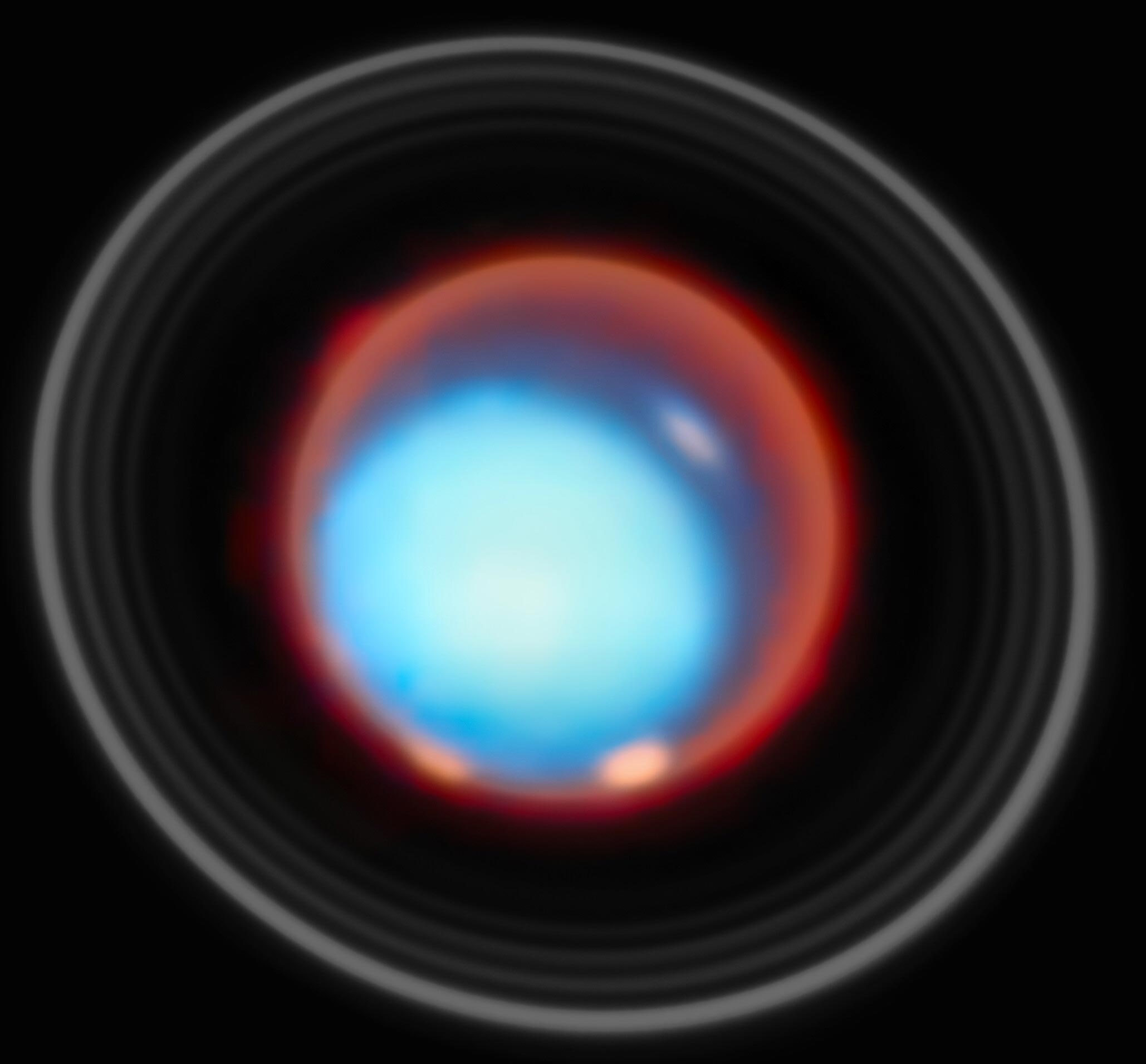
Webb just revealed Uranus’s upper atmosphere in 3D, exposing wild auroras and a planet that is still cooling.
Astronomers have produced the first detailed map showing how Uranus’s upper atmosphere is layered from bottom to top. The international team tracked how temperatures and electrically charged particles change with altitude, offering a clearer picture of conditions far above the planet’s clouds.
To do this, they used the James Webb Space Telescope and its NIRSpec instrument, watching Uranus for nearly one full rotation and capturing faint molecular emissions glowing high in the atmosphere. The findings provide fresh insight into how ice giant planets circulate and balance energy in their outermost layers.
This timelapse shows a full rotation of Uranus captured by James Webb Space Telescope. Thanks to its orbit at L2, Webb was able to observe the planet for approximately 17 hours continuously. Credit: ESA/Webb, NASA, CSA, STScI, P. Tiranti, H. Melin, M. Zamani (ESA/Webb)
Exploring Uranus’s Ionosphere and Magnetic Field
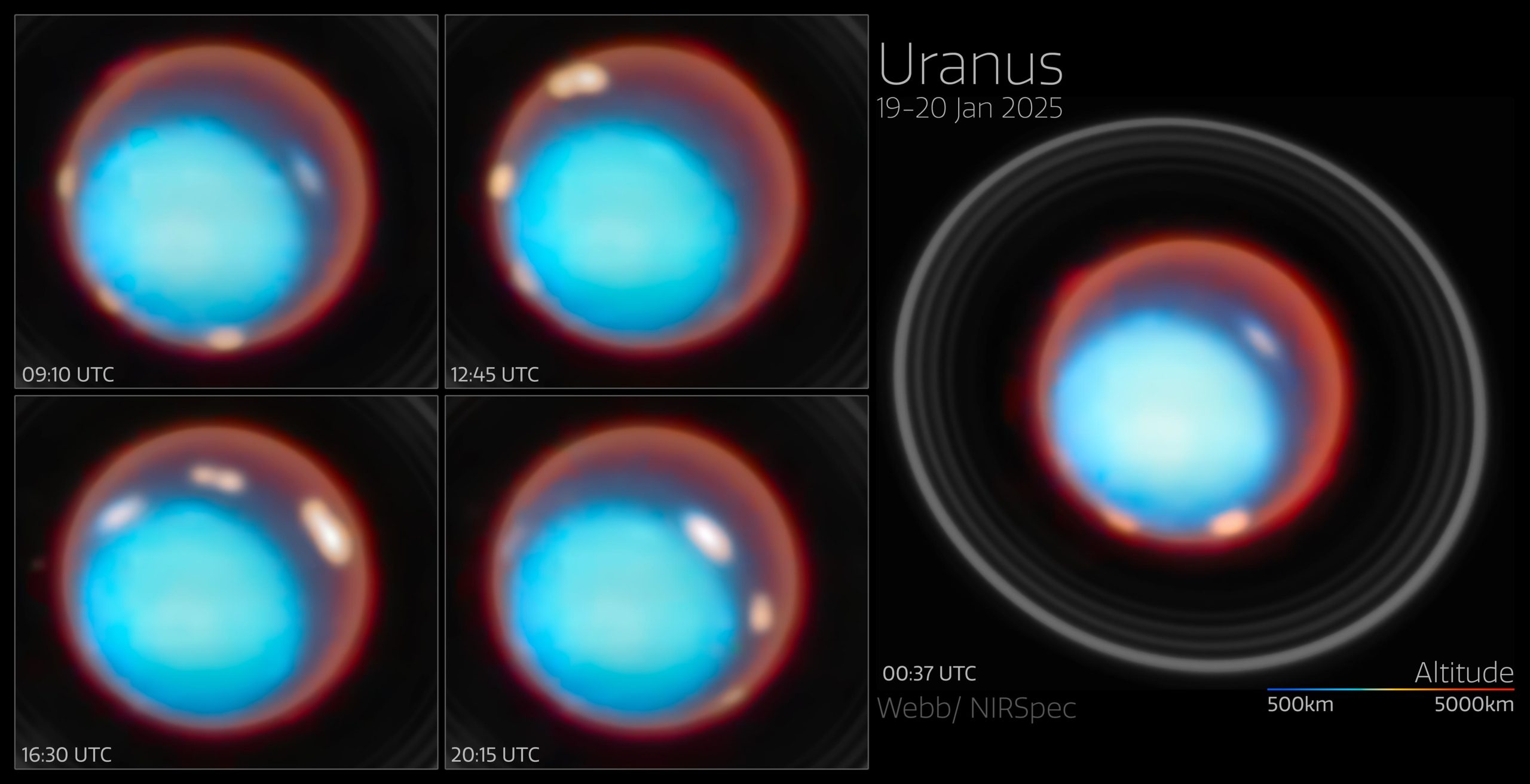
The research was led by Paola Tiranti of Northumbria University in the United Kingdom. Scientists measured temperature and ion density as high as 5000 km above the cloud tops, in a region known as the ionosphere where the atmosphere becomes ionised and interacts strongly with the planet’s magnetic field.
The data deliver the most comprehensive view so far of where Uranus’s auroras originate and how they are shaped by its unusually tilted magnetic field. The results also confirm that the planet’s upper atmosphere has continued cooling over the past three decades. Temperatures were found to reach their highest values between 3000 and 4000 km above the clouds, while ion densities were greatest at about 1000 km. The team also identified clear variations with longitude, reflecting the complex structure of Uranus’s magnetic field.
“This is the first time we’ve been able to see Uranus’s upper atmosphere in three dimensions,” said Paola. “With Webb’s sensitivity, we can trace how energy moves upward through the planet’s atmosphere and even see the influence of its lopsided magnetic field.”
Uranus’s Long-Term Atmospheric Cooling
Measurements from Webb show that Uranus’s upper atmosphere is still cooling, continuing a pattern first detected in the early 1990s. The researchers calculated an average temperature of about 426 kelvins (about 150 degrees Celsius), which is lower than temperatures previously reported by ground-based telescopes or earlier spacecraft missions.
Auroral Bands and Unusual Magnetosphere
Webb observed two bright auroral bands close to Uranus’s magnetic poles. Between these bands, the team detected a noticeable drop in both emission and ion density (a feature likely linked to transitions in magnetic field lines). Similar darker regions have been recorded at Jupiter, where the shape of that planet’s magnetic field guides the movement of charged particles through its upper atmosphere.
“Uranus’s magnetosphere is one of the strangest in the Solar System,” added Paola. “It’s tilted and offset from the planet’s rotation axis, which means its auroras sweep across the surface in complex ways. Webb has now shown us how deeply those effects reach into the atmosphere. By revealing Uranus’s vertical structure in such detail, Webb is helping us understand the energy balance of the ice giants. This is a crucial step towards characterising giant planets beyond our Solar System.”
The findings were published in Geophysical Research Letters.
Reference: “JWST Discovers the Vertical Structure of Uranus’ Ionosphere” by Paola I. Tiranti, H. Melin, L. Moore, E. M. Thomas, K. L. Knowles, T. S. Stallard, K. Roberts and J. O’Donoghue, 19 February 2026, Geophysical Research Letters.
DOI: 10.1029/2025GL119304
The results are based on observations from JWST General Observer programme 5073 (PI: H. Melin of Northumbria University in the United Kingdom). On January 19, 2025, scientists used NIRSpec’s Integral Field Unit to study Uranus continuously for 15 hours.
Webb is the most powerful space telescope ever launched. As part of an international collaboration, the European Space Agency supplied the launch service using the Ariane 5 rocket. ESA also oversaw the necessary Ariane 5 modifications for the mission and arranged the launch through Arianespace. In addition, ESA provided the NIRSpec instrument and 50% of the mid infrared instrument MIRI, which was designed and built by a consortium of nationally funded European Institutes (The MIRI European Consortium) in partnership with JPL and the University of Arizona.
The James Webb Space Telescope is a joint mission involving NASA, ESA and the Canadian Space Agency (CSA).
Never miss a breakthrough: Join the SciTechDaily newsletter.
Follow us on Google and Google News.
1 Comment
thanks for this