
What do grasshoppers eat? It’s not just grass!
New Leicester research shows similarities with mammal teeth like never before.
New research led by paleobiologists at the University of Leicester has identified startling similarities between the mouths of grasshoppers and mammal teeth.
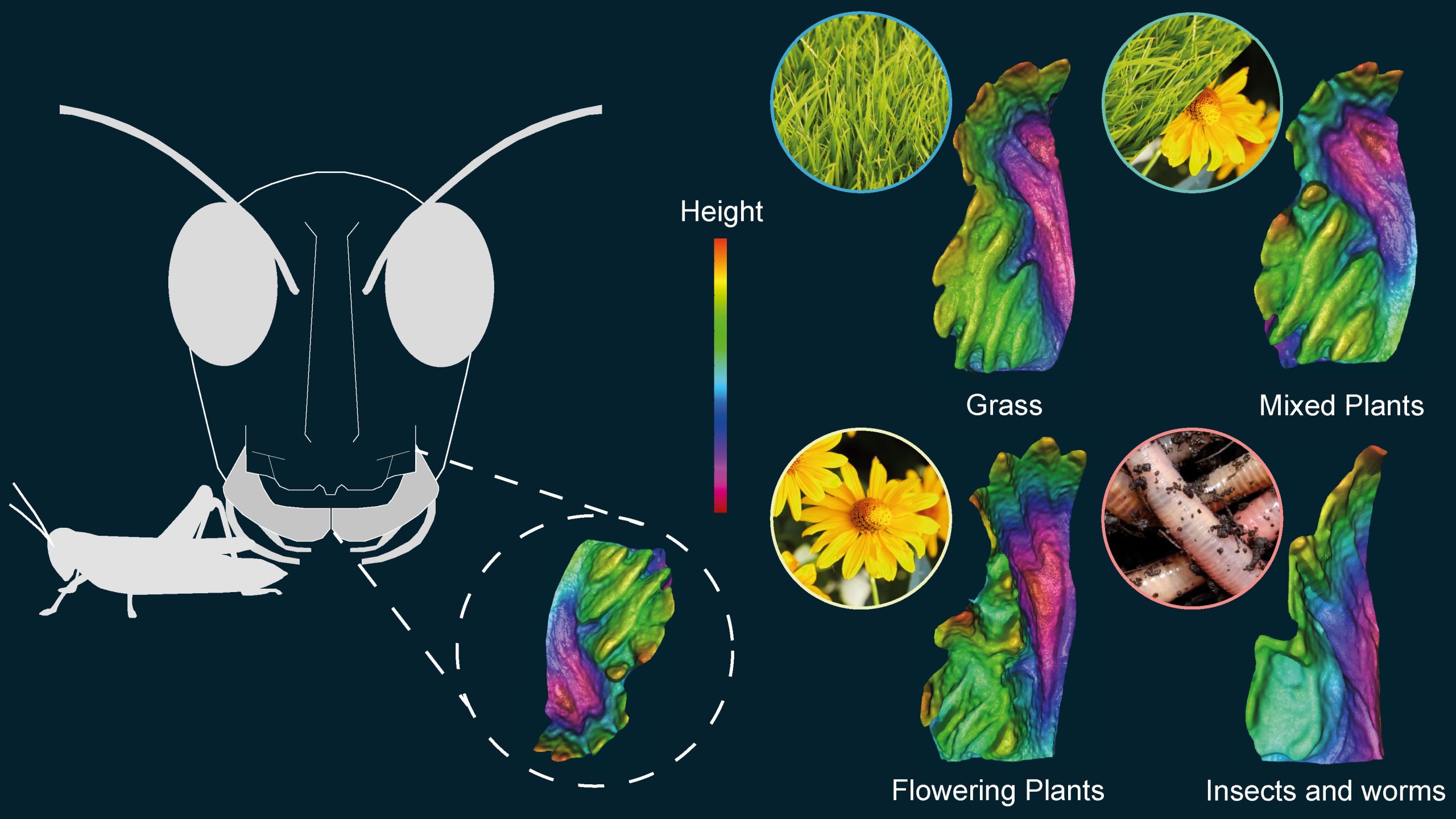
The team of researchers used sophisticated three-dimensional imaging techniques to precisely map the shape of grasshopper’s mandibles, and present their findings in Methods in Ecology and Evolution, published today (Wednesday).
There are around 11,000 known species of grasshopper. It likely comes as a surprise that not all grasshoppers eat grass. In fact, they play a range of important roles in grasslands and other ecosystems – some are even carnivorous.
But analysis of the ecological importance of grasshoppers is not straightforward, and finding out what they eat requires detailed study of the contents of their guts or painstaking and time-consuming observations of how they feed in the wild. There is, however, a better way.
Link Between Mandible Structure and Diet
Like animals with teeth, the mouthparts of grasshoppers, known as mandibles, differ according to what they eat: some are molar-like and grind tough foods like grass, while others have sharper cutting edges. Until now this approach has lacked precision, able to assign grasshoppers only to broad feeding categories.
But the Leicester research – with input from the School of Earth Sciences at the University of Bristol – provides a new way to investigate the diets of the many species scientists have little information about, either because of their rarity or because they are extinct.
Leicester PhD researcher Chris Stockey is corresponding author for the study. He said:
“Knowing what animals eat is fundamental to understanding ecosystems, but working this out can be difficult and time consuming, especially if the animals you study are rare, small, or move quickly.
“One of the advantages of our method is the powerful comparisons that it provides.
Mandible Landscapes and Diet Prediction
“Surprisingly, comparing the mandible landscapes of grasshoppers with mammal’s teeth allows grasshopper diet to be predicted with 82% accuracy – pretty amazing when you consider that the mouthparts of mammals and grasshoppers have evolved independently for 400 million years, and were not present in their common ancestor.”
Mark Purnell, Professor of Palaeobiology and Director of the Centre for Palaeobiology at the University of Leicester, said:
“We measured the shapes of grasshopper’s mouthparts and analyzed them like the topography of a landscape, and found clear differences linked to diet.
“Mandibles from carnivorous grasshoppers that eat soft flesh have steeper slopes and sharper cliff edges, while those that eat tough plant material, such as grass, have mandibles with complex undulating ‘landscapes’.”
The research was based on museum specimens, part of the huge collections kept behind the scenes for scientists to study – rooms full of millions of samples underneath the viewing galleries. Even the most studied of collections, such as Charles Darwin’s, yield new species each year.
Preserving Rare Species Through Non-Destructive Techniques
Without having seen these organisms alive the only way to learn about their lifestyles and diets previously has been to painstakingly dissect them. Not only is dissection a slow process, but it can damage the specimens and limit their usefulness for further study.
The application of this new non-destructive method to museum collections provides an alternative way to learn about the ecologies of rare animals whilst preserving them for future study.
Dr. Ben Price, Senior Curator at the Natural History Museum, who was not involved in the research, added:
“This study is a great example of combining modern analytical methods with historical samples from museum collections to help understand the biodiversity of our planet. As technology advances additional uses of museum collections become possible and this non-destructive approach could reveal the diet information for thousands of species, decades after the specimens were collected.”
Reference: “Dietary inference from dental topographic analysis of feeding tools in diverse animals” by Christopher Stockey, Neil F. Adams, Thomas H. P. Harvey, Philip C. J. Donoghue and Mark A. Purnell, 15 March 2022, Methods in Ecology and Evolution.
DOI: 10.1111/2041-210X.13832
Never miss a breakthrough: Join the SciTechDaily newsletter.
Follow us on Google and Google News.