
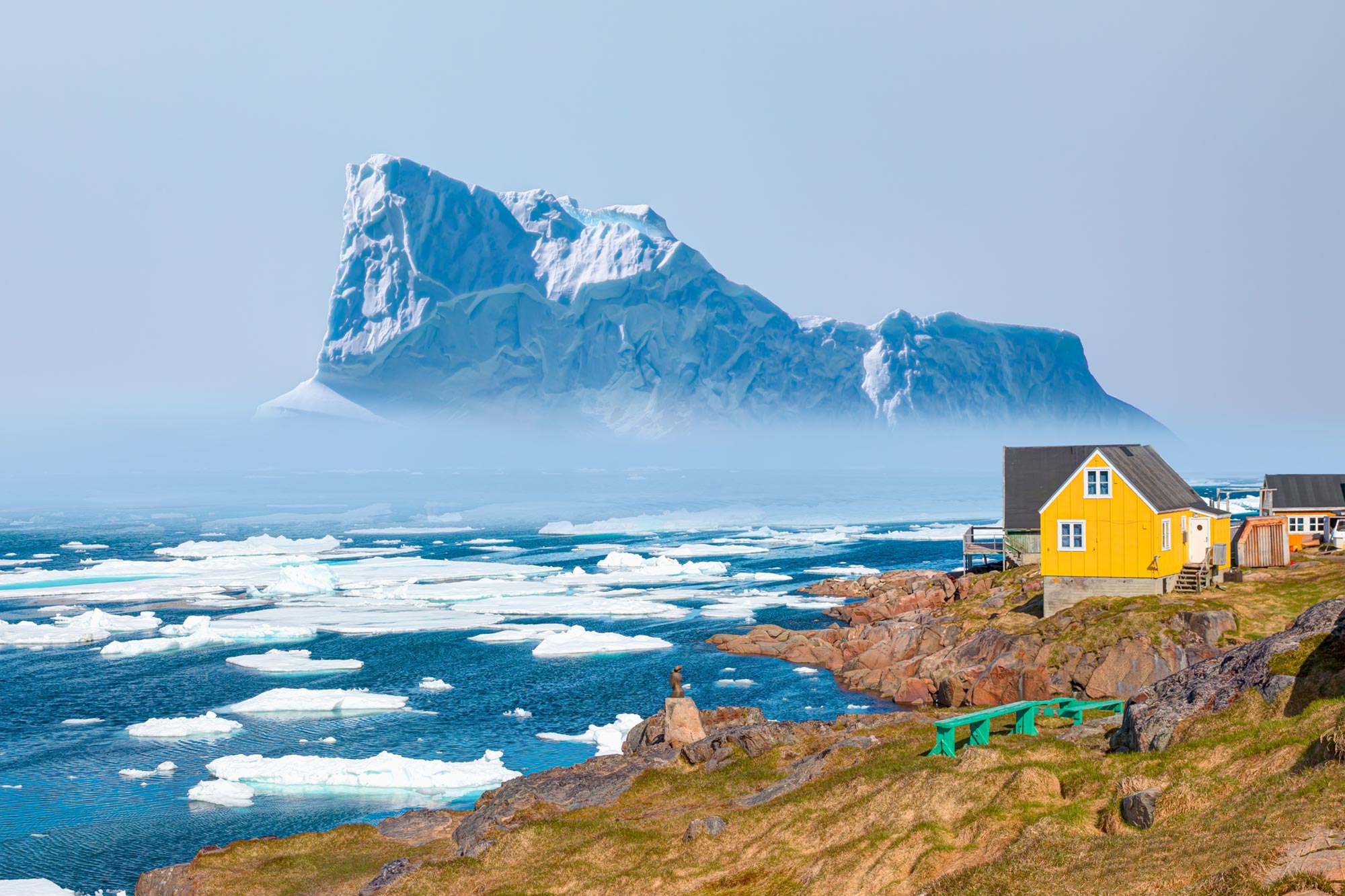
New 3D models uncover hidden heat beneath Greenland, linking deep Earth processes to ice sheet behavior and future sea level change.
A team led by scientists at the University of Ottawa has produced high-resolution 3-D maps of temperatures deep beneath Greenland and northeastern Canada. Greenland is a key place to study because it sits above an ice sheet expected to be a major driver of global sea level rise and because the land has moved over the Iceland hotspot, a deep heat source that has shaped its geology.
The new results suggest the subsurface temperature contrasts are unexpectedly large, and those differences help narrow down the likely route the hotspot took across the island while also affecting how the ground flexes as ice loads change.
Hidden heat beneath Greenland
The research was carried out at the University of Ottawa with collaborators from the University of Twente in the Netherlands and the Geological Survey of Denmark and Greenland (GEUS). The team combined multiple satellite and land-based data sets in a probabilistic analysis and ran hundreds of thousands of simulations on high-performance computing systems, including those at the Digital Research Alliance of Canada.
By linking the temperature maps to the mechanical behavior of the solid Earth, the researchers found that viscosity in parts of the upper mantle could vary by as much as three orders of magnitude, and an ensemble of 3D viscosity models matched both paleo sea level records and present-day vertical land motion measurements, supporting the temperature model and underscoring its value for improving reconstructions of past ice sheet change and future sea level projections.

“Our new regional temperature models reveal significant lateral variations in the Earth’s thermal structure beneath Greenland, which provide important information on the island’s passage over the Iceland hotspot,” explains uOttawa’s PhD graduate Parviz Ajourlou, the study’s first author. “These variations help us better interpret Greenland’s tectonic history and the influence of this history on the geophysical properties of the underlying rocks.”
Glenn Milne, Chair and Full Professor within the Department of Earth and Environmental Sciences at uOttawa and the principal investigator, emphasizes the implications: “This research advances our understanding of the Earth’s internal structure beneath Greenland. Temperature variations directly influence the interaction between the ice sheet and the bedrock, which must be quantified to interpret observations of land motion and gravity changes. These observations tell us how the ice sheet is responding to recent climate warming.”

Modeling the future of sea levels
The innovative approach involved processing multiple geophysical data sets, such as seismic velocities, gravity anomalies, and heat flow, to develop a comprehensive 3D temperature model. The findings not only clarify Greenland’s geologic past and the current state of the ice sheet but also improve the ability of scientists to simulate future changes of the ice sheet and its contribution to global sea level rise.
“This work is a good illustration of how our knowledge of the solid Earth enhances our ability to understand the climate system,” says Ajourlou. “By improving how we model ice-earth interactions, we can better forecast future sea level rise and plan accordingly.”
Reference: “Upper mantle temperatures illuminate the Iceland hotspot track and understanding of ice–Earth interactions in Greenland” by Parviz Ajourlou, Glenn A. Milne, Ryan Love, Juan C. Afonso, Farshad Salajegheh, Konstantin Latychev, Kristian K. Kjeldsen, Alexis Lepipas, Yasmina M. Martos and Sarah A. Woodroffe, 8 December 2025, Proceedings of the National Academy of Sciences.
DOI: 10.1073/pnas.2504752122
Never miss a breakthrough: Join the SciTechDaily newsletter.
Follow us on Google and Google News.
8 Comments
The author tells us this work describes the state of the ice sheet yet never bothers to tell us what that is.
Wait… what… it’s not CO2 related?
There are hundreds of factors that impact the earth’s / solar system’s environment, including its temperature and climate. Yes, we humans can be a mess and soil our environment, but when it comes to climate? Nada.
For example, this FROM the DOE:
Each hour, every 60 minutes, 430 quintillion Joules of energy from the sun hits the Earth. That’s 430 with 18 zeroes after it!
In comparison, the total amount of energy that all humans on planet Earth use in a year is about 410 quintillion Joules.
The Sun has 10,000 times more impact on Earth’s climate than the entire human race.
https://www.energy.gov/articles/top-6-things-you-didnt-know-about-solar-energy
The Law of Conservation of Energy states that Energy can neither be created nor destroyed; rather, it can only be transformed or transferred from one form to another.
Fossil fuels are merely stored solar energy; thank you Mother Nature!
Why do so many people seem to want so badly to convince themselves and others that we can burn as much fuel of whatever type without it having any effect on global temperatures? We even have people who think that if tge ice sheets melting triggers other changes, that doesn’t have anything to do with extra carbon dioxide in the air. It’s almost like they think God made the Earth so durable that there is no way humanity can do any permanent damage. Presumably, all the rules set out in leviticus are intended exclusively to show God that we are listening, and the benefits to the ecology of the world are mere coincidence. When the Bible says that these rules matter, I tend to think it’s meant literally.
You can “tend” to think what you please. That doesn’t make it true. There is no more scientific proof for the existence of a God that served as a model for the sexual organs of men than there is proof that CO2 is responsible for all the warming that has occurred since the peak of continental glaciation about 20,000-years ago.
Considering that the Earth is nearly 8,000 miles in diameter, and humans have only physically been present about 2 miles below the surface, and immutable oceans cover something like 70% of the Earth, there aren’t a lot of reasons to believe we are capable of having more than a local influence on the terrestrial surface. Geological evidence suggests that Earth has been both much warmer and colder than it currently is.
One might ask why you “want so badly to convince themselves and others that we can” have significant long-term impacts on the habitability of Earth. It appears that you are appealing to the authority of a book written by men, expressing what they think God wants. That is not a description of how science works.
“Greenland is a key place to study because it sits ABOVE an ice sheet expected to be a major driver of global sea level …”
Greenland is effectively a continental ice sheet. It doesn’t sit above and ice sheet. It IS an ice sheet. Most of the exposed bedrock is at the shoreline and is below the ice.
I’m not a big fan of the computer ensemble approach to modeling. The unstated assumption is that many models, and varying input parameters between different runs, will provide results that exhibit symmetrical, random variations around the mean or nominal value for all given times. Under that unstated assumption, it is rational to average the ensemble. However, I don’t recollect ever reading a justification for that assumption. Indeed, in the case of General Circulation Models (AKA Climate Models), there is good empirical evidence that the forecasts for different emissions scenarios produce biased temperature results. That is, most of the runs produce forecasts that are too warm. In fact, it is generally acknowledged that the Russian model, which is the coolest, is the only one not significantly biased.
In any ensemble, there will only be one ‘best’ run — the one closest to reality. All others will be inferior to that run. Averaging the results of all the runs of the inferior models with the best run of the best model will degrade the accuracy of the ensemble. Have you ever seen a press release that addresses this problem?
Notably missing from this missive is whether or not the authors think their findings have any applicability to the situation in West Antarctica where it has recently been shown that there are similar anomalously high geothermal gradients.
Al Gore and Greta are also major sources of hot air. What are we doing to stop those toxic pollutants?