
Debates about the beginning of human life have deep philosophical roots, but until recently, they were constrained by the limitations of available technology.
According to birth certificates, a child’s life officially begins at birth, when they emerge from the mother’s womb. However, in a new review published in the journal Aging, researchers Polina A. Loseva and Vadim N. Gladyshev from Harvard Medical School pose the controversial question: when does their organismal life begin? Science holds a palette of answers—depending on how one defines a human life.
In 1984, a commission on the regulatory framework for human embryo experimentation opted not to answer this question, instead setting a boundary, 14 days post-fertilization, beyond which any experiments were forbidden.
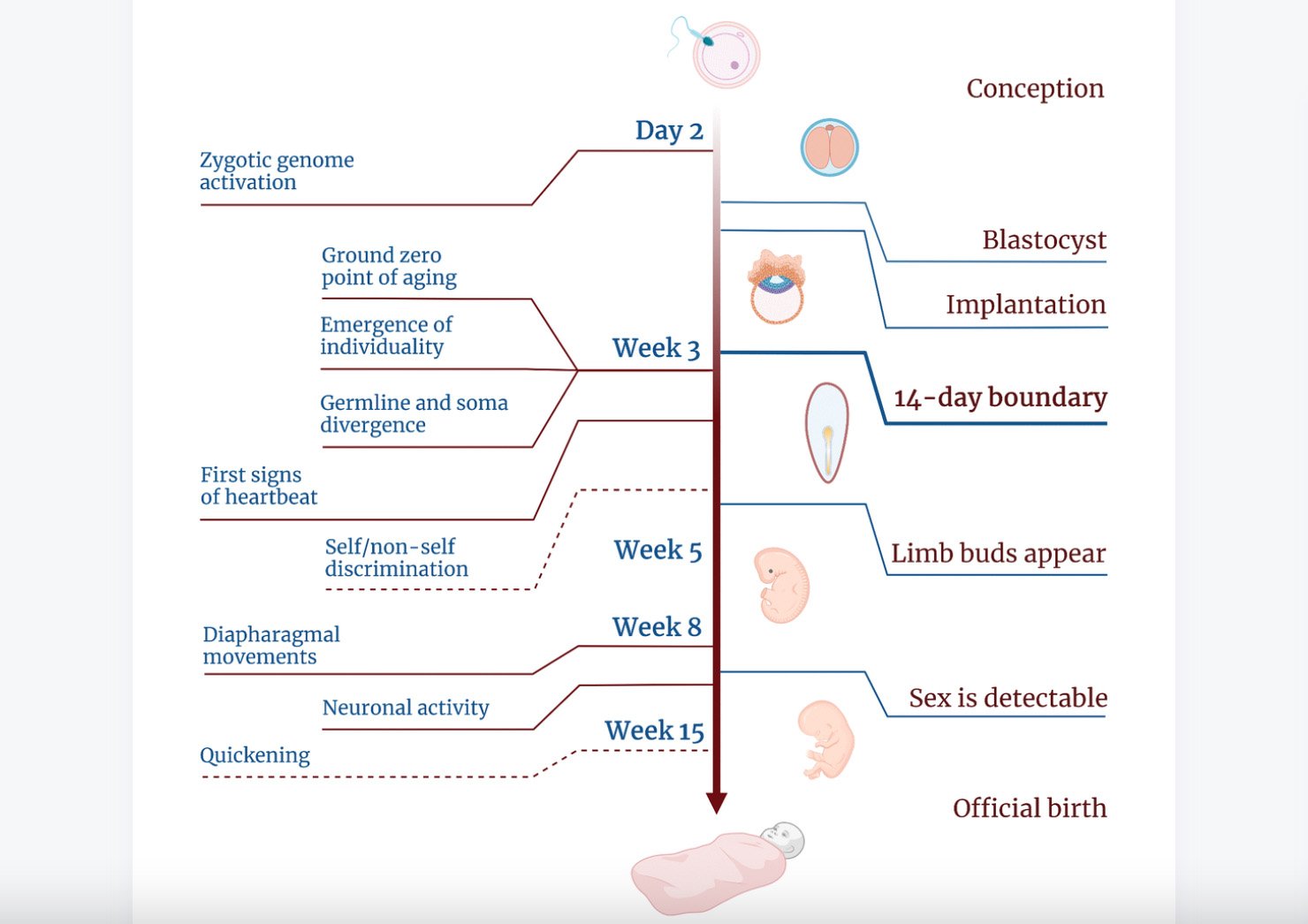
Recently, as the reproductive technologies developed and the demand for experimentation grew stronger, this boundary may be set aside leaving the ultimate decision to local oversight committees.
Advances in Embryogenesis Understanding
While science has not come closer to setting a zero point for human life, there has been significant progress in our understanding of early mammalian embryogenesis. It has become clear that the 14-day stage does in fact possess features, which make it a foundational time point for a developing human. Importantly, this stage defines the separation of soma from the germline and marks the boundary between rejuvenation and aging.
“We explore how different levels of life organization emerge during human development and suggest a new meaning for the 14-day stage in organismal life that is grounded in recent mechanistic advances and insights from aging studies.”
Reference: “The beginning of becoming a human” by Polina A. Loseva and Vadim N. Gladyshev, 6 May 2024, Aging.
DOI: 10.18632/aging.205824
Never miss a breakthrough: Join the SciTechDaily newsletter.
Follow us on Google and Google News.
9 Comments
When there is a process in motion, like the development of the body from a zygote to an emergent baby, it seems arbitrary to pick a point and say that is when life begins as a separate organism. The problem is that we have an assumption that the baby is a separate organism from the mother at some time. However, another theoretical approach can see the mother and baby as one organism. We assume that physical separation means two separate beings. However, we can also be seen as parts of a greater organism of which we are all parts, regardless of space between individual body “units”. Cells of the body are part of the same whole organism, and are connected despite physical separation between cells. This means this question is really a metaphysical one about organisms as separate or connected beings.
Syd’s comment’s presuppositions are hidden. No attempt to suggest at what point life begins, yet good scientific definitions for life are jetisoned in favor of publish or perish…denial of the definition of “life” and ignoring the science observed of the merger of a zygote and a sperm cell uniting a complete genetic profile..
All in favor of a theory? An appeal to the lack of technology? A full throated denial of a creation event.
I just think it’s interesting that while many agree birth is when human life can be said to officially begin for most practical purposes, we’re born helpless and unable to survive independently. Is a baby who needs a mother’s breast an independent being? What about a 4 year-old who is utterly dependent on adults in her life to provide and protect? What about a 20-something who can’t make it in a tough economy? We’re all interdependent, not independent, beings by nature, and by nature’s standards we take forever to grow up, and that makes the question of when a person becomes a person complex. And what appears true is that we get different personhoods as statues conferred to us upon achieving different milestones. And this varies a lot between cultures. I don’t get this article acting like this is a “hard science” question when it’s very much the realm of potentially endless philosophical speculation with science having limited ability to shed light.
“Many agree”? How many? I’m curious where the philosophical inter changes with the scientific formula. Now, add social and adaptational psychology..and walla!
Mush.
we have a brain death criteria, we need to use the same metrics on the beginning of life.
So, you are now self appointing authority as to what or who lives or dies? Social Democrats and Nazis endorsed that idea.
As a now eighty year old independent lay researcher who began learning and practicing secular mind power methods in late 1975 with dozens of particular personal ‘insights’ into nature, human nature and my own nature, since, I have two criteria that, regardless of age, define life for me. 1) Most applicable to life beginning, when all of the individual cell, tissue, organ and system minds coalesce to form one conscious mind, probably within three days (72 hours) of natural or other birth. 2) A human being of any age who can survive outside the womb for at least three days by only natural means. In the absence of either or both criteria (e.g., premature birth, birth defects, acute illness, accidental injury, etc.), private (e.g., insurance?) support should be optional, not mandatory public support for potential long-term care. In either case and in the absence of prior directives, expert medical advice would be advisable to allow responsible and/or merely concerned (e.g., family, friends, church, etc.) parties to make a well-informed, competent, choice.
Nietcheism!
Not so! Self-derived, based on self-discovered universal laws and rules of nature during brief drug free forays into alternate states of consciousness and suggesting of a more functional definition of when a fetus becomes a ‘person,’ for legal purposes.