
Close Menu
    Facebook X (Twitter) Instagram
    SciTechDaily
    • Biology
    • Chemistry
    • Earth
    • Health
    • Physics
    • Science
    • Space
    • Technology
    Facebook X (Twitter) Pinterest YouTube RSS
    SciTechDaily
    Home»Science»Why Is Your Heart on the Left? Unraveling the Mysteries of Biological Chirality
    Science

    Why Is Your Heart on the Left? Unraveling the Mysteries of Biological Chirality

    By Chan Zuckerberg BiohubAugust 12, 2024No Comments4 Mins Read
    Facebook Twitter Pinterest Telegram LinkedIn WhatsApp Email Reddit
    Share
    Facebook Twitter LinkedIn Pinterest Telegram Email Reddit
    Visual Chirality Abstract
    New research on the sphinx tile, an asymmetric hexiamond, revealed its ability to create complex, scalable patterns that illuminate the underlying principles of chirality in biology, explaining the preference for specific molecular and physiological orientations.

    Exploring geometry and chirality in life by probing the sphinx tile.

    Why is the heart slightly to the left side of the body for most people? Why is DNA almost always a right-handed helix? The same goes for alpha helices, the building blocks of proteins. Chirality, or handedness, is pervasive in biology, yet the reasons behind it often remain mysterious.

    Greg Huber, a biophysicist and researcher at the Chan Zuckerberg Biohub San Francisco, spent three years exploring these questions and more using a simple asymmetric shape that lives on the triangular lattice, and that has received little academic attention – the sphinx tile. He and his collaborators – Craig Knecht, Walter Trump, and Robert Ziff – found unexpected properties related to its chirality. Their study was published recently in the journal Physical Review Research.
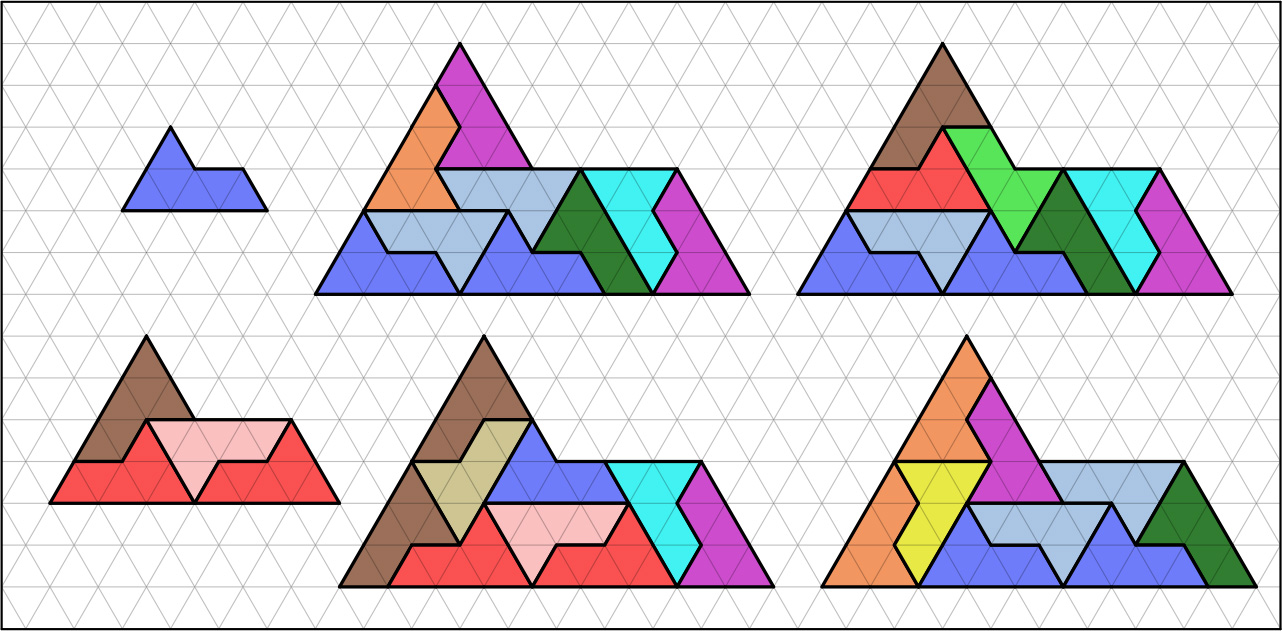
    Sphinx Tile Order 1,2,3
    The sphinx tile is both asymmetric and “rep-tilian,” meaning its shape can be composed with repeated, smaller copies of itself. Credit: Huber, et. al, Physical Review Research, 2024

    Unique Properties of Sphinx Tiles

    Composed of six equilateral triangles (a hexiamond), the sphinx has an intrinsic handedness, coming in either left- or right-handed orientations. It is the only known asymmetric hexiamond that can tile every order of itself, meaning all sphinxes scaled by a factor n can be tiled by n•n smaller unit sphinxes. In other words, an order-2 sphinx can be made from 4 sphinx tiles, an order-3 sphinx can be made from 9, and so on. The numbers of tile arrangements or layouts possible, beginning from the single unit sphinx, start out small: 1, 1, 4, 16, …, but not for long.

    As the number of sphinxes in a tiling goes up, the number of possible layouts increases superexponentially. For example, an order-5 sphinx has 153 possible tilings (shown below), order-6 has nearly 72,000 tilings, and order-13 a whopping 1030, or 10 to the order 30! (That’s a 1 with 30 zeros.)
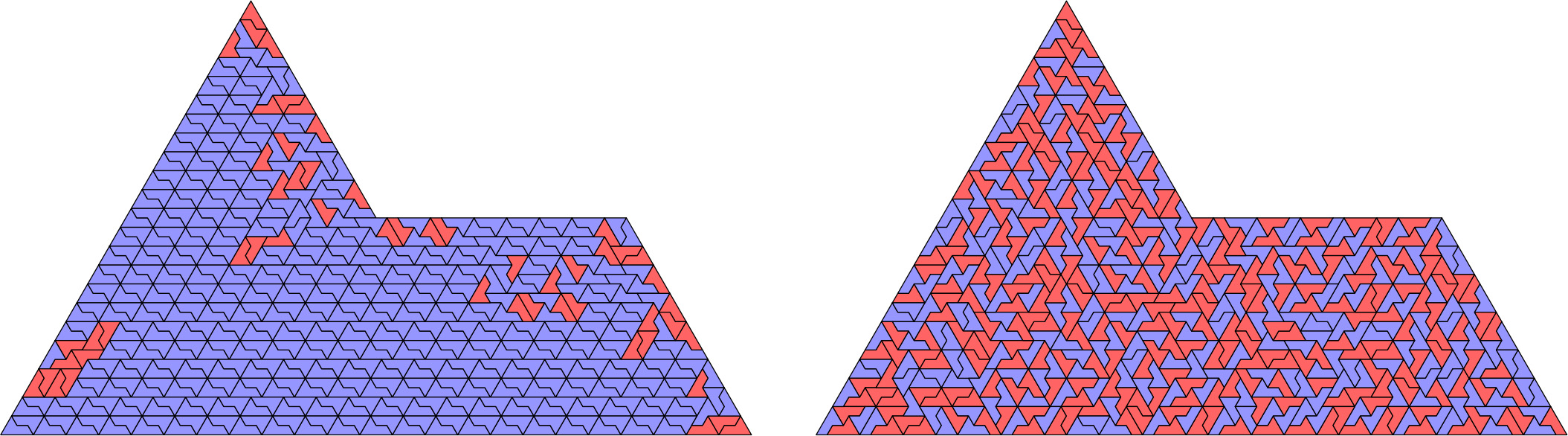
    Sphinx With Low and High Chiral Energy
    An order-23 sphinx with low chiral energy (left, with left-handed sphinxes in blue, right-handed sphinxes in red) and high chiral energy (right). Credit: Huber, et. al, Physical Review Research, 2024

    The asymmetry of the tile provided rich avenues to explore chirality. Take the simple matter of placing two tiles side by side. There are 46 (or 47, depending on how you count) different ways for two sphinx tiles to form a dyad. (In contrast, there is only one way for two unit squares to form a dyad.)

    And they can be tiled in such a way that they have low chiral energy, meaning most neighboring sphinxes are in the same orientation or high chiral energy.
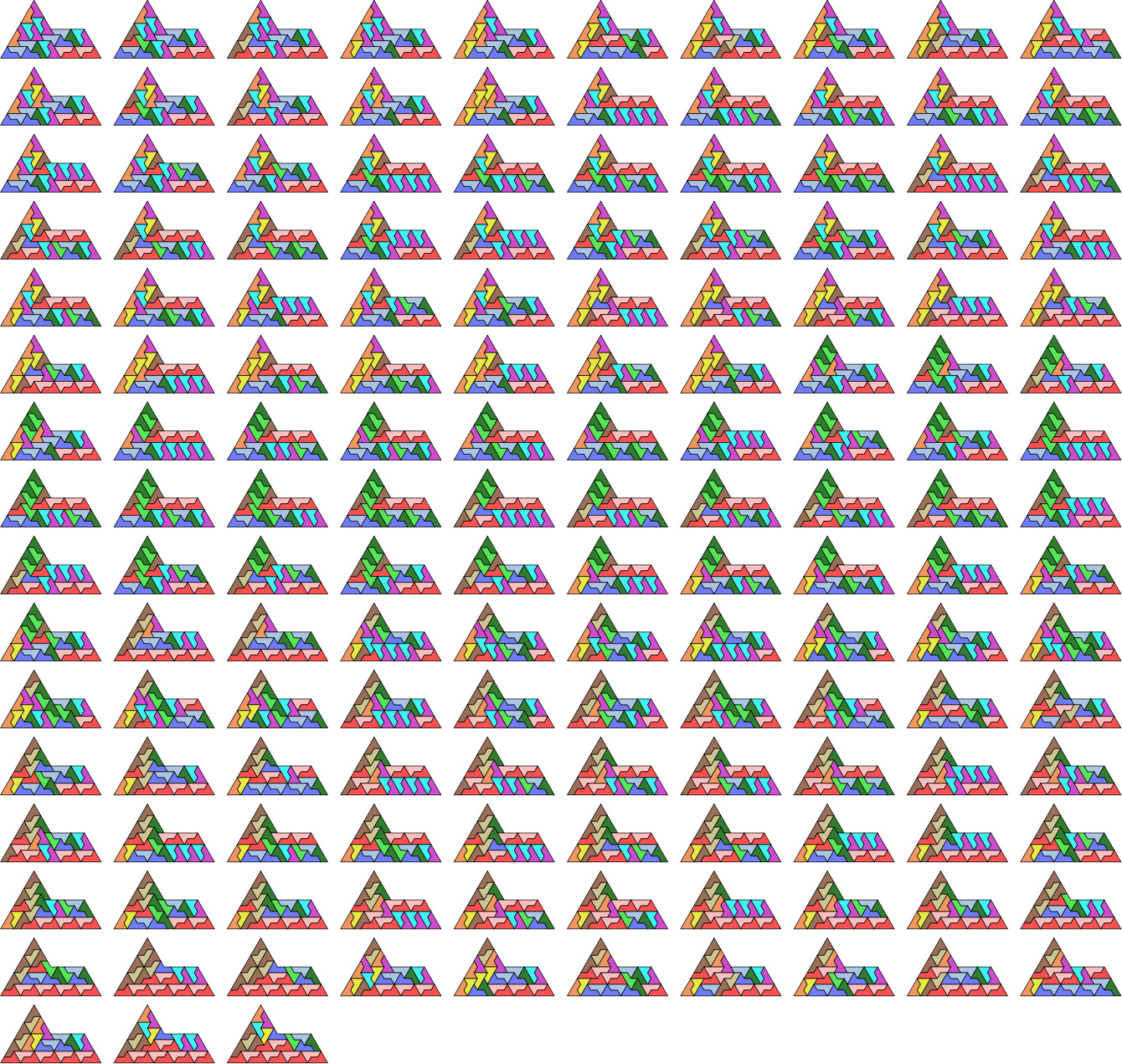
    Order 5 Sphinx
    An order-5 sphinx, which is composed of 25 smaller sphinx tiles, has 153 possible tiling arrangements. Credit: Huber, et. al, Physical Review Research, 2024

    Huber, leader of the Theory Group at the San Francisco Biohub, emphasizes that this endeavor was more than an abstract exercise. He notes that geometry and chirality both have important but often overlooked connections to biology. Virus capsids, for example, have a geometric symmetry (the “quasi-equivalence principle”) based on the same lattice.

    “The universe shouldn’t favor one handedness over another, but at scale after scale, chiral preferences emerge,” Huber says. “Chirality can be very mysterious, and the sphinx tiles’ surprising chiral interactions were the motivation for this work.”

    Reference: “Entropy and chirality in sphinx tilings” by Greg Huber, Craig Knecht, Walter Trump and Robert M. Ziff, 4 March 2024, Physical Review Research.
    DOI: 10.1103/PhysRevResearch.6.013227

    Never miss a breakthrough: Join the SciTechDaily newsletter.
    Follow us on Google and Google News.

    Biophysics Structural Biology
    Share. Facebook Twitter Pinterest LinkedIn Email Reddit

    Related Articles

    Scientists Discover Why We Know When To Stop Scratching an Itch

    New Research Reveals Humans Have a Remote Touch “Seventh Sense”

    A 100-Year-Old Problem Solved? Scientists Discover How To Freeze Organs Without Cracking Them

    Scientists Overturn 20 Years of Textbook Biology With Stunning Discovery About Cell Division

    These Glow-in-the-Dark Succulents Could Replace Your Night Light

    The Quantum Blueprint: How Photosynthesis Defies Classical Physics

    Yale Physicists Unveil Hidden “Modes” in the Human Ear, Redefining How We Hear

    New Method Detects Ligand-Protein Interactions With Unprecedented Sensitivity

    Knotty by Nature: Blackworms and the Secrets of Rapid Untangling

    Leave A Reply Cancel Reply

    • Facebook
    • Twitter
    • Pinterest
    • YouTube

    Don't Miss a Discovery

    Subscribe for the Latest in Science & Tech!

    Trending News

    Millions Take These IBS Drugs, But a New Study Finds Serious Risks

    Scientists Unlock Hidden Secrets of 2,300-Year-Old Mummies Using Cutting-Edge CT Scanner

    Bread Might Be Making You Gain Weight Even Without Eating More Calories

    Scientists Discover Massive Magma Reservoir Beneath Tuscany

    Europe’s Most Active Volcano Just Got Stranger – Here’s Why Scientists Are Rethinking It

    Alzheimer’s Symptoms May Start Outside the Brain, Study Finds

    Millions Take This Popular Supplement – Scientists Discover a Concerning Link to Heart Failure

    The Universe Is Expanding Too Fast and Scientists Can’t Explain Why

    Follow SciTechDaily
    • Facebook
    • Twitter
    • YouTube
    • Pinterest
    • Newsletter
    • RSS
    SciTech News
    • Biology News
    • Chemistry News
    • Earth News
    • Health News
    • Physics News
    • Science News
    • Space News
    • Technology News
    Recent Posts
    • Simple Blood Test May Predict Alzheimer’s Years Before Brain Scans Show Signs
    • Scientists Say Adding This Unusual Seafood to Your Diet Could Reverse Signs of Aging
    • U.S. Waste Holds $5.7 Billion Worth of Crop Nutrients
    • Scientists Say a Hidden Structure May Exist Inside Earth’s Core
    • Doctors Surprised by the Power of a Simple Drug Against Colon Cancer
    Copyright © 1998 - 2026 SciTechDaily. All Rights Reserved.
    • Science News
    • About
    • Contact
    • Editorial Board
    • Privacy Policy
    • Terms of Use

    Type above and press Enter to search. Press Esc to cancel.