
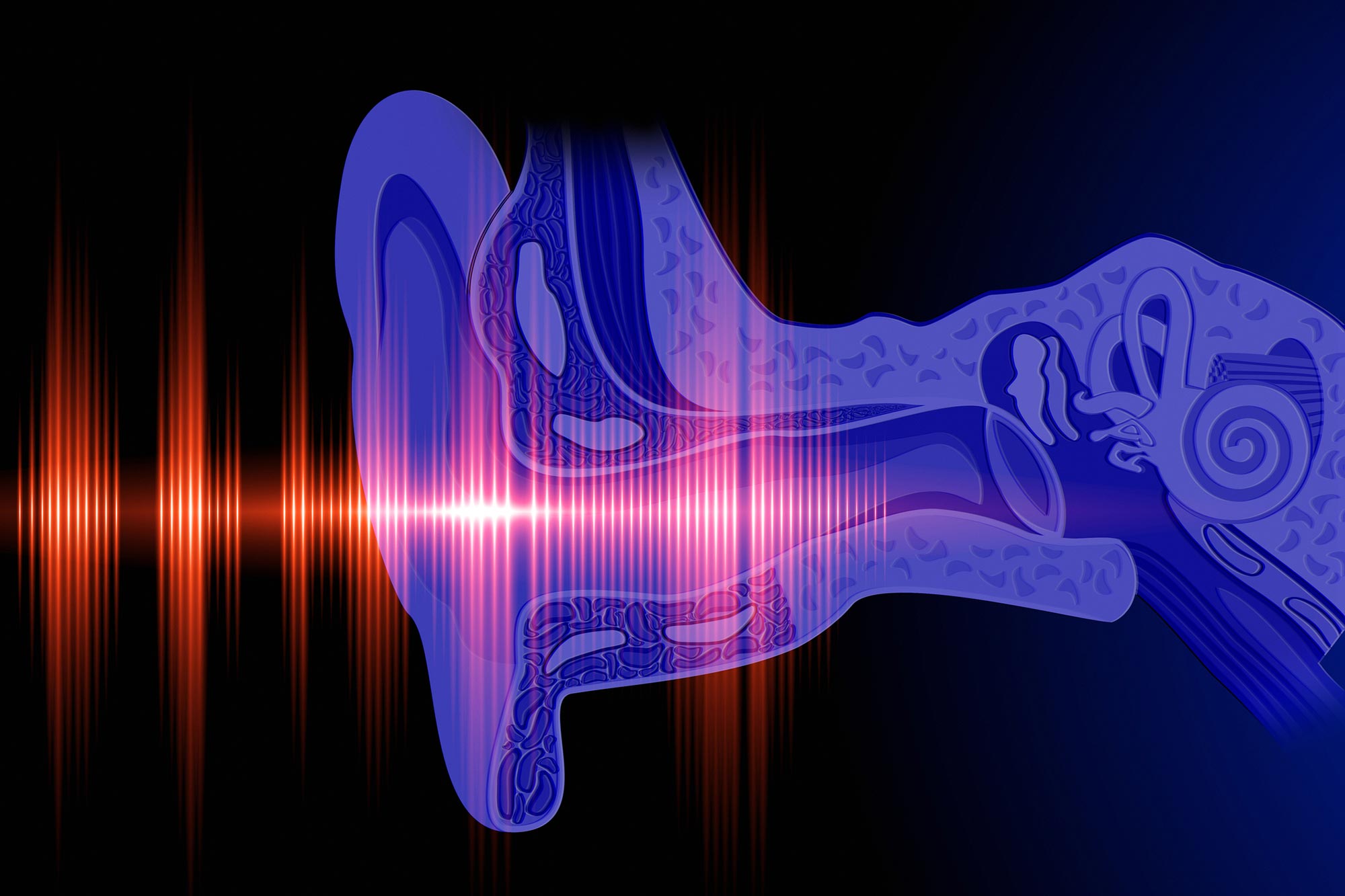
Yale researchers discovered new cochlear hearing modes that influence how the ear amplifies sound and processes frequencies.
Yale physicists have uncovered a sophisticated and previously unknown set of “modes” within the human ear, which impose crucial constraints on how the ear amplifies faint sounds, withstands loud noises, and distinguishes an astonishing range of sound frequencies.
By applying existing mathematical models to a generic mock-up of the cochlea—a spiral-shaped organ in the inner ear—the researchers revealed an additional layer of cochlear complexity. Their findings provide new insights into the remarkable capacity and precision of human hearing.
“We set out to understand how the ear can tune itself to detect faint sounds without becoming unstable and responding even in the absence of external sounds,” said Benjamin Machta, an assistant professor of physics in Yale’s Faculty of Arts and Science and co-senior author of a new study in the journal PRX Life. “But in getting to the bottom of this we stumbled onto a new set of low frequency mechanical modes that the cochlea likely supports.”
In humans, sound is converted into electrical signals in the cochlea. People are able to detect sounds with frequencies across three orders of magnitude and more than a trillion-fold range in power, down to tiny vibrations of air.
The Dual Role of Hair Cells in Hearing
Once sound waves enter the cochlea, they become surface waves that travel along the cochlea’s hair-lined basilar membrane.
“Each pure tone rings at one point along this spiral organ,” said Asheesh Momi, a graduate student in physics in Yale’s Graduate School of Arts and Sciences and the study’s first author. “The hair cells at that location then tell your brain what tone you are hearing.”
Those hairs do something else as well: They act as mechanical amplifiers, pumping energy into sound waves to counteract friction and help them reach their intended destinations. Pumping in just the right amount of energy — and making constant adjustments — is crucial for precise hearing, the researchers said.
But that is simply one set of hearing modes within the cochlea, and it is well-documented. The Yale team discovered a second, extended set of modes within the organ.
In these extended modes, a large portion of the basilar membrane reacts and moves together, even for a single tone. This collective response places constraints on how hair cells respond to incoming sound and how the hair cells pump energy into the basilar membrane.
Implications for Low-Frequency Hearing Research
“Since these newly discovered modes exhibit low frequencies, we believe our findings might also contribute to a better understanding of low-frequency hearing, which is still an active area of research,” said Isabella Graf, a former Yale postdoctoral researcher who is now at the European Molecular Biology Laboratory in Heidelberg, Germany.
Graf and Machta have collaborated on a series of studies in recent years that used mathematical models and statistical physics concepts to better understand biological systems, such as a pit viper’s sensitivity to temperature change and the interplay between phases of matter that come into contact within cell membranes.
Reference: “Hair Cells in the Cochlea Must Tune Resonant Modes to the Edge of Instability without Destabilizing Collective Modes” by Asheesh S. Momi, Michael C. Abbott, Julian Rubinfien, Benjamin B. Machta and Isabella R. Graf, 2 January 2025, PRX Life.
DOI: 10.1103/PRXLife.3.013001
Michael Abbott of Yale and Julian Rubinfien of Harvard are co-authors of the new study. Machta, Momi, and Abbott are part of Yale’s Quantitative Biology Institute.
The research was supported by the National Institutes of Health, a Simons Investigator award, and the German Research Foundation.
Never miss a breakthrough: Join the SciTechDaily newsletter.
Follow us on Google and Google News.
2 Comments
So many animals have hearing ability. Research should focus on hearing in various animal models. With added advancements in AI and quantum computers, research can leap.
I have exeptuonaly good hearing especially of low frequencies an Was wonderingeif you take volunteers to do research on, I think it would be beneficial to they types of discoveries you are making an talking about in your newly discovered works.