
Close Menu
    Facebook X (Twitter) Instagram
    SciTechDaily
    • Biology
    • Chemistry
    • Earth
    • Health
    • Physics
    • Science
    • Space
    • Technology
    Facebook X (Twitter) Pinterest YouTube RSS
    SciTechDaily
    Home»Earth»World’s Longest Wave? A “Dreamland for Surfers”
    Earth

    World’s Longest Wave? A “Dreamland for Surfers”

    By Kathryn Hansen, NASA Earth ObservatoryApril 1, 2022No Comments3 Mins Read
    Facebook Twitter Pinterest Telegram LinkedIn WhatsApp Email Reddit
    Share
    Facebook Twitter LinkedIn Pinterest Telegram Email Reddit
    Pacific Coast of Northern Peru Annotated
    Pacific Coast of Northern Peru. March 4, 2020

    The coastal and oceanic conditions off of northern Peru create a “dreamland for surfers.”

    The waters off the Pacific coast of northern Peru routinely build what has been called the world’s longest wave. There’s no way to know for sure, but the seemingly endless waves that roll up to the fishing town of Puerto Malabrigo (Chicama) are legendary among surfers. While some famous wave breaks around the world can be ridden for seconds, the breaks at Chicama can be ridden for minutes.

    The swells responsible for Chicama’s famous waves are visible in this image, acquired on March 23, 2021, with the Operational Land Imager (OLI) on Landsat 8. Notice the row after row of the waves neatly lining up as they approach the coast.

    According to Andrew Thomas, an oceanographer at University of Maine and ex-surfer, the swell is generated by storm systems and weather fronts hundreds to thousands of miles away in the Pacific Ocean—and occasionally the Southern Ocean. As the waves propagate across the open water, waves of similar wavelengths (and speed) become sorted and start to travel together. “Because the coast of Peru is very deep,” Thomas said, “these large swells will continue their journey until very close to shore.”
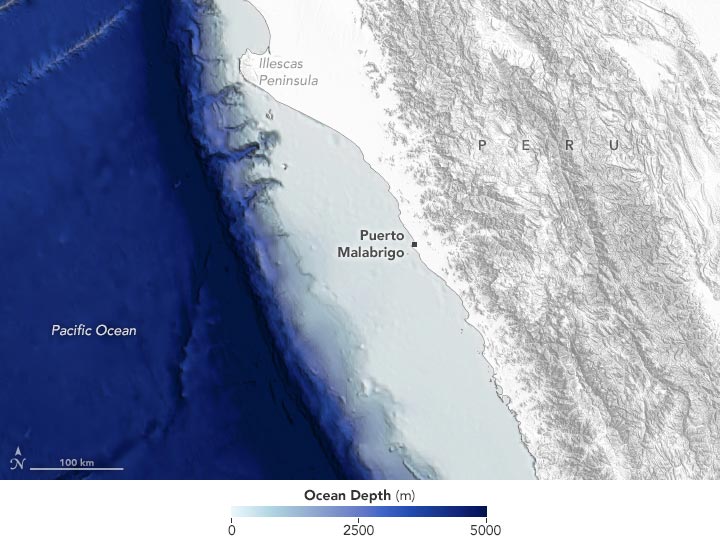
    Pacific Ocean Depth Peru Coast

    Another fortuitous feature for surfers is that the waves arriving from the open ocean roll nearly parallel to this part of Peru’s coastline. “This is not common in Peru or Chile, where the waves mostly just crash into a coast that is perpendicular to the direction of swell propagation,” Thomas said. The arrangement means Chicama’s waves can progressively break along a long stretch of shoreline.

    The breaks that surfers most frequently ride begin along the cape that juts out into the Pacific. This is where four points—Malpaso, Keys, El Point, and El Hombre—trigger the crest of a swell to overturn and peel as it approaches the shallowing shore. Chicama’s waves break left, which means they peel from left to right from the perspective of an observer on the shore. Large swell is most consistent from March through November, during which time some of the sections occasionally connect. The distance from Malpaso to the pier is nearly 4 kilometers (2.5 miles), but surfers usually have to catch multiple waves to make it the entire distance.

    The coastal and oceanic conditions set up what Thomas called a “dreamland for surfers.” So much so that in 2013 the area gained protection from the Peruvian government against development and infrastructure that would harm the waves. Since Chicama, the first wave to be listed in the Protected Waves Registry, dozens more waves across Peru have been added to the list.

    NASA Earth Observatory images by Lauren Dauphin, using Landsat data from the U.S. Geological Survey, bathymetry data from the General Bathymetric Chart of the Oceans (GEBCO) and topographic data from the Shuttle Radar Topography Mission (SRTM).

    Never miss a breakthrough: Join the SciTechDaily newsletter.
    Follow us on Google and Google News.

    Geography NASA NASA Earth Observatory Popular
    Share. Facebook Twitter Pinterest LinkedIn Email Reddit

    Related Articles

    From Russia With Questions: Distinctive Striping Pattern in Siberia Puzzles Researchers

    A Geologist’s Dream: A Short Journey to the Center of the Earth

    Spied by Satellite: Phytoplankton Factory in the Argentine Sea

    Elephant Island: The Incredible Survival Story of Ernest Shackleton and the Crew of HMS Endurance

    Robinson Crusoe Island Captured by Landsat 8 Satellite

    Huacachina: The Only Natural Oasis in South America

    NASA Picturing Earth: Astronaut Photography In Focus [Video]

    NASA Scientists Map Beirut Blast Damage – Devastating Explosion Rocked Port Area

    NASA Advanced Rapid Imaging Satellite Maps Blast Damage: Beirut Explosion Aftermath

    Leave A Reply Cancel Reply

    • Facebook
    • Twitter
    • Pinterest
    • YouTube

    Don't Miss a Discovery

    Subscribe for the Latest in Science & Tech!

    Trending News

    289-Million-Year-Old Reptile Mummy Reveals Origin of Human Breathing System

    New Brain Discovery Challenges Long-Held Theory of Teenage Brain Development

    Scientists Discover Plants “Scream” – We Just Couldn’t Hear Them Until Now

    Scientists Discover a Surprising Reason Intermittent Fasting Extends Life

    This Simple Fruit Wash Could Make Produce Safer and Last Days Longer

    Scientists Say Adding This Unusual Seafood to Your Diet Could Reverse Signs of Aging

    Scientists Say a Hidden Structure May Exist Inside Earth’s Core

    Doctors Surprised by the Power of a Simple Drug Against Colon Cancer

    Follow SciTechDaily
    • Facebook
    • Twitter
    • YouTube
    • Pinterest
    • Newsletter
    • RSS
    SciTech News
    • Biology News
    • Chemistry News
    • Earth News
    • Health News
    • Physics News
    • Science News
    • Space News
    • Technology News
    Recent Posts
    • This Simple Trick Can Boost Your Workout Endurance by 20%
    • This Popular Supplement May Interfere With Cancer Treatment, Scientists Warn
    • Scientists Propose Radical New Way To Detect Alien Life – Without Traditional Biosignatures
    • Scientists Just Discovered Light Can Actually Slow Plant Growth
    • Scientists Finally Solved One of Water’s Biggest Mysteries
    Copyright © 1998 - 2026 SciTechDaily. All Rights Reserved.
    • Science News
    • About
    • Contact
    • Editorial Board
    • Privacy Policy
    • Terms of Use

    Type above and press Enter to search. Press Esc to cancel.