
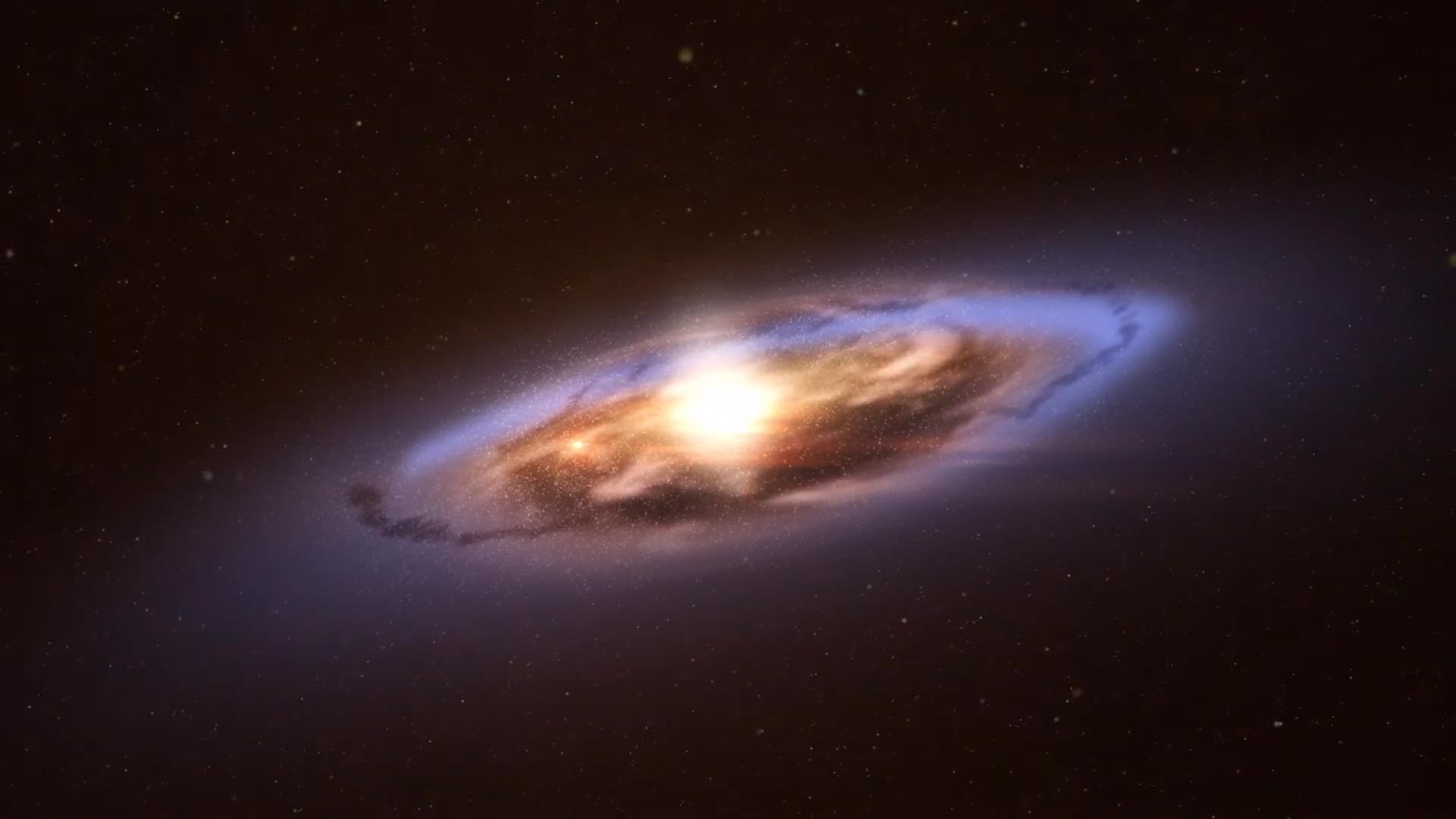
A groundbreaking X-ray study reveals how sulfur changes form in space, offering new insight into the hidden chemistry of the Milky Way.
A global team of scientists has made a groundbreaking measurement of elemental sulfur distributed throughout space, using observations from the XRISM (X-ray Imaging and Spectroscopy Mission) spacecraft, which is led by Japan.
By analyzing X-rays emitted from two binary star systems, astronomers were able to detect sulfur within the interstellar medium—the mixture of gas and dust that fills the space between stars. This marks the first time sulfur has been directly observed in both its gaseous and solid forms. The discovery was made possible by XRISM’s (pronounced “crism”) core technology, X-ray spectroscopy, which allows scientists to study the universe in exceptional detail.
“Sulfur is important for how cells function in our bodies here on Earth, but we still have a lot of questions about where it’s found out in the universe,” said Lía Corrales, an assistant professor of astronomy at the University of Michigan in Ann Arbor. “Sulfur can easily change from a gas to a solid and back again. The XRISM spacecraft provides the resolution and sensitivity we need to find it in both forms and learn more about where it might be hiding.”
A paper about these results, led by Corrales, was published on June 27 in the Publications of the Astronomical Society of Japan.
Where Does Sulfur Go?
Using ultraviolet light, researchers have found gaseous sulfur in the space between stars. In denser parts of the interstellar medium, such as the molecular clouds where stars and planets are born, this form of sulfur quickly disappears.
Scientists assume the sulfur condenses into a solid, either by combining with ice or mixing with other elements.
When a doctor performs an X-ray here on Earth, they place the patient between an X-ray source and a detector. Bone and tissue absorb different amounts of the light as it travels through the patient’s body, creating contrast in the detector.
Watch to learn how the XRISM (X-ray Imaging and Spectroscopy Mission) satellite took an unprecedented look at our galaxy’s sulfur. XRISM is led by JAXA (Japan Aerospace Exploration Agency) in collaboration with NASA, along with contributions from ESA (European Space Agency). Credit: NASA’s Goddard Space Flight Center
To study sulfur, Corrales and her team did something similar.
They picked a portion of the interstellar medium with the right density — not so thin that all the X-rays would pass through unchanged, but also not so dense that they would all be absorbed.
Then the team selected a bright X-ray source behind that section of the medium, a binary star system called GX 340+0 located over 35,000 light-years away in the southern constellation Scorpius.
Using the Resolve instrument on XRISM, the scientists were able to measure the energy of GX 340+0’s X-rays and determined that sulfur was present not only as a gas, but also as a solid, possibly mixed with iron.
Sulfur’s Interstellar Companions
“Chemistry in environments like the interstellar medium is very different from anything we can do on Earth, but we modeled sulfur combined with iron, and it seems to match what we’re seeing with XRISM,” said co-author Elisa Costantini, a senior astronomer at the Space Research Organization Netherlands and the University of Amsterdam. “Our lab has created models for different elements to compare with astronomical data for years. The campaign is ongoing, and soon we’ll have new sulfur measurements to compare with the XRISM data to learn even more.”

Iron-sulfur compounds are often found in meteorites, so scientists have long thought they might be one way sulfur solidifies out of molecular clouds to travel through the universe.
In their paper, Corrales and her team propose a few compounds that would match XRISM’s observations — pyrrhotite, troilite, and pyrite, which is sometimes called fool’s gold.
The researchers were also able to use measurements from a second X-ray binary called 4U 1630-472 that helped confirm their findings.
“NASA’s Chandra X-ray Observatory has previously studied sulfur, but XRISM’s measurements are the most detailed yet,” said Brian Williams, the XRISM project scientist at NASA’s Goddard Space Flight Center in Greenbelt, Maryland. “Since GX 340+0 is on the other side of the galaxy from us, XRISM’s X-ray observations are a unique probe of sulfur in a large section of the Milky Way. There’s still so much to learn about the galaxy we call home.”
Reference: “XRISM insights for interstellar sulfur” by Lía Corrales, Elisa Costantini, Sascha Zeegers, Liyi Gu, Hiromitsu Takahashi, David Moutard, Megumi Shidatsu, Jon M Miller, Misaki Mizumoto, Randall K Smith, Ralf Ballhausen, Priyanka Chakraborty, María Díaz Trigo, Renee Ludlam, Takao Nakagawa, Ioanna Psaradaki, Shinya Yamada and Caroline A Kilbourne, 27 June 2025, Publications of the Astronomical Society of Japan.
DOI: 10.1093/pasj/psaf068
XRISM is led by JAXA (Japan Aerospace Exploration Agency) in collaboration with NASA, along with contributions from ESA (European Space Agency). NASA and JAXA developed Resolve, the mission’s microcalorimeter spectrometer.
Never miss a breakthrough: Join the SciTechDaily newsletter.
Follow us on Google and Google News.