

XRISM’s detailed study of Cygnus X-3, a unique binary system 32,000 light-years away, reveals complex gas dynamics driven by a Wolf-Rayet star and its compact companion, likely a black hole.
By monitoring the system over several orbits, XRISM’s high-resolution spectrometer identified interactions of outflowing gas, illuminated and ionized by X-rays. The findings, including insights into Doppler shifts and stellar wind effects, highlight the mission’s cutting-edge capabilities and pave the way to understanding Cygnus X-3’s enigmatic companion.
Capturing Cygnus X-3’s Intriguing Dynamics
The Japan-led XRISM (X-ray Imaging and Spectroscopy Mission) observatory has produced the most detailed view yet of gas flows within Cygnus X-3, a widely studied and fascinating source of X-rays in the sky.
Cygnus X-3 is a binary star system featuring a rare, massive star paired with a compact companion, which is likely a black hole.
“The nature of the massive star is one factor that makes Cygnus X-3 so intriguing,” explained Ralf Ballhausen, a postdoctoral associate at the University of Maryland, College Park, and NASA’s Goddard Space Flight Center in Greenbelt, Maryland. “It’s a Wolf-Rayet star, a type that has evolved to the point where strong outflows called stellar winds strip gas from the star’s surface and drive it outward. The compact object sweeps up and heats some of this gas, causing it to emit X-rays.”
The findings, led by Ballhausen, are set to be published in an upcoming edition of The Astrophysical Journal.
Why XRISM Is Perfect for Cygnus X-3
“For XRISM, Cygnus X-3 is a Goldilocks target — its brightness is ‘just right’ in the energy range where XRISM is especially sensitive,” said co-author Timothy Kallman, an astrophysicist at NASA Goddard. “This unusual source has been studied by every X-ray satellite ever flown, so observing it is a kind of rite of passage for new X-ray missions.”
XRISM (pronounced “crism”) is led by JAXA (Japan Aerospace Exploration Agency) in collaboration with NASA, along with contributions from ESA (European Space Agency). NASA and JAXA developed the mission’s microcalorimeter spectrometer instrument, named Resolve.
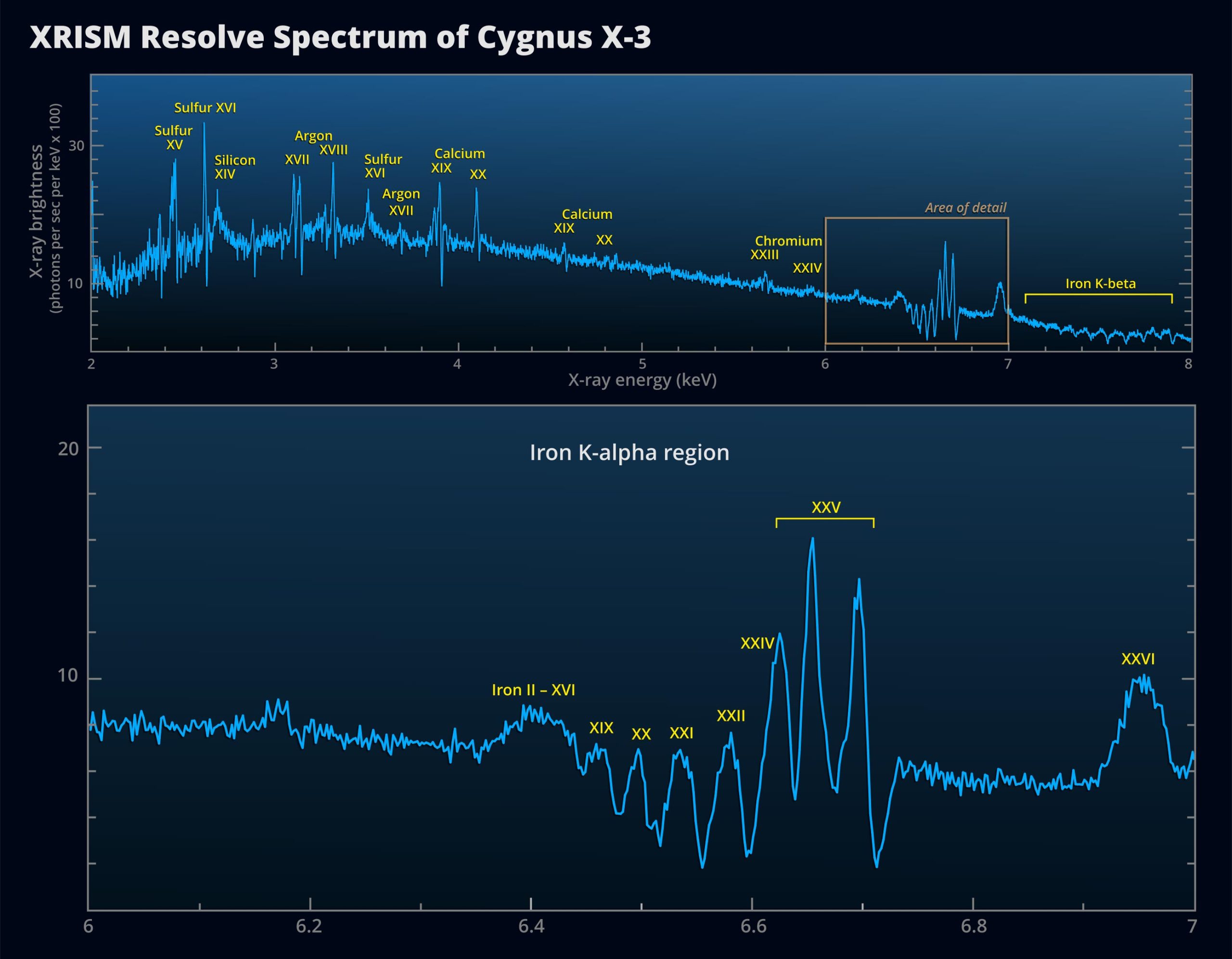
High-Resolution Insights From XRISM’s Resolve Instrument
Observing Cygnus X-3 for 18 hours in late March, Resolve acquired a high-resolution spectrum that allows astronomers to better understand the complex gas dynamics operating there. These include outflowing gas produced by a hot, massive star, its interaction with the compact companion, and a turbulent region that may represent a wake produced by the companion as it orbits through the outrushing gas.
In Cygnus X-3, the star and compact object are so close they complete an orbit in just 4.8 hours. The binary is thought to lie about 32,000 light-years away in the direction of the northern constellation Cygnus.
While thick dust clouds in our galaxy’s central plane obscure any visible light from Cygnus X-3, the binary has been studied in radio, infrared, and gamma-ray light, as well as in X-rays.
Unraveling Gas Motions With the Doppler Effect
The system is immersed in the star’s streaming gas, which is illuminated and ionized by X-rays from the compact companion. The gas both emits and absorbs X-rays, and many of the spectrum’s prominent peaks and valleys incorporate both aspects. Yet a simple attempt at understanding the spectrum comes up short because some of the features appear to be in the wrong place.
That’s because the rapid motion of the gas displaces these features from their normal laboratory energies due to the Doppler effect. Absorption valleys typically shift up to higher energies, indicating gas moving toward us at speeds of up to 930,000 mph (1.5 million kph). Emission peaks shift down to lower energies, indicating gas moving away from us at slower speeds.
Some spectral features displayed much stronger absorption valleys than emission peaks. The reason for this imbalance, the team concludes, is that the dynamics of the stellar wind allow the moving gas to absorb a broader range of X-ray energies emitted by the companion. The detail of the XRISM spectrum, particularly at higher energies rich in features produced by ionized iron atoms, allowed the scientists to disentangle these effects.
Determining Cygnus X-3’s Compact Companion
“A key to acquiring this detail was XRISM’s ability to monitor the system over the course of several orbits,” said Brian Williams, NASA’s project scientist for the mission at Goddard. “There’s much more to explore in this spectrum, and ultimately we hope it will help us determine if Cygnus X-3’s compact object is indeed a black hole.”
XRISM is a collaborative mission between JAXA and NASA, with participation by ESA. NASA’s contribution includes science participation from CSA (Canadian Space Agency).
Never miss a breakthrough: Join the SciTechDaily newsletter.
Follow us on Google and Google News.