
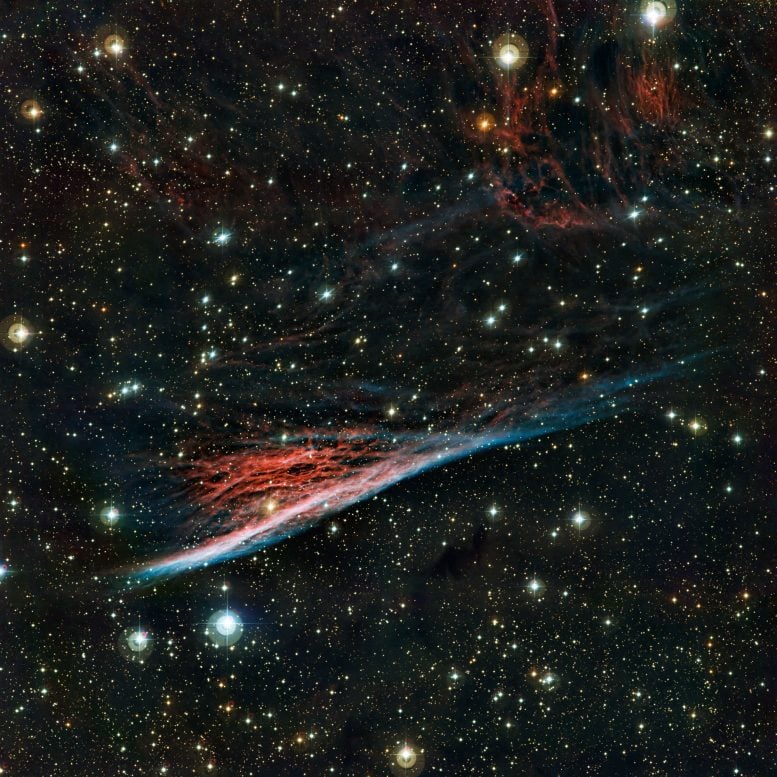
A new image from the Wide Field Imager on the MPG/ESO 2.2-meter telescope at ESO’s La Silla Observatory in Chile shows the Pencil Nebula, which is also known as NGC 2736 and is located roughly 800 light-years from Earth in the constellation of Vela.
The Pencil Nebula is pictured in a new image from ESO’s La Silla Observatory in Chile. This peculiar cloud of glowing gas is part of a huge ring of wreckage left over after a supernova explosion that took place about 11,000 years ago. This detailed view was produced by the Wide Field Imager on the MPG/ESO 2.2-meter telescope.
Despite the tranquil and apparently unchanging beauty of a starry night, the Universe is far from being a quiet place. Stars are being born and dying in an endless cycle, and sometimes the death of a star can create a vista of unequaled beauty as material is blasted out into space to form strange structures in the sky.
This video gives a close-up view of the oddly shaped Pencil Nebula (NGC 2736) in a new image from ESO’s La Silla Observatory in Chile.
This new image from the Wide Field Imager on the MPG/ESO 2.2-meter (7.2-foot) telescope at ESO’s La Silla Observatory in Chile shows the Pencil Nebula[1] against a rich starry background. This oddly shaped cloud, which is also known as NGC 2736, is a small part of a supernova remnant[2] in the southern constellation of Vela (The Sails). These glowing filaments were created by the violent death of a star that took place about 11,000 years ago. The brightest part resembles a pencil; hence the name, but the whole structure looks rather more like a traditional witch’s broom.
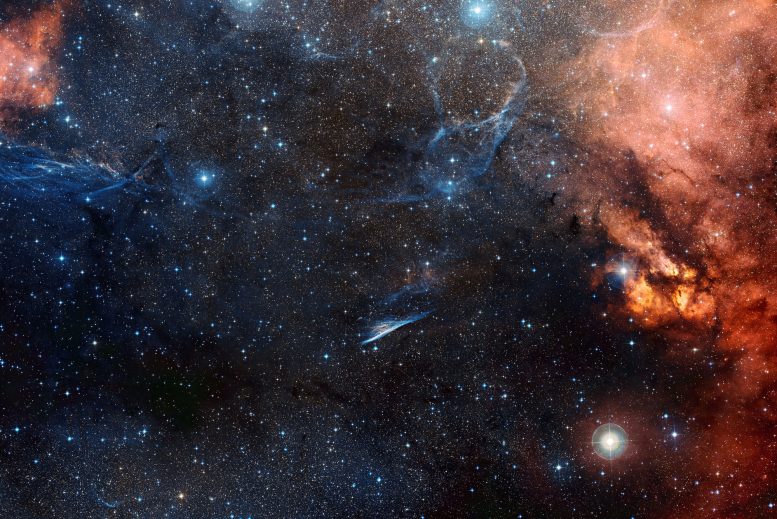
The Vela supernova remnant is an expanding shell of gas that originated from the supernova explosion. Initially, the shock wave was moving at millions of kilometers per hour, but as it expanded through space it plowed through the gas between the stars, which has slowed it considerably and created strangely shaped folds of nebulosity. The Pencil Nebula is the brightest part of this huge shell.
This new image shows large, wispy filamentary structures, smaller bright knots of gas, and patches of diffuse gas. The nebula’s luminous appearance comes from dense gas regions that have been struck by the supernova shock wave. As the shock wave travels through space, it rams into the interstellar material. At first, the gas was heated to millions of degrees, but it then subsequently cooled down and is still giving off the faint glow that was captured in the new image.
By looking at the different colors of the nebula, astronomers have been able to map the temperature of the gas. Some regions are still so hot that the emission is dominated by ionized oxygen atoms, which glow blue in the picture. Other cooler regions are seen glowing red, due to emission from hydrogen.
The Pencil Nebula measures about 0.75 light-years across and is moving through the interstellar medium at about 650,000 kilometers per hour. Remarkably, even at its distance of approximately 800 light-years from Earth, this means that it will noticeably change its position relative to the background stars within a human lifetime. Even after 11,000 years the supernova explosion is still changing the face of the night sky.
This video starts with a wide-field view of the spectacular southern part of the Milky Way. We close in gradually on a large bubble-shaped region of glowing gas in the constellation of Vela (The Sails). This is the Vela supernova remnant, gas clouds that were ejected from a dying star in a huge explosion about 11,000 years ago. The final detailed view comes from the Wide Field Imager on the MPG/ESO 2.2-meter telescope at ESO’s La Silla Observatory in Chile.
Notes
- The Pencil Nebula, also known as NGC 2736 and sometimes nicknamed Herschel’s Ray, was discovered by British astronomer John Herschel back in 1835 while he was in South Africa. He described it as “an extraordinarily long narrow ray of excessively feeble light”.
- A supernova is a violent stellar explosion, resulting from the death of either a high-mass star or a white dwarf in a close double star system. The structure resulting from the explosion is called the supernova remnant. This consists of ejected material expanding at supersonic velocities into the surrounding interstellar medium. Supernovae are the main source of the heavier chemical elements in the interstellar medium, which in turn leads to the chemical enrichment of a new generation of stars and planets.
Never miss a breakthrough: Join the SciTechDaily newsletter.
Follow us on Google and Google News.