
Close Menu
    Facebook X (Twitter) Instagram
    SciTechDaily
    • Biology
    • Chemistry
    • Earth
    • Health
    • Physics
    • Science
    • Space
    • Technology
    Facebook X (Twitter) Pinterest YouTube RSS
    SciTechDaily
    Home»Space»Dying Star Kohoutek 4-55 Offers a Glimpse of Our Sun’s Future
    Space

    Dying Star Kohoutek 4-55 Offers a Glimpse of Our Sun’s Future

    By European Space AgencyMarch 8, 2016No Comments2 Mins Read
    Facebook Twitter Pinterest Telegram LinkedIn WhatsApp Email Reddit
    Share
    Facebook Twitter LinkedIn Pinterest Telegram Email Reddit
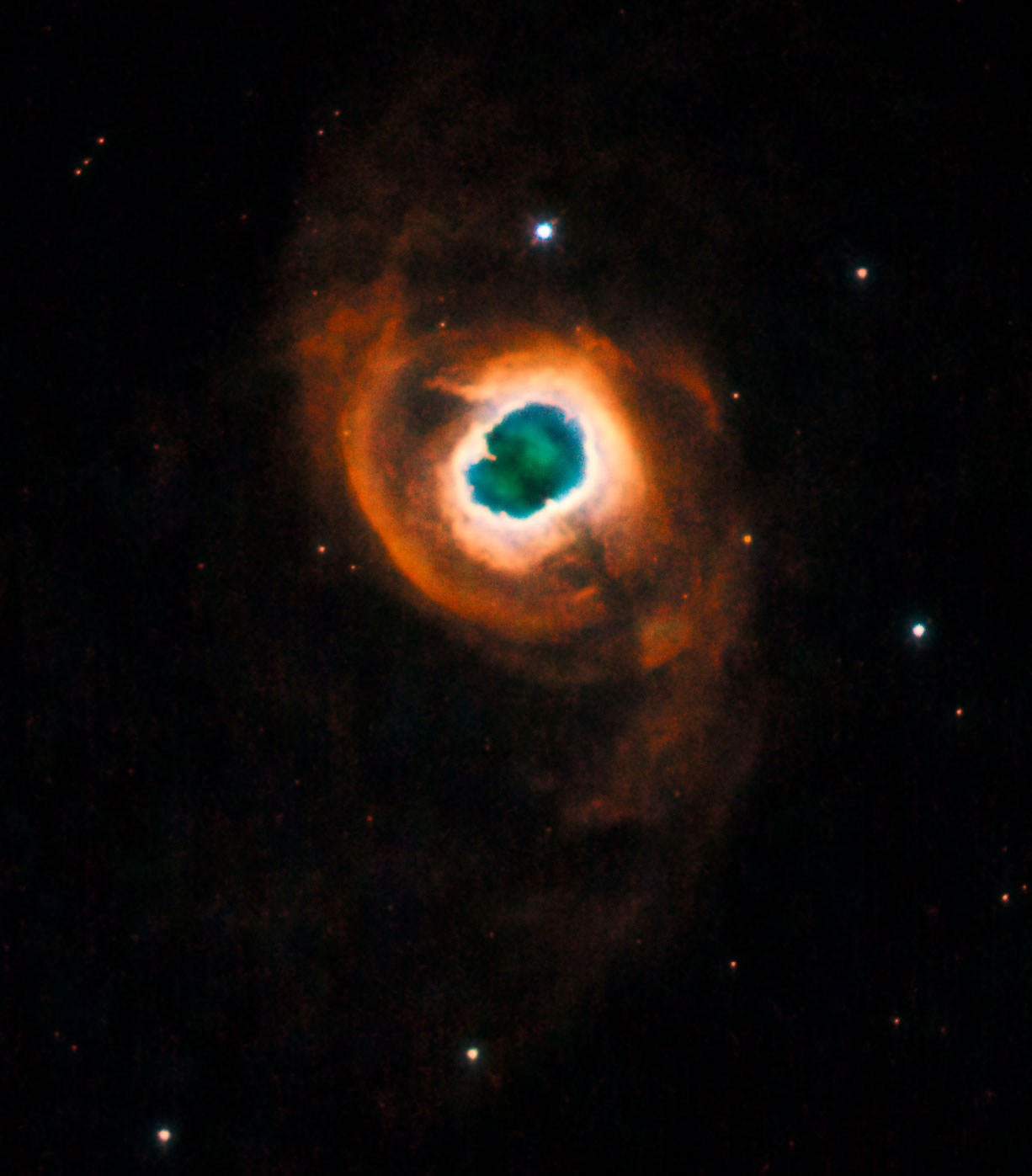
    Kohoutek 4-55 Offers a Glimpse of Our Sun’s Future
    Dying Star Kohoutek 4-55 offers a glimpse of our Sun’s future

    This Hubble image reveals the final act of celestial beauty before the long fade into cosmic history. Invisibly buried in the center of this colorful swirl of gas is a dying star, roughly the same mass as the Sun.

    As a star ages, the nuclear reactions that keep it shining begin to falter. This uncertain energy generation causes the stars to pulsate in an irregular way, casting off its outer layers into space.

    As the star sheds these outer gases, the super-hot core is revealed. It gives off huge quantities of ultraviolet light, and this radiation causes the gas shells to glow, creating the fragile beauty of the nebula.

    This example is known as Kohoutek 4-55. Named after its discoverer, the Czech astronomer Luboš Kohoutec, it is located 4,600 light years from Earth, in the direction of the constellation Cygnus.

    This image was the final ‘pretty picture’ taken by the Hubble Space Telescope’s Wide Field Planetary Camera 2 (WFPC2). The camera was installed in 1993 and worked until 2009, offering a 16-year stretch of unparalleled observations.

    WFPC2 took many of Hubble’s iconic images. They helped to make the space telescope a household name across the world.

    This particular shot is a composite of three images, each taken at a specific wavelength to isolate the light coming from particular atoms of gas. The different wavelengths have been color-coded to aid recognition.

    Red signifies nitrogen gas, green shows hydrogen, and blue represents oxygen. The whole sequence was captured in 2 hours on 4 May 2009.

    The intricate swirls of gas offer us a glimpse of our Sun’s distant future. In 5 billion years’ time, our star will be dying. It is expected to behave in the same way as seen here, shedding its outer layers to reveal the burning core, which then becomes a slowly cooling ember known as a white dwarf.

    By that time, Earth will be long gone, burnt to a crisp as the Sun dies. But the beauty of our star’s passing will shine across the Universe.

    Never miss a breakthrough: Join the SciTechDaily newsletter.
    Follow us on Google and Google News.

    Astronomy Cosmology European Space Agency Hubble Space Telescope
    Share. Facebook Twitter Pinterest LinkedIn Email Reddit

    Related Articles

    Extraordinary Hubble Image: Light Bends From the Beyond

    Hubble Space Telescope Sees Volcanic Activity Reforming the Atmosphere on a Rocky Exoplanet

    Hubble Spies a Luminous Heart With Dark Tendrils

    Spectacular Return to the Veil Nebula

    Hubble Spots a Peculiar Sight: Unusual Spiral Galaxy With a Heavy Arm

    A Flash of Life: Hubble Spies an Unusual Planetary Nebula

    Through the Cosmic Clouds: Hubble Spots a Beautiful Stellar Nursery

    Big, Beautiful and Blue: Hubble Captures Immense Galaxy That Stretches 200,000 Light-Years Across

    Hubble Captures an Eye in the Sky – “Evil Eye” Galaxy With Strange Internal Motion

    Leave A Reply Cancel Reply

    • Facebook
    • Twitter
    • Pinterest
    • YouTube

    Don't Miss a Discovery

    Subscribe for the Latest in Science & Tech!

    Trending News

    Scientists May Have Found the Key to Jupiter and Saturn’s Moon Mystery

    Scientists Uncover Brain Changes That Link Pain to Depression

    Saunas May Do More Than Raise Body Temperature – They Activate Your Immune System

    Exercise in a Pill? Metformin Shows Surprising Effects in Cancer Patients

    Hidden Oceans of Magma Could Be Protecting Alien Life

    New Study Challenges Alzheimer’s Theories: It’s Not Just About Plaques

    Artificial Sweeteners May Harm Future Generations, Study Suggests

    Splashdown! NASA Artemis II Returns From Record-Breaking Moon Mission

    Follow SciTechDaily
    • Facebook
    • Twitter
    • YouTube
    • Pinterest
    • Newsletter
    • RSS
    SciTech News
    • Biology News
    • Chemistry News
    • Earth News
    • Health News
    • Physics News
    • Science News
    • Space News
    • Technology News
    Recent Posts
    • Physicists Discover a Strange New Kind of One-Dimensional Particle
    • Scientists Discover Unexpected Climate Benefit Hidden in Forest Soils
    • The Grand Canyon’s “Swiss Cheese” Rocks Hold a Critical Secret
    • Scientists Discover 430,000-Year-Old Wooden Tools, Rewriting Human History
    • Scientists Make Breakthrough on 40-Year-Old 2D Physics Puzzle
    Copyright © 1998 - 2026 SciTechDaily. All Rights Reserved.
    • Science News
    • About
    • Contact
    • Editorial Board
    • Privacy Policy
    • Terms of Use

    Type above and press Enter to search. Press Esc to cancel.