
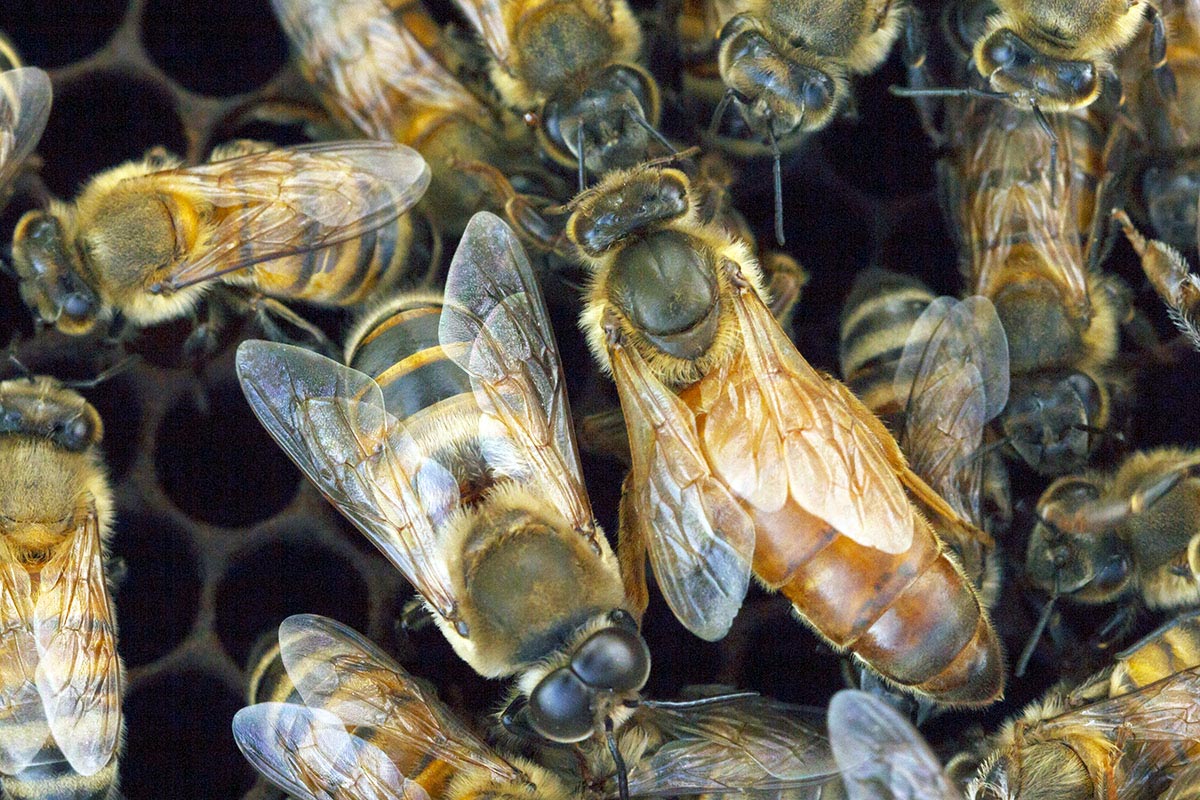
Researchers often study the genomes of individual organisms to try to tease out the relationship between genes and behavior. A new study of Africanized honey bees reveals, however, that the genetic inheritance of individual bees has little influence on their propensity for aggression. Instead, the genomic traits of the hive as a whole are strongly associated with how fiercely its soldiers attack.
The findings are reported in the Proceedings of the National Academy of Sciences.
“We’ve always thought that the most significant aspects of an organism’s behavior are driven, at least in part, by its own genetic endowment and not the genomics of its society,” said Matthew Hudson, a University of Illinois at Urbana-Champaign professor of bioinformatics who led the research with Gene Robinson, an entomology professor and the director of the Carl R. Woese Institute for Genomic Biology at the U. of I. “This is a signal that there may be more to genetics as a whole than we’ve been thinking about.”
The researchers focused on a unique population of gentle Africanized honey bees in Puerto Rico, which have evolved to become more docile than Africanized bees anywhere else in the world.
“We wanted to know which parts of the genome are responsible for gentle behavior versus aggressive behavior,” Hudson said. “And because these are Africanized bees but they’re also gentle, they are an ideal population to study. There’s quite a bit of variation in aggression among them.”
Africanized bees are hardier and more resistant to disease than their European predecessors on the island, so scientists are eager to learn more about the genetic underpinnings of the Puerto Rican bees’ gentle nature.
When a honeybee hive is disturbed, guard bees emit a chemical signal that spurs soldier bees into action. The response depends on the nature of the threat and the aggressiveness of the hive. Whether the soldiers sting their target is another measure of aggression, as soldiers that sting will die as a result.
In general, foragers do little to defend the hive.
The researchers compared the genomes of soldier and forager bees from each of nine honey bee colonies in Puerto Rico. They also tested how aggressively the soldier bees responded to an assault on the hive.
To their surprise, the scientists found no genome-sequence differences between the soldiers and foragers that consistently explained the different responses.
But when the researchers conducted a genomewide association study comparing the most-aggressive and least-aggressive hives, they saw a strong correlation between hive genomics and aggression. The analyses revealed that one region of the genome appeared to play a central role in the hives’ relative gentleness or aggression.
“Mostly these bees’ genomes look like Africanized bees,” Hudson said. “But there was one chunk that looked very European. And the frequency of that European chunk in the hive seems to dictate how gentle that hive is going to be to a large extent.
“What that tells us is that the individual genetic makeup of the bee doesn’t have a strong influence on how aggressive it is,” he said. “But the genetic makeup of the society that the bees live in — the colony — has a very strong impact on how aggressive the bees in that colony are.”
“Many behavioral traits in animals and humans are known to be strongly affected by inherited differences in genome sequence, but for many behaviors, how an individual acts also is influenced by how others around it are acting — nature and nurture, respectively,” Robinson said. “We now see that in the beehive, nurture can also have a strong genomic signature.”
Such behavioral genomic influences may be particularly pronounced in honey bees, which live in an extraordinarily cooperative society where each individual has a defined social and functional role, he said.
Hudson also is a professor of crop sciences at Illinois.
Reference: “Genomic regions influencing aggressive behavior in honey bees are defined by colony allele frequencies” by Arián Avalos, Miaoquan Fang, Hailin Pan, Aixa Ramirez Lluch, Alexander E. Lipka, Sihai Dave Zhao, Tugrul Giray, Gene E. Robinson, Guojie Zhang and Matthew E. Hudson, 6 July 2020, Proceedings of the National Academy of Sciences.
DOI: 10.1073/pnas.1922927117
The National Science Foundation and the National Institutes of Health supported this research.
Never miss a breakthrough: Join the SciTechDaily newsletter.
Follow us on Google and Google News.
1 Comment
It is written that the research “has spotted parts of the genome responsible for gentle behavior versus aggressive behavior”. Are these parts referring to protein-coding genes or are they from the section of the so-called “junk” DNA? Is it possible to have an answer, please?