
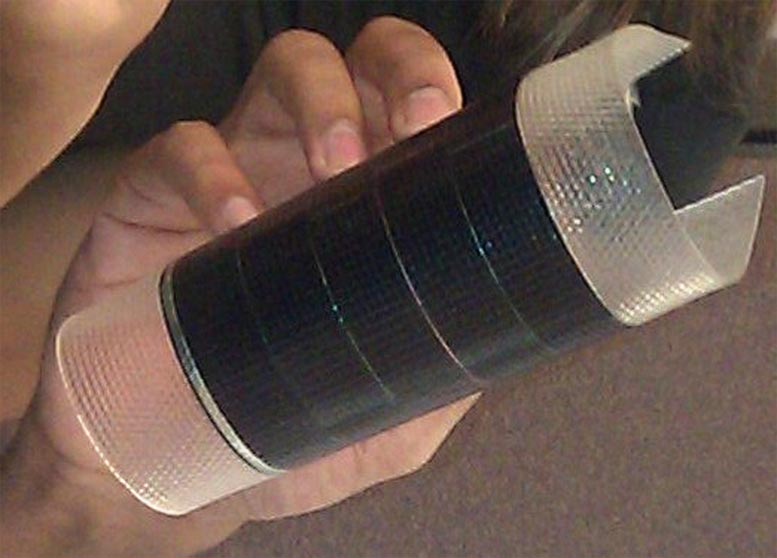
Solar cell technology continues to advance and new research from the University of California, Berkeley demonstrates a new record-breaking technique. Designed to be more like and LED, the Berkeley engineers designed a solar cell that is able to emit light as well as absorb it, breaking the efficiency record along the way.
To produce the maximum amount of energy, solar cells are designed to absorb as much light from the Sun as possible. Now researchers from the University of California, Berkeley, have suggested – and demonstrated – a counterintuitive concept: solar cells should be designed to be more like LEDs, able to emit light as well as absorb it. The Berkeley team will present its findings at the Conference on Lasers and Electro Optics (CLEO: 2012), to be held May 6-11 in San Jose, California.
“What we demonstrated is that the better a solar cell is at emitting photons, the higher its voltage and the greater the efficiency it can produce,” says Eli Yablonovitch, principal researcher and UC Berkeley professor of electrical engineering.
Since 1961, scientists have known that, under ideal conditions, there is a limit to the amount of electrical energy that can be harvested from sunlight hitting a typical solar cell. This absolute limit is, theoretically, about 33.5 percent. That means that at most 33.5 percent of the energy from incoming photons will be absorbed and converted into useful electrical energy.
Yet for five decades, researchers were unable to come close to achieving this efficiency: as of 2010, the highest anyone had come was just more than 26 percent. (This is for flat-plate, “single junction” solar cells, which absorb light waves above a specific frequency. “Multi-junction” cells, which have multiple layers and absorb multiple frequencies, are able to achieve higher efficiencies.)
More recently, Yablonovitch and his colleagues were trying to understand why there has been such a large gap between the theoretical limit and the limit that researchers have been able to achieve. As they worked, a “coherent picture emerged,” says Owen Miller, a graduate student at UC Berkeley and a member of Yablonovitch’s group. They came across a relatively simple, if perhaps counterintuitive, solution based on a mathematical connection between absorption and emission of light.
“Fundamentally, it’s because there’s a thermodynamic link between absorption and emission,” Miller says. Designing solar cells to emit light – so that photons do not become “lost” within a cell – has the natural effect of increasing the voltage produced by the solar cell. “If you have a solar cell that is a good emitter of light, it also makes it produce a higher voltage,” which in turn increases the amount of electrical energy that can be harvested from the cell for each unit of sunlight, Miller says.
The theory that luminescent emission and voltage go hand in hand is not new. But the idea had never been considered for the design of solar cells before now, Miller continues.
This past year, a Bay area-based company called Alta Devices, co-founded by Yablonovitch, used the new concept to create a prototype solar cell made of gallium arsenide (GaAs), a material often used to make solar cells in satellites. The prototype broke the record, jumping from 26 percent to 28.3 percent efficiency. The company achieved this milestone, in part, by designing the cell to allow light to escape as easily as possible from the cell – using techniques that include, for example, increasing the reflectivity of the rear mirror, which sends incoming photons back out through the front of the device.
Solar cells produce electricity when photons from the Sun hit the semiconductor material within a cell. The energy from the photons knocks electrons loose from this material, allowing the electrons to flow freely. But the process of knocking electrons free can also generate new photons, in a process called luminescence. The idea behind the novel solar cell design is that these new photons – which do not come directly from the Sun – should be allowed to escape from the cell as easily as possible.
“The first reaction is usually, why does it help [to let these photons escape]?” Miller says. “Don’t you want to keep [the photons] in, where maybe they could create more electrons?” However, mathematically, allowing the new photons to escape increases the voltage that the cell is able to produce.
The work is “a good, useful way” of determining how scientists can improve the performance of solar cells, as well as of finding creative new ways to test and study solar cells, says Leo Schowalter of Crystal IS, Inc. and visiting professor at Rensselaer Polytechnic Institute, who is chairman of the CLEO committee on LEDs, photovoltaics, and energy-efficient photonics.
Yablonovitch says he hopes researchers will be able to use this technique to achieve efficiencies close to 30 percent in the coming years. And since the work applies to all types of solar cells, the findings have implications throughout the field.
The CLEO: 2012 presentation CF2J.1, “The Opto-Electronics which Broke the Efficiency Record in Solar Cells,” by Eli Yablonovitch and Owen D. Miller, is at 10:30 a.m. Friday May 11 in the San Jose Convention Center.
Never miss a breakthrough: Join the SciTechDaily newsletter.
Follow us on Google and Google News.
2 Comments
How does allowing photons to escape help increase efficiency? All you said was “However, mathematically” and then the same thing you said three times before that? Is it because the escaping photons would be of a spectrum the cells can’t absorb? or is it an over crowding issue, get the lazy photons outta the way of the more productive members of society? PLEASE elaborate.
“Mathematically” probably means that they did the math, and it would be too boring for us simple-minded people to explain it here. Not every scientist is able to explain their work in simple English, you know…