
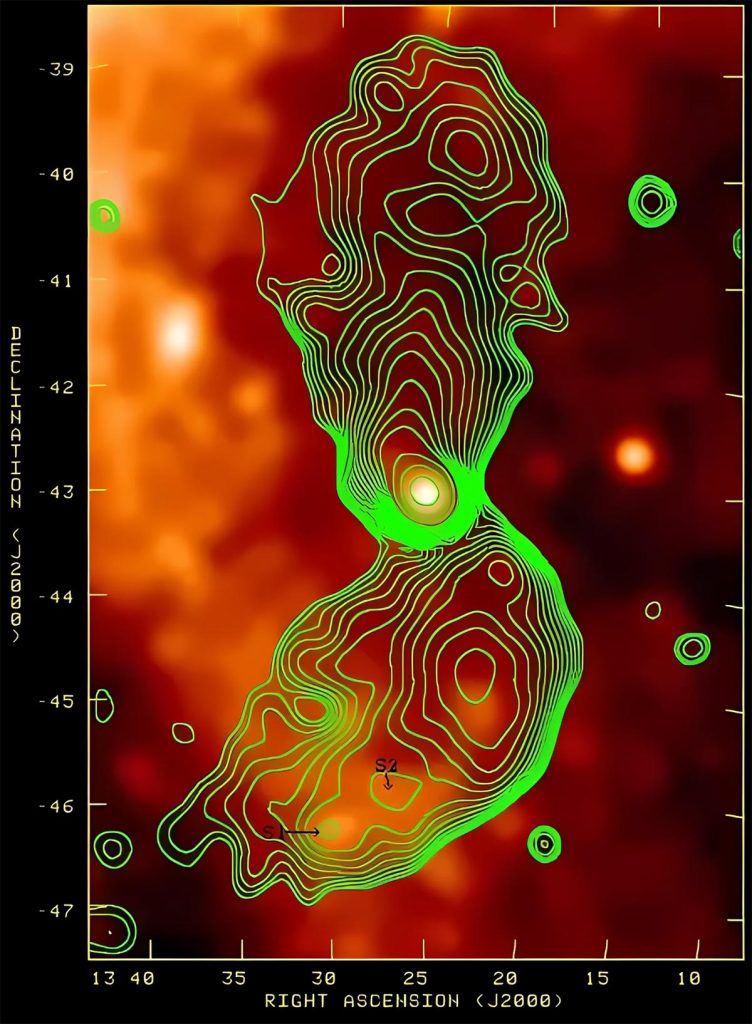
The PAPER array in South Africa’s Karoo Radio Astronomy Reserve is producing ground-breaking science and spectacular cosmic images.
Scientific studies done with the “PAPER” array, one of the world-class scientific instruments in South Africa’s Karoo Radio Astronomy Reserve, is producing ground-breaking science and spectacular cosmic images, resulting in several important articles in top astronomy journals.
The primary goal of PAPER (Precision Array to Probe the Epoch of Reionization) is to detect emission from the neutral gas that pervaded the universe before the first galaxies and black holes were formed. This ‘epoch of reionization’, as it is called, is the last frontier in observational cosmology.
Recent observations with PAPER were used to set the first physically interesting limits on emission from the neutral hydrogen during this key epoch in cosmic structure formation. Besides providing important constraints on the very early evolution of the universe, the PAPER observations are helping to define the techniques and instrumentation that will translate into the design of a next-generation ‘Hydrogen Epoch of Reionization Array’ (HERA), and eventually, the low-frequency SKA.
Beyond the cosmological studies, PAPER has produced unprecedented images of the southern radio sky at low frequency. PAPER comprises a unique combination of very wide field (‘full-sky imaging’), reasonable spatial resolution, and wide frequency range. Spectacular images of the closest powerful radio galaxy, Centaurus A, have been made with PAPER, revealing very large structure in this giant radio galaxy, some 200 kpc in extent. This is 10 times the size of the entire Milky Way. The PAPER data provide interesting insight into the interaction between these giant radio ‘jets’ emanating from the massive black hole at the center of the Centaurus A galaxy, with the large-scale intergalactic medium surrounding the galaxy.
(kpc = kiloparsec, a unit that astronomers use to measure distances between parts of a galaxy, or within groups of galaxies; 1 kpc = 3 000 light years)
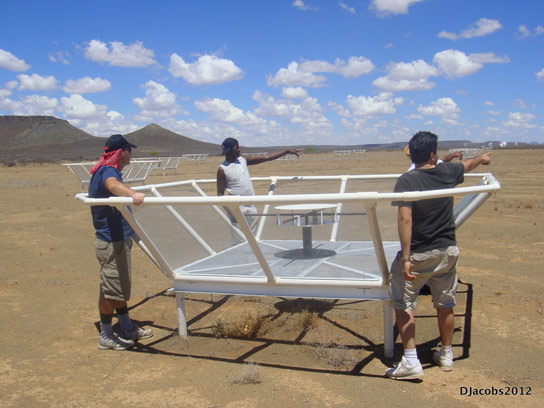
PAPER involves a close collaboration with South African astronomers and engineers on all aspects of the project, from design and construction to scientific discovery.
PAPER team member and chief scientist at the US National Radio Astronomy Observatory (NRAO) Chris Carilli emphasized that: “The help of the SKA project office, and the intern-student support for work in the Karoo, have been fundamental to the success of PAPER, as well as an important educational resource for South Africa. The Karoo has now been established as a world-leading site for studies of the radio cosmos. We look forward to the coming years, as the collaboration matures with next-generation instruments in the Karoo, leading to profound insights into the nature of the universe.”
“The PAPER instrument, in concert with site infrastructure and support, showed remarkable stability with not a single interruption during our recent six-month observation window,” says William Walbrugh, PAPER project manager at SKA SA.
“Hosting PAPER successfully confirms the integrity of the South Africa SKA site, and the technical expertise of the South African team,” Prof Justin Jonas, associate director for science and engineering at SKA South Africa adds.
About PAPER
PAPER has been operating on the Karoo site in South Africa for over two years. The Karoo provides a unique environment on planet Earth, with remarkably low interference from man-made radio transmissions, thereby enabling sensitive observations at low radio frequencies.
PAPER currently consists of 64 dipole antennas arranged in a grid formation over a 300 m clearing. Plans are underway to double the number of antennas at the Karoo site to 128 by September 2013.
The correlator, a custom-built array of supercomputers responsible for processing data received from the antennas, will also double in size. This will be amongst the world’s largest and most powerful correlators used for radio astronomy. The effective doubling in collecting area will dramatically increase the combined sensitivity of the instrument and thereby improve the probability of making a detection of the faint Epoch of Reionization emissions — this would be a major scientific breakthrough.
PAPER operates two arrays, the primary science instrument in the Karoo and a secondary, smaller, sister array in Green Bank, West Virginia in the USA. Together, these two arrays provide full sky coverage of both the northern and southern hemispheres.
Scientists from the SKA Project office working on PAPER collaborate with partners at American research institutions, such as the National Radio Astronomy Observatory, the University of California, Berkeley, and the University of Pennsylvania.
Recent scientific papers from research done with PAPER:
“Imaging on PAPER: Centaurus A at 148 MHz” by Irina I. Stefan, Chris L. Carilli, David A. Green, Zaki Ali, James E. Aguirre, Richard F. Bradley, Dave DeBoer, Matthew Dexter, Nicole E. Gugliucci, D. E. Harris, Daniel C. Jacobs, Pat Klima, Dave MacMahon, Jason Manley, David F. Moore, Aaron R. Parsons, Jonathan C. Pober and William P. Walbrugh, 19 April 2013, Monthly Notices of the Royal Astronomical Society.
DOI: 10.1093/mnras/stt548
“Opening the 21cm EoR Window: Measurements of Foreground Isolation with PAPER” by Jonathan C. Pober, Aaron R. Parsons, James E. Aguirre, Zaki Ali, Richard F. Bradley, Chris L. Carilli, Dave DeBoer, Matthew Dexter, Nicole E. Gugliucci, Daniel C. Jacobs, Patricia J. Klima, Dave MacMahon, Jason Manley, David F. Moore, Irina I. Stefan and William P. Walbrugh, 29 April 2013, The Astrophysical Journal Letters.
DOI: 10.1088/2041-8205/768/2/L36
“New Limits on 21cm EoR From PAPER-32 Consistent with an X-Ray Heated IGM at z=7.7” by Aaron R. Parsons, Adrian Liu, James E. Aguirre, Zaki S. Ali, Richard F. Bradley, Chris L. Carilli, David R. DeBoer, Matthew R. Dexter, Nicole E. Gugliucci, Daniel C. Jacobs, Pat Klima, David H. E. MacMahon, Jason R. Manley, David F. Moore, Jonathan C. Pober, Irina I. Stefan and William P. Walbrugh, 28 May 2014, The Astrophysical Journal.
DOI: 10.1088/0004-637X/788/2/106
Never miss a breakthrough: Join the SciTechDaily newsletter.
Follow us on Google and Google News.