
Close Menu
    Facebook X (Twitter) Instagram
    SciTechDaily
    • Biology
    • Chemistry
    • Earth
    • Health
    • Physics
    • Science
    • Space
    • Technology
    Facebook X (Twitter) Pinterest YouTube RSS
    SciTechDaily
    Home»Space»Planets Aligning in Rare Triple Conjunction
    Space

    Planets Aligning in Rare Triple Conjunction

    By Science@NASAMay 14, 20131 Comment3 Mins Read
    Facebook Twitter Pinterest Telegram LinkedIn WhatsApp Email Reddit
    Share
    Facebook Twitter LinkedIn Pinterest Telegram Email Reddit
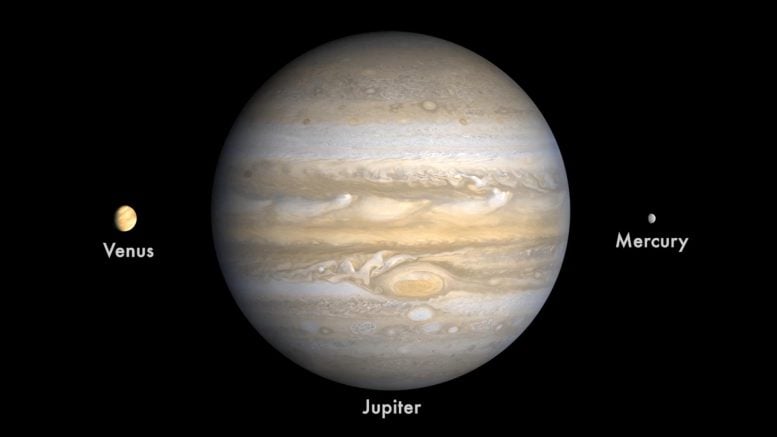
    Rare Triple Conjunction of Planets
    At the close of May, a striking celestial triangle will be formed by Venus, Jupiter, and Mercury, spanning just three degrees in the night sky during sunset. This uncommon event presents a dazzling triple planetary conjunction. Credit: NASA

    At the end of May, Venus, Jupiter, and Mercury will form a bright triangle only three degrees wide in the night’s sunset, displaying a rare triple conjunction of planets.

    Sunset is a special time of day. Low-hanging clouds glow vivid red and orange as the background sky turns cobalt blue. The first stars pop out in the heavenly dome overhead, eliciting wishes from backyard sky watchers.

    The sunset of May 26th will be extra special. On that date, Venus, Jupiter, and Mercury will gather in the fading twilight to form a bright triangle only three degrees wide.


    ScienceCasts: Sunset Triangle. A new ScienceCast video previews coming attractions in the sunset sky.

    Triple conjunctions of planets are fairly rare. The last time it happened was in May 2011, and it won’t happen again until October 2015. This triple is especially good because it involves the three brightest planets in May’s night sky: #1, Venus; #2, Jupiter; and #3, Mercury. The triangle will be visible even in places with heavy urban light pollution.

    The best time to look is about 30 to 60 minutes after sunset. The three planets will be hugging the horizon, so a clear view of the western sky is essential.

    Let Venus be your guide. It pops out of the fading twilight long before the others. As soon as you locate Venus, look in that direction using binoculars. If your binoculars are typical, all three planets will fit in the eyepiece simultaneously. As the twilight continues to fade, set the optics aside; eventually the triangle will become visible to the naked eye.

    You don’t have to wait until May 26th to enjoy the show, however. The planets start gathering weeks earlier. Dates of special interest include:

    May 11th through 13th, when the crescent Moon, Venus, and Jupiter form a long diagonal line jutting upward from the sunset;

    May 23rd, when Jupiter and Venus converge to less than 5 degrees apart, close enough for simultaneous binocular viewing;

    May 24th, when Mercury passes Venus less than 2 degrees away, giving shape to the triangle that reaches maximum compactness two nights later on May 26th.

    The triangle begins to disperse on May 27th, but even then the show is not over. On May 28th, Venus passes Jupiter at a distance of 1 degree, forming a truly spectacular pair.

    From beginning to end, the three naked-eye planets will be close enough to fit inside the field of ordinary binoculars from May 23rd until early June. May 26th is just the best among many very good nights.

    Step outside, face west, and observe the planets. It’s a beautiful way to end the day.

    Never miss a breakthrough: Join the SciTechDaily newsletter.
    Follow us on Google and Google News.

    Astronomy NASA Planets
    Share. Facebook Twitter Pinterest LinkedIn Email Reddit

    Related Articles

    A Century-Old Cosmic Mystery Solved – Four Hidden Planets Found Near Earth

    Bright Planets, Bold Encounters: February’s Sky Comes Alive

    Astronomers Unveil the Mysterious 350,000-Mile Tail of Exoplanet WASP-69 b

    A Tale of Four Worlds: Hubble’s Ten-Year Hunt for Secrets in the Outer Solar System

    In the “Hot Neptune Desert,” a Rare Planet Offers Clues to Cosmic Mysteries

    NASA Finds Signs of an Io-Like Volcanic Exomoon Just 635 Light-Years Away

    Jupiter’s Great Red Spot Enigma: Unexplained Oscillations Baffle Astronomers

    Unlocking Uranus: NASA’s Dual Observations Pave the Way to Discovering New Worlds

    The Great Escape: NASA’s Hubble and MAVEN Help Solve Mystery of Mars’ Vanishing Water

    1 Comment

    1. andi on March 8, 2016 6:14 pm

      stop avoiding telling us the next conjunction of mars, Jupiter and venus

      Reply
    Leave A Reply Cancel Reply

    • Facebook
    • Twitter
    • Pinterest
    • YouTube

    Don't Miss a Discovery

    Subscribe for the Latest in Science & Tech!

    Trending News

    New Study Reveals Why Ozempic Works Better for Some People Than Others

    Climate Change Is Altering a Key Greenhouse Gas in a Way Scientists Didn’t Expect

    New Study Suggests Gravitational Waves May Have Created Dark Matter

    Scientists Discover Why the Brain Gets Stuck in Schizophrenia

    Scientists Engineer “Tumor-Eating” Bacteria That Devour Cancer From Within

    Even “Failed” Diets May Deliver Long-Term Health Gains, Study Finds

    NIH Scientists Discover Powerful New Opioid That Relieves Pain Without Dangerous Side Effects

    Collapsing Plasma May Hold the Key to Cosmic Magnetism

    Follow SciTechDaily
    • Facebook
    • Twitter
    • YouTube
    • Pinterest
    • Newsletter
    • RSS
    SciTech News
    • Biology News
    • Chemistry News
    • Earth News
    • Health News
    • Physics News
    • Science News
    • Space News
    • Technology News
    Recent Posts
    • The Surprising Reason You Might Want To Sleep Without a Pillow
    • Household Cats Could Hold the Secret to Fighting Breast Cancer
    • Scientists Say This Natural Hormone Reverses Obesity by Targeting the Brain
    • This 15,000-Year-Old Discovery Changes What We Know About Early Human Creativity
    • 35-Million-Year-Old Mystery: Strange Arachnid Discovered Preserved in Amber
    Copyright © 1998 - 2026 SciTechDaily. All Rights Reserved.
    • Science News
    • About
    • Contact
    • Editorial Board
    • Privacy Policy
    • Terms of Use

    Type above and press Enter to search. Press Esc to cancel.