
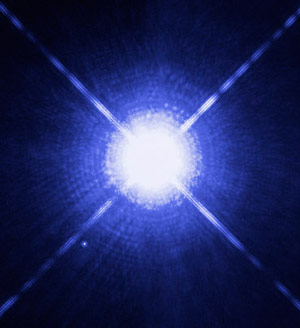
A Hubble image of the binary stars Sirius A and B. Sirius B, the very faint companion, is a white dwarf, an evolved star that has burned its nuclear fuel. There is one known binary star pair consisting of two white dwarfs that is also a “runaway” star, moving very rapidly through the galaxy. A new study concludes that this runaway star was probably ejected from a dense stellar cluster. Credit: NASA/Hubble
A new study examines runaway binary LP400-22, providing key insights into runaway stars, white-dwarf binaries, and the complex interactions going on in dense stellar clusters.
CfA astronomers made a remarkable and fortuitous discovery in 2005: an extremely fast moving star, clocked going over three million kilometers an hour. It appears to have been ejected from the vicinity of the galactic center’s supermassive black hole around 80 million years ago by powerful gravitational effects as it swung past the black hole. Racing outward from the galaxy, the star lends added credibility to the picture of a massive black hole at the galactic center, and to calculations of how black holes might interact with their stellar environments.
Other hypervelocity stars and less fast-moving runaway stars have also been found. Most of them have been accelerated by one of the two other gravitational mechanisms: ejection from a dense cluster of stars as random motions bring it into a slingshot-like orbit, or ejection from a supernova binary system after the supernovae explodes and frees it from its orbit. A binary star is a pair of stars that orbit each other, and many (perhaps most) stars are members of binary systems. So far, there have been no hypervelocity binary stars discovered. They have been predicted, however, with at least one theory proposing that the discovery of a hypervelocity binary pair might indicate that the nuclear black hole is itself a binary pair.
CfA astronomers Warren Brown and Scott Kenyon and their colleagues decided to investigate the case of the peculiar runaway binary LP400-22. The binary pair was known to consist of two very evolved orbiting stars, so-called white dwarf stars, currently about 1400 light-years away from us. The object is unique in being the only known runaway white dwarf pair, and moreover its velocity is larger than most other runaway stars. The astronomers examined its motion across the sky over a period of five years and concluded from its path in the galaxy that it almost surely was not ejected from the vicinity of the galactic center. Moreover, they report that the supernovae mechanism is also very unlikely because there is no hint at X-ray wavelengths of the remnants of such a supernova. The team concludes that the probable origin of this binary pair is in a dense stellar cluster – and indeed they can tentatively traced the path back to one of several possible globular clusters. The runaway pair was either involved in a multi-body interaction there, or was originally part of a triple-star system that was disrupted by an intermediate-mass black hole in the cluster. Although the result of the investigation ended up not addressing the properties of the galactic center’s black hole, it provides key insights into runaway stars, white-dwarf binaries, and the complex interactions going on in dense stellar clusters.
Reference: “The runaway binary LP 400−22 is leaving the Galaxy” by Mukremin Kilic, A. Gianninas, Warren R. Brown, Hugh C. Harris, Conard C. Dahn, M. A. Agüeros, Craig O. Heinke, S. J. Kenyon, J. A. Panei and Fernando Camilo, 1 August 2013, Monthly Notices of the Royal Astronomical Society.
DOI: 10.1093/mnras/stt1282
arXiv:1307.3258
Never miss a breakthrough: Join the SciTechDaily newsletter.
Follow us on Google and Google News.
3 Comments
If they had just made the statement; ‘Fast moving Star ejected from galaxy centre.’ Then that would have been spot on! However, they spoiled it by suggesting that it had been influenced via a ‘Sling-Shot’ effect.
Just think about the following as a logical reason for the effect given in the report.
Our universe was in situ in its entirety before the Bang (which would by virtue mean that the galaxies are just chunks of debris sent out in the, ‘Bang’). If the latter was the case then objects such as this would simply be chunks breaking away from the central core of the galaxy and flying off exactly in accordance with centrifugal forces involved.
Just shut up, ok? The big bang is not the same kind of explosion you imagine in your head. Your reason does not make ‘logical’ sense. Big Bang occurred way too long ago for this binary pair to have retained this much velocity for this long and still remain in milky way. It is easy to calculate that the binary system was in the vicinity of Sagitarius A* 80 million years ago and the most likely explanation is that it gained velocity at that time. Before calling out people who actually understands physics much better than you do, at least try to understand what the terms mean:
http://en.wikipedia.org/wiki/Gravity_assist
Spot on peter? nothing we say about space is spot on peter…