
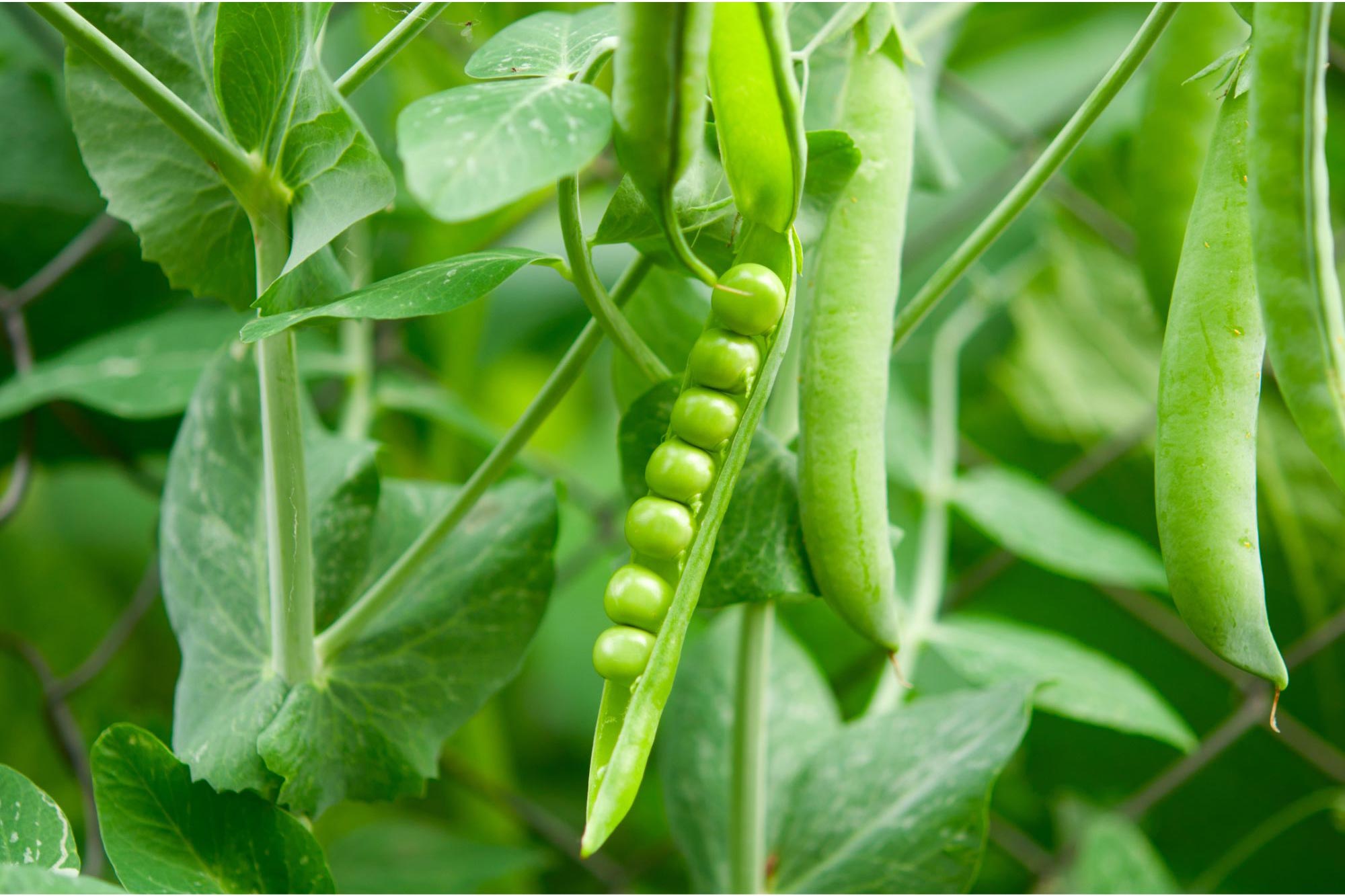
A global team mapped pea genomic diversity, advancing breeding research, revisiting Mendel’s traits, and boosting sustainable agriculture.
Gregor Mendel’s pioneering experiments with pea plants laid the foundation for the science of genetics more than 160 years ago.
Now, an international team of researchers has harnessed genomics, bioinformatics, and genetics to map the diversity of a globally significant pea collection. Their work has uncovered new insights into the traits that Mendel famously studied and revealed an unprecedented breadth of agriculturally valuable genetic diversity.
According to the authors of a new study, the expanded gene bank and genomic resources now available to researchers and breeders worldwide have the potential to transform pea breeding and advance research into this environmentally vital legume.
“Our collaboration has created a genomic resource of extraordinary depth and breadth, including the whole genome sequence data for pea,” said one of the co-corresponding authors Dr Noam Chayut, who manages the Germplasm Resource Unit (GRU) at the John Innes Centre.
“We already have researchers and multi-national companies ordering seeds corresponding to the novel genomic resources, which will revolutionise how companies breed peas, and how scientists study them, across the world.”
A Global Collaborative Effort
The research, which appears in the journal Nature, is built on a collaboration between the John Innes Centre (JIC) and the Chinese Academy of Agricultural Sciences (CAAS), together with other research groups in China, the UK, USA, and France.
This landmark study comes at a time when peas and other legumes are being called upon as a source of plant protein, and as sustainable crops which can fix their own nitrogen. This means pea and other legume crops need less chemical fertiliser to grow, potentially lowering land and river pollution.

“Mendel was not just interested in pea because it was a perfect model organism, although it was,” said Dr Chayut. “It was also an important crop that he wanted to improve by solving problems that were facing gardeners and growers at the time.
“Similarly, this study not only shines a light on Mendel’s fundamental discoveries, but it also opens the route to growing pea in many parts of the world, including the UK. Pea is a crop which can deliver a sustainable source of plant-based protein and has a major role to play in the future of farming.”
How did researchers unlock the genomes of a global pea collection?
Unlocking the Genomic Secrets of Pea
Researchers selected a representative sample of around 700 pea accessions from the collection of 3,500, assembled from around the world over decades and maintained at the GRU, a national capability funded by BBSRC.
This generated 62 terabytes of raw data, comprising 25.6 trillion pieces of information which, if printed out, would cover 3.6 billion sheets of A4 paper.
With this data, the team created a global genomic map of pea, from the highly bred and cultivated pea, through to locally adapted varieties called landraces, and wild relatives.
Using this map and a technique called Genome Wide Association Studies, they identified regions of the genomes that corresponded to valuable trait variation. The research has connected more than 70 agronomic traits to corresponding genomic locations. The many different genetic markers at each of these locations can be used to accelerate pea improvement.
Looking forward, the new resource, coupled with other modern technologies such as gene editing, long-read DNA and RNA sequencing, will open unprecedented opportunities for novel gene discovery. It will also pave the way for more predictive breeding – such as using AI models which can select combinations of genes to deliver better yielding, disease resistant, agronomically viable pea plants.
Mendel’s enduring legacy
Mendel’s work on peas was described by the science historian Allan Franklin as “the best experiments ever done.”
Working in the early days of cell theory, and before genetics was known, he focused on seven traits: pea seed shape (round or wrinkled), pea seed colour (green or yellow), pod shape (constricted or inflated), pod colour (green or yellow), flower colour (purple or white), plant size (tall or dwarf) and position of flowers (axial or terminal).
Over many years of experiments, involving thousands of plants, he established fundamental rules of inheritance, how characteristics are passed down through the generations, and single-handedly laid the groundwork for the science of genetics.
Modern Tools Illuminate Classic Experiments
The novel genomic tools created by this modern scientific collaboration are being used to revisit these classic experiments, shedding light on the genetics underpinning Mendelian traits. For the trait of flower colour, the team found an unusual type of naturally occurring mutation which restores the purple colour to white flowered peas.
The team also discovered a mutation that results in the yellow pod trait, which is of great interest to academics as it is the consequence of an interaction between two adjacent genes.
Mendel discovered what we now call the laws of inheritance without knowing what a gene was,” said one of the lead authors of the study, Professor Shifeng Cheng of the CAAS Agricultural Genomics Institute at Shenzhen. “Today using modern tools, we can see the exact genes and the precise mutations that he unknowingly tracked.”
Mendel scholar Professor Noel Ellis, co-corresponding author of the study and researcher at the John Innes Centre, commented: “In addition to the practical utility of these accessions and associated data to breeders, the resources are of great value for academics and teachers of genetics because our study gives an up-to-date description of Mendel’s variants. The data is available, and the pea lines can be ordered – we hope that academics will access these resources freely.”
Cong Feng, a graduate student in Professor Cheng’s team and co-first author of the paper, said: “Genome-wide association studies (GWAS) and haplotype analysis proved to be incredibly powerful tools. We were thrilled to uncover sequence-level insights into all seven of Mendel’s classical traits.”
Mei Jiang, a student and co-first author, added: “This project deepened my fascination with peas, genetics, and the legacy of Mendel. It has become both a scientific and personal journey.”
Dr Julie Hofer, another co-first author on the paper and postdoc at the John Innes Centre, said: “For years, the genetic basis of pod color resisted explanation despite extensive research. Our discovery highlights the subtle ways that genomic structure can influence gene function at a transcriptional level.”
The study exemplifies the importance of collaboration in science, concluded Dr Chayut: “We can achieve so much more when we work together.”
Reference: “Genomic and genetic insights into Mendel’s pea genes” by Cong Feng, Baizhi Chen, Julie Hofer, Yan Shi, Mei Jiang, Bo Song, Hong Cheng, Lu Lu, Luyao Wang, Alex Howard, Abdel Bendahmane, Anissa Fouchal, Carol Moreau, Chie Sawada, Christine LeSignor, Cuijun Zhang, Eleni Vikeli, Georgios Tsanakas, Hang Zhao, Jitender Cheema, J. Elaine Barclay, Junliang Hou, Liz Sayers, Luzie Wingen, Marielle Vigouroux, Martin Vickers, Mike Ambrose, Marion Dalmais, Paola Higuera-Poveda, Pengfeng Li, Quan Yuan, Rebecca Spanner, Richard Horler, Roland Wouters, Smitha Chundakkad, Tian Wu, Xiaoxiao Zhao, Xiuli Li, Yuchen Sun, Zejian Huang, Zhen Wu, Xing Wang Deng, Burkhard Steuernagel, Claire Domoney, Noel Ellis, Noam Chayut and Shifeng Cheng, 23 April 2025, Nature.
DOI: 10.1038/s41586-025-08891-6
Never miss a breakthrough: Join the SciTechDaily newsletter.
Follow us on Google and Google News.