

We may be witnessing the moment when our ancestors first defied a hostile world, using the same tools in the same place for nearly 300,000 years despite the chaos of shifting climates.
Picture early humans carefully shaping stone tools over a span of nearly 300,000 years, all while facing frequent wildfires, severe droughts, and major environmental changes. A new study published in Nature Communications reveals compelling evidence of a long-lasting technological tradition from Kenya’s Turkana Basin.
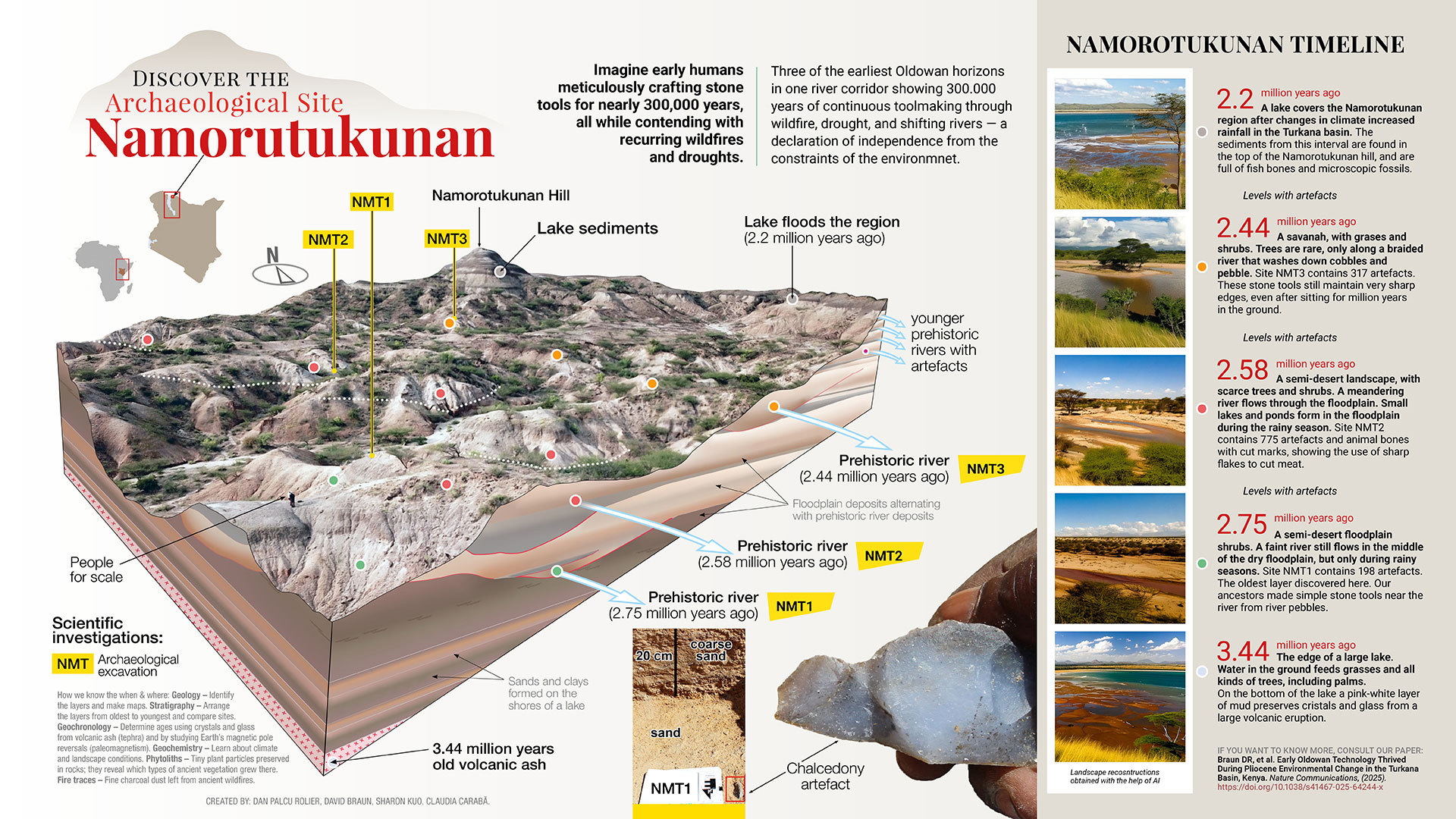
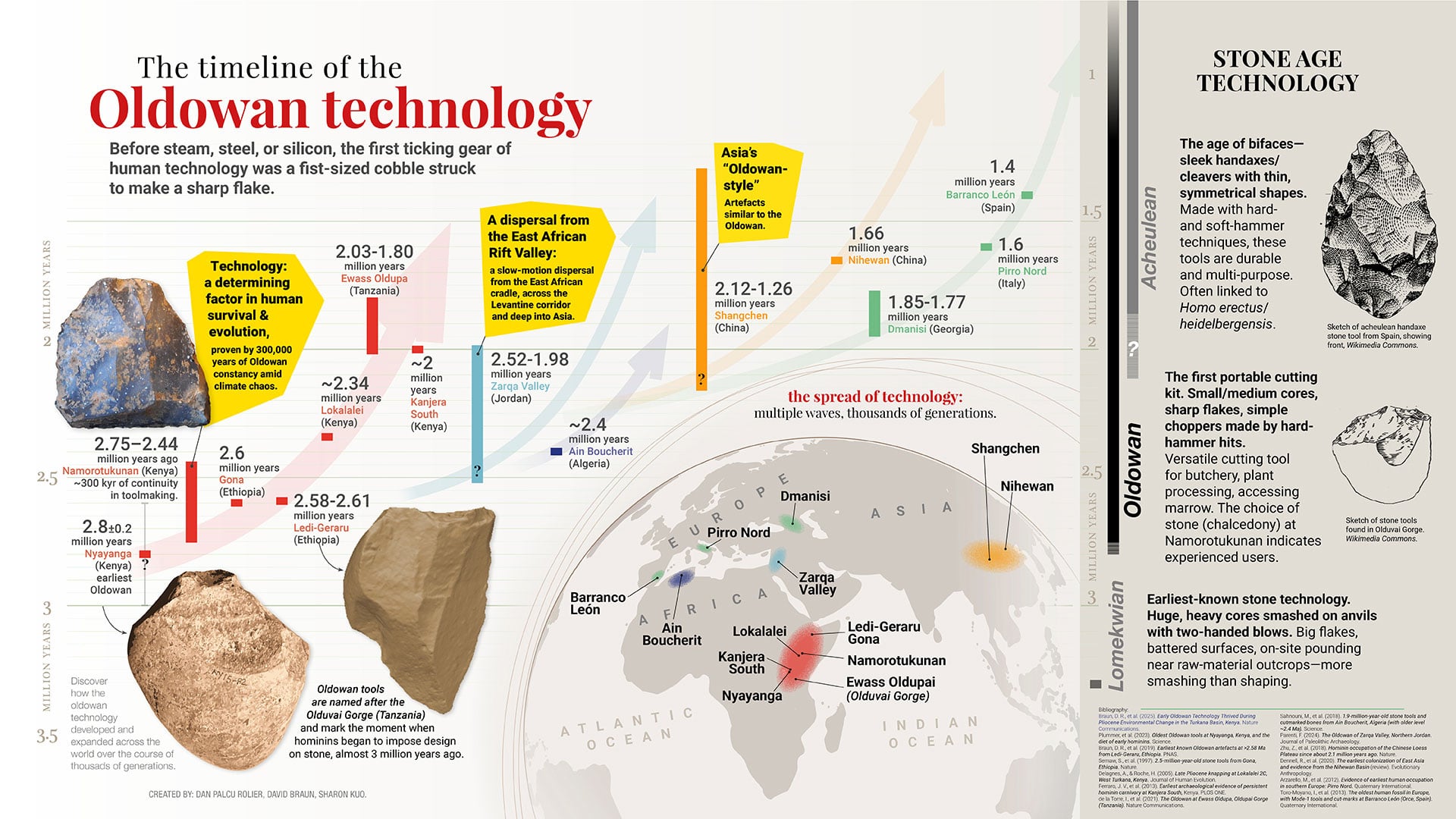
At the Namorotukunan Site, an international team of researchers discovered one of the most extensive and ancient records of early Oldowan stone tools ever found, dating between roughly 2.75 and 2.44 million years ago. These tools, essentially the earliest multi-purpose “Swiss Army knives” created by hominins, show that our ancestors were not merely enduring harsh conditions but flourishing amid one of the most unstable climates in Earth’s history.
“This site reveals an extraordinary story of cultural continuity,” said lead author David R. Braun, a professor of anthropology at the George Washington University. He is also affiliated with the Max Planck Institute. “What we’re seeing isn’t a one-off innovation—it’s a long-standing technological tradition.”
“Our findings suggest that tool use may have been a more generalized adaptation among our primate ancestors,” adds Susana Carvalho, director of science at the Gorongosa National Park in Mozambique and senior author of the study.
“Namorotukunan offers a rare lens on a changing world long gone—rivers on the move, fires tearing through, aridity closing in—and the tools, unwavering. For ~300,000 years, the same craft endures—perhaps revealing the roots of one of our oldest habits: using technology to steady ourselves against change,” said Dan V. Palcu Rolier, corresponding author and a senior scientist at GeoEcoMar, Utrecht University and the University of São Paulo.
Key Findings
- Tech Mastery Over Hundreds of Millennia: Early hominins engineered sharp-edged stone tools with extraordinary consistency, showing advanced skill and knowledge passed down across countless generations—a steady legacy.
- Cutting-Edge Science with Ancient Rocks: Using volcanic ash dating, magnetic signals frozen in ancient sediments, chemical signatures of rocks, and microscopic plant remains, researchers pieced together an epic climatic saga that provides context for understanding the role of technology in human evolution.
- Thriving in the Face of Climate Chaos: These toolmakers lived through radical environmental upheavals. Their adaptable technology helped unlock new diets, including meat, turning hardship into a survival advantage.
What The Experts Say
On the ground, the craft is remarkably consistent: “These finds show that by about 2.75 million years ago, hominins were already good at making sharp stone tools, hinting that the start of the Oldowan technology is older than we thought,” said Niguss Baraki at the George Washington University.
The butchery signal is clear as well: “At Namorotukunan, cutmarks link stone tools to meat eating, revealing a broadened diet that endured across changing landscapes,” said Frances Forrest at Fairfield University.
“The plant fossil record tells an incredible story: The landscape shifted from lush wetlands to dry, fire-swept grasslands and semideserts,” said Rahab N. Kinyanjui at the National Museums of Kenya / Max Planck Institute. “As vegetation shifted, the toolmaking remained steady. This is resilience.”
Reference: “Early Oldowan technology thrived during Pliocene environmental change in the Turkana Basin, Kenya” by David R. Braun, Dan V. Palcu Rolier, Eldert L. Advokaat, Will Archer, Niguss G. Baraki, Maryse D. Biernat, Ella Beaudoin, Anna K. Behrensmeyer, René Bobe, Katherine Elmes, Frances Forrest, Ashley S. Hammond, Luigi Jovane, Rahab N. Kinyanjui, Ana P. de Martini, Paul R. D. Mason, Amanda McGrosky, Joanne Munga, Emmanuel K. Ndiema, David B. Patterson, Jonathan S. Reeves, Diana C. Roman, Mark J. Sier, Priyeshu Srivastava, Kristen Tuosto, Kevin T. Uno, Amelia Villaseñor, Jonathan G. Wynn, John W. K. Harris and Susana Carvalho, 4 November 2025, Nature Communications.
DOI: 10.1038/s41467-025-64244-x
This research was carried out with permission from the National Museums of Kenya and Kenya’s Ministry of Education, Science, and Technology, and in partnership with the Koobi Fora Field School. Funding was provided by the U.S. National Science Foundation the Leakey Foundation, the Palaeontological Scientific Trust, the Dutch Research Council, the Fundação de Amparo à Pesquisa do Estado de São Paulo, the American Museum of Natural History, and the Romanian National Authority for Scientific Research.
Never miss a breakthrough: Join the SciTechDaily newsletter.
Follow us on Google and Google News.
2 Comments
Finally a case to which the clickbaity term “rewriting” can actually apply to.
The history of mankind really goes far deeper and earlier than what they used to teach us in school.
Why is y the use of tools and the persistent use of tools by folk such as H erectus and others so surprising? With an upright stature and opposable thumbs one can make anything, even satelltes that can transmit messages from beyond the edge of the Solar System. All it needs is an increasing critical mass of taught brain-power.