
Close Menu
    Facebook X (Twitter) Instagram
    SciTechDaily
    • Biology
    • Chemistry
    • Earth
    • Health
    • Physics
    • Science
    • Space
    • Technology
    Facebook X (Twitter) Pinterest YouTube RSS
    SciTechDaily
    Home»Space»30 Exocomets Discovered in a Young Planetary System
    Space

    30 Exocomets Discovered in a Young Planetary System

    By CNRSApril 28, 2022No Comments3 Mins Read
    Facebook Twitter Pinterest Telegram LinkedIn WhatsApp Email Reddit
    Share
    Facebook Twitter LinkedIn Pinterest Telegram Email Reddit
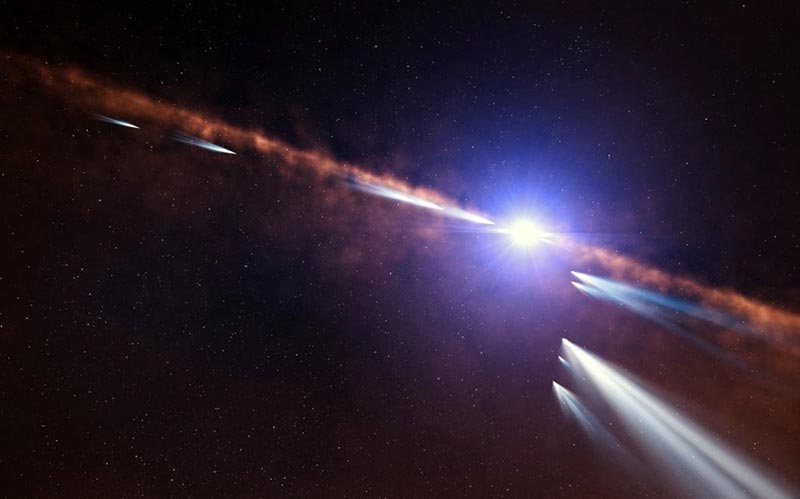
    Exocomets Orbiting ß Pictoris
    Artist’s impression of exocomets orbiting the star ß Pictoris. Credit: ESO/L. Calçada

    Thirty exocomets orbiting ß Pictoris were discovered, with sizes from 3 to 14 km, shedding light on comet evolution and planetary system formation.

    For the past thirty years, astronomers have been fascinated with the star ß Pictoris because it allows them to observe a young planetary system in the process of formation. It is made up of at least two young planets, as well as comets, which were detected as early as 1987. These were the first comets ever discovered orbiting a star other than the Sun.

    Now, an international team of researchers has discovered 30 such exocomets and determined the size of their nuclei,[1] which vary between 3 and 14 kilometers (~2 and 9 miles) in diameter. The scientists were headed by Alain Lecavelier des Etangs, CNRS researcher at the Institut d’Astrophysique de Paris (CNRS/Sorbonne Université).[2]

    Size and Distribution of Exocomets’ Nuclei

    The scientists were also able to estimate the size distribution of the objects, i.e. the proportion of small comets to large ones. This is the first time this distribution has been measured outside our Solar System, and it is strikingly similar to that of comets orbiting the Sun. It shows that, just like the comets of the Solar System, the exocomets of ß Pictoris were shaped by a series of collisions and breakups.
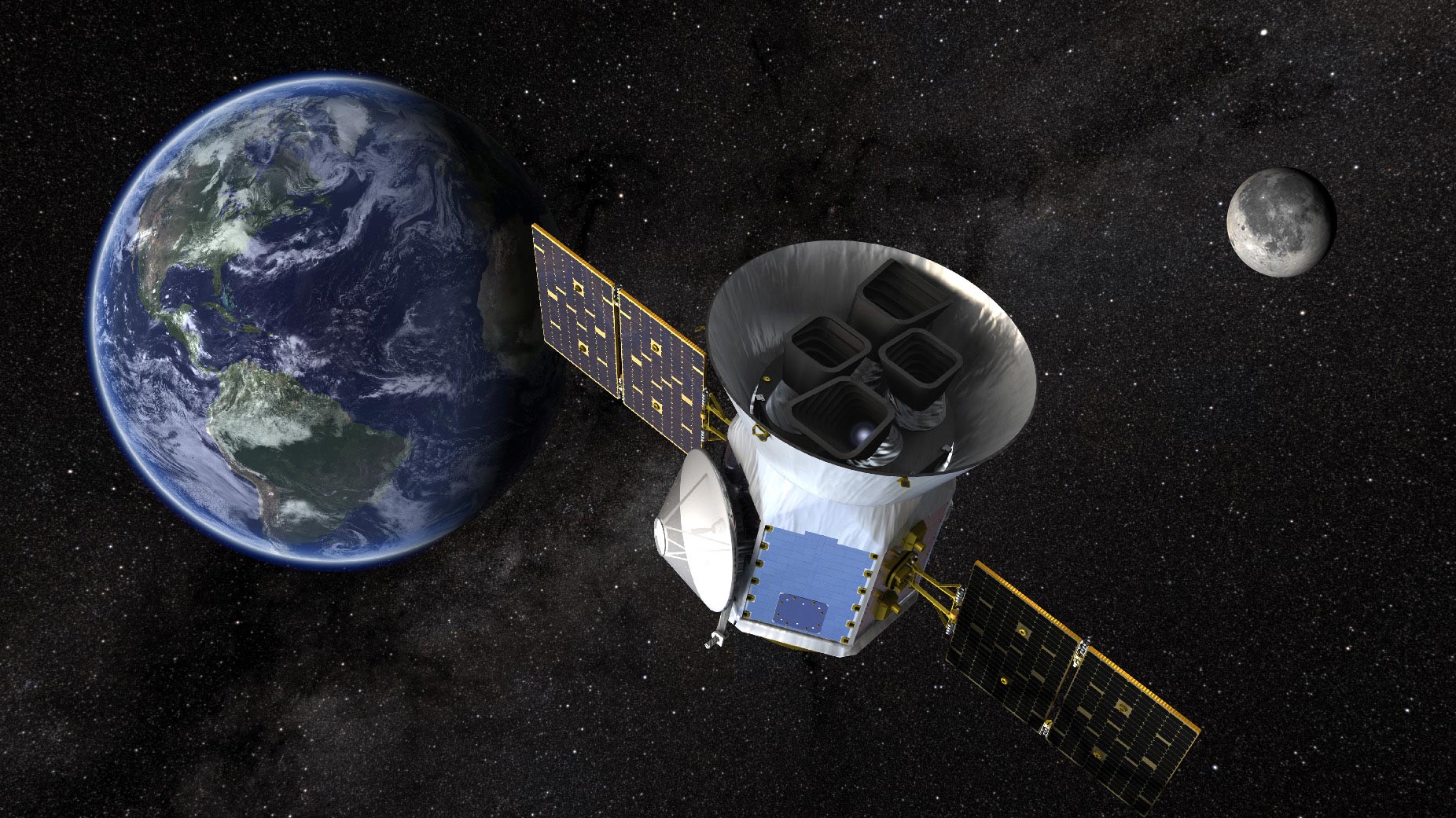
    NASA TESS in Space
    Illustration of NASA’s Transiting Exoplanet Survey Satellite (TESS) at work. Credit: NASA’s Goddard Space Flight Center

    This work sheds new light on the origin and evolution of comets in planetary systems. Since a part of Earth’s water probably originated in comets, scientists are seeking to understand their impact on the characteristics of planets.

    Their findings, to be published in the journal Scientific Reports today (April 28, 2022) are the outcome of 156 days of observation of the ß Pictoris system using NASA’s Transiting Exoplanet Survey Satellite (TESS). Other upcoming observations, in particular with the Hubble and James Webb space telescopes, should enable scientists to find out more in the future.

    Notes

    1. A comet is formed primarily by a rocky core covered with dust and gas in the solid state. The tail of the comet appears only temporarily, when the frozen gases are warmed and enter the gaseous state.
    2. Scientists from the Laboratoire d’Etudes Spatiales et d’Instrumentation en Astrophysique (Observatoire de Paris – PSL /CNRS/Sorbonne Université/Université Paris Cité) and the Institut de Planétologie et d’Astrophysique de Grenoble (CNRS/UGA) also took part in this research.

    Reference: “Exocomets size distribution in the ß Pictoris planetary system” by Alain Lecavelier des Etangs, Lucie Cros, Guillaume Hébrard, Eder Martioli, Marc Duquesnoy, Matthew A. Kenworthy, Flavien Kiefer, Sylvestre Lacour, Anne-Marie Lagrange, Nadège Meunier and Alfred Vidal-Madjar, 28 April 2022, Scientific Reports.
    DOI: 10.1038/s41598-022-09021-2

    Never miss a breakthrough: Join the SciTechDaily newsletter.
    Follow us on Google and Google News.

    Astronomy CNRS Comet Exocomets TESS
    Share. Facebook Twitter Pinterest LinkedIn Email Reddit

    Related Articles

    “Very Surprised!” – NASA’s Exoplanet-Hunting Mission Catches an Explosive Comet Outburst

    NASA’s Planet-Hunting Satellite Catches a Comet in Motion

    Astronomers Reveal How Catastrophic Collisions Form Two Lobe Comets

    Kepler Detects Transiting Comets Outside Our Solar System

    Trillions of Comet Collisions Explain 17-Year-Old Stellar Mystery

    Scientists Discover a New Type of Cosmic Ray

    ISON Comet May Become Brightest Object in the Night Skies

    Trajectory Models of Refractory Particles Help Solve Two Solar System Puzzles

    View the Eta Aquarid Meteor Shower From Halley’s Comet

    Leave A Reply Cancel Reply

    • Facebook
    • Twitter
    • Pinterest
    • YouTube

    Don't Miss a Discovery

    Subscribe for the Latest in Science & Tech!

    Trending News

    A Billion Years Before the Grand Canyon, a Giant Cliff May Have Stretched Across America

    The Immune Systems of 110-Year-Olds Are Hiding a Remarkable Secret

    Common Osteoarthritis Treatment Fails a Major Test

    Dark Stars May Have Left a Gravitational-Wave Signal We Can Detect Today

    Blackbirds Somehow Know When a Snake Is Too Dangerous To Attack

    A Hidden Gut Reaction May Explain Why Vegetables Are So Good for You

    New “Invisible” Cell Therapy Could Provide Side-Effect-Free Diabetes Treatment

    Nanoscale “Defects” Unlock a Major Heat Transfer Breakthrough

    Follow SciTechDaily
    • Facebook
    • Twitter
    • YouTube
    • Pinterest
    • Newsletter
    • RSS
    SciTech News
    • Biology News
    • Chemistry News
    • Earth News
    • Health News
    • Physics News
    • Science News
    • Space News
    • Technology News
    Recent Posts
    • “Zombie” Cells Reveal a Surprising New Driver of Chronic Inflammation
    • The Rare Vision Side Effect of Ozempic and Wegovy You Should Know About
    • NASA’s New Space Telescope Could Map the Entire Sky With Hubble-Like Detail
    • Hidden Deep Beneath Mars, Scientists Find Evidence of a Vast Magmatic System
    • One Tiny Chemical Difference in RNA Could Help Explain the Origins of Life
    Copyright © 1998 - 2026 SciTechDaily. All Rights Reserved.
    • Science News
    • About
    • Contact
    • Editorial Board
    • Privacy Policy
    • Terms of Use

    Type above and press Enter to search. Press Esc to cancel.