

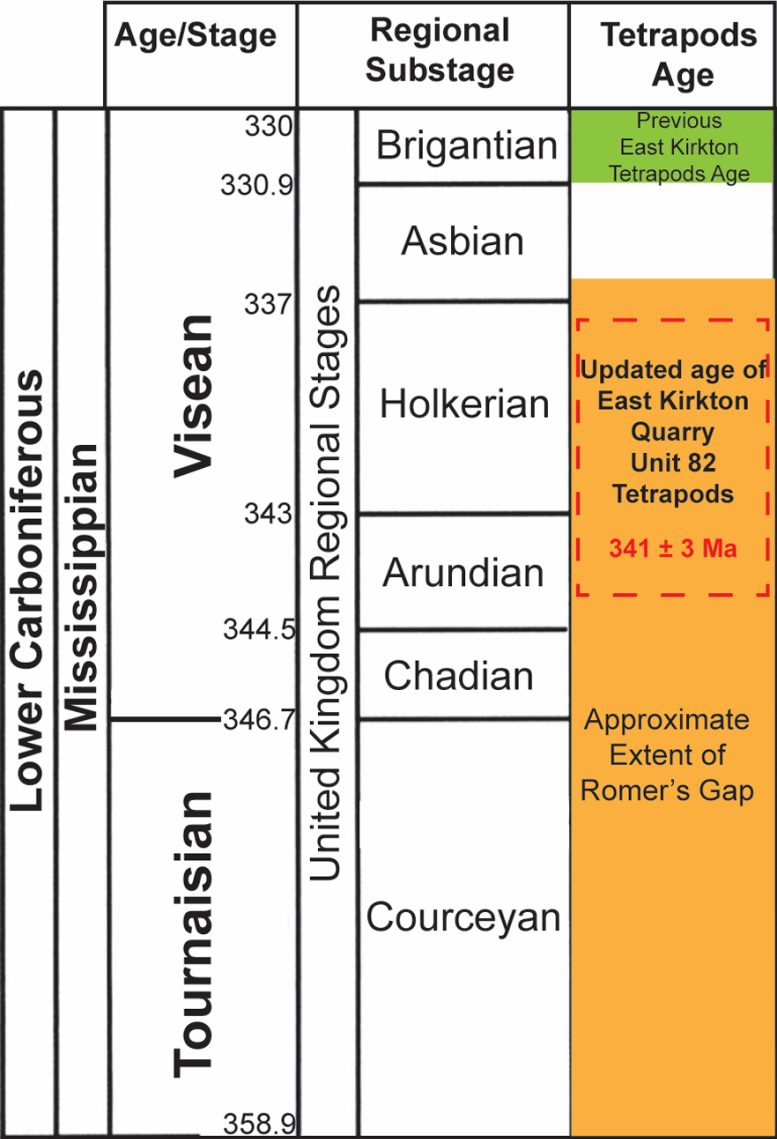
Fossils from Scotland’s East Kirkton Quarry are now dated to 346 million years ago, offering rare insight into vertebrate evolution during Romer’s Gap.
In 1984, an amateur paleontologist in Scotland discovered a remarkable fossil: a nearly complete skeleton resembling a small lizard or salamander, just 20 centimeters long.
The fossil, later named Westlothiana lizziae, turned out to be one of the earliest known four-legged animals to have made the evolutionary transition from water to land. Along with other early stem tetrapods, it represents a common ancestor of all modern amphibians, reptiles, birds, and mammals, including humans.
Revising the timeline of land animals
Despite its importance, scientists had never been able to determine the precise age of the fossil. However, new research from The University of Texas at Austin has revealed that Westlothiana lizziae, along with similar salamander-like creatures from the same site in Scotland, may be 14 million years older than previously believed.
This updated age, dating back to 346 million years ago, makes the discovery even more significant, as it places the fossils within Romer’s Gap, a poorly understood interval in the fossil record.
Radiometric dating takes a risky turn
The research, published recently in the journal PLOS One, was led by Hector Garza, who just graduated with his doctoral degree from the Department of Earth and Planetary Sciences at the UT Jackson School of Geosciences. Garza took a risk when he embarked on his mission to date the ancient fossils using a geochemical technique called radiometric dating.

That’s because while geoscientists can use zircon crystals to determine how long ago a rock was formed, not all rock types are amenable to this type of analysis. And the site in Scotland where the fossils were discovered was near ancient volcanoes whose lava flows had long hardened into basalt rock, where zircons do not typically form. Fellow scientists warned Garza that chemically dating the rocks might be fruitless.
“I think that was one of the reasons why no one tried to go into them before,” Garza said. “Because of all the time and effort that it takes to obtain the zircons, and then taking the risk of not finding any.”
Volcanic luck leads to breakthrough
But he got lucky. As mud cascaded down from the volcanoes, the flowing lava and debris eroded sediment that contained zircons, which got swept into a lake where limestone was forming, entombing these early tetrapod creatures.
Garza X-rayed 11 of the rock samples at the Jackson School and was able to extract zircons from the rock surrounding six of the fossils. He then conducted uranium-lead laser dating on the zircons at the University of Houston to determine their oldest possible age.
Filling in Romer’s Gap
Before Garza’s gamble, scientists had figured the fossils were as old as similar fossils from around the world — about 331 million years old.
The more accurate, older maximum age of 346 million years is significant because it places the specimens in Romer’s Gap. This is a time period from 360 to 345 million years ago where, for reasons scientists are not exactly sure of, very few fossils have been discovered. It is during this crucial point in history that water-dwelling fish took an evolutionary leap, growing lungs and four legs to become land animals. This is one of the most pivotal milestones in the history of animal evolution.
“I can’t overstate the importance of the iconic East Kirkland tetrapods,” said Julia Clarke, professor at the Jackson School and co-author of this paper. “Better constraining the age of these fossils is key to understanding the timing of the emergence of vertebrates onto land. Timing in turn is key to assessing why this transition occurs when it does and what factors in the environment may be linked to this event.”
The site in Scotland where the fossils were found is the East Kirkton Quarry, a veritable treasure trove of early tetrapod records. Seven stem tetrapod fossils, including the Westlothiana lizziae, have been found there. Hundreds of millions of years ago, when these early four-legged creatures roamed, this site was a tropical forest with nearby active volcanoes, a toxic lake, and a diverse plant and animal community.
Reference: “New U-Pb constraints and geochemistry of the East Kirkton Quarry, Scotland: Implications for early tetrapod evolution in the Carboniferous” by Hector K. Garza, Elizabeth J. Catlos, Thomas J. Lapen, Julia A. Clarke and Michael E. Brookfield, 16 April 2025, PLOS ONE.
DOI: 10.1371/journal.pone.0321714
Never miss a breakthrough: Join the SciTechDaily newsletter.
Follow us on Google and Google News.
2 Comments
To say re-writing the land dwelling story is quite a stretch but great click bait. Dating this particular fossil is an accomplishment but terrestrial vertebrates have long been known to exist around 345ma. Nevertheless a good story, thanks Scitechdaily.
It is a nice breakthrough. But what caught my attention was the sentence that water dwelling fish took an evolutionary leap growing legs and lungs to become land animals . In the Hindu Scriptures 10 Avatars ( = evolutionary developments ) are mentioned starting with the fish , called “Matsya” in Sanskrit . The next one is “Koorma “ : tortoises ( amphibians), the next is Varaha ( boars and pigs – 4 legged mammals ) , the next is Narasimha ( literally meaning man-lion , half human and half animal) , the next is Vaamana ( full man but short , like a dwarf) . Parashurama ( with an axe as his weapon ) , then Raama ( the Avatar of god in the mundane world showing how to live as a do-gooder to humanity emphasising the importance of one man one wife) , then Balaraama — representing well developed and cultured agriculture with a sickle as his symbol , Krishna —a total common man relationship and human behaviour , as we know today . The 10th Avatar called Kalki is yet to happen . Don’t the evolving evidences such as the one reported, resonate totally with the Hindu Scriptures ?