
Close Menu
    Facebook X (Twitter) Instagram
    SciTechDaily
    • Biology
    • Chemistry
    • Earth
    • Health
    • Physics
    • Science
    • Space
    • Technology
    Facebook X (Twitter) Pinterest YouTube RSS
    SciTechDaily
    Home»Space»A Cosmic Hourglass – Bipolar Planetary Nebula Captured by Hubble
    Space

    A Cosmic Hourglass – Bipolar Planetary Nebula Captured by Hubble

    By ESA/HubbleFebruary 7, 2021No Comments1 Min Read
    Facebook Twitter Pinterest Telegram LinkedIn WhatsApp Email Reddit
    Share
    Facebook Twitter LinkedIn Pinterest Telegram Email Reddit
    M1-63
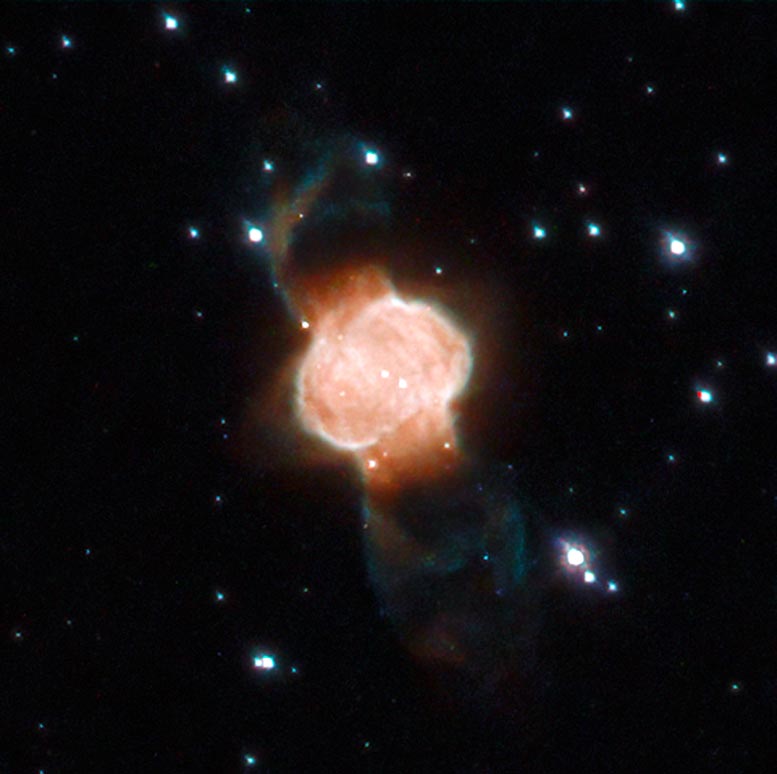
    Portrait of M1-63, a beautiful example of a bipolar planetary nebula located in the constellation of Scutum, captured by the Hubble Space Telescope. Credit: ESA/Hubble & NASA, L. Stanghellini

    This week’s NASA/ESA Hubble Space Telescope Picture of the Week features an impressive portrait of M1-63, a beautifully captured example of a bipolar planetary nebula located in the constellation of Scutum (the Shield). A nebula like this one is formed when the star at its center sheds huge quantities of material from its outer layers, leaving behind a spectacular cloud of gas and dust. 

    It is believed that a binary system of stars at the center of the bipolar nebula is capable of creating hourglass or butterfly-like shapes like the one in this image. This is because the material from the shedding star is funneled towards its poles, with the help of the companion, creating the distinctive double-lobed structure seen in nebulae such as M1-63.

    Never miss a breakthrough: Join the SciTechDaily newsletter.
    Follow us on Google and Google News.

    Astronomy European Space Agency Hubble Space Telescope NASA
    Share. Facebook Twitter Pinterest LinkedIn Email Reddit

    Related Articles

    Hubble’s Newest Discovery Isn’t a Star, It’s a Window Into the Dark Universe

    This Nearby Galaxy Shows How Frozen Clouds Ignite Into Stars

    This Chaotic Spiral Galaxy Is Still Recovering From a Cosmic Collision

    This Strange Spiral Galaxy Is Hiding a Massive Black Hole

    Hubble Zooms In on a Galaxy That Maps the Universe’s Expansion

    Hubble Captures a Dazzling Spiral Galaxy Alive With Birth and Destruction

    Hubble Spots a Glowing “Ring of Fire” in a Distant Spiral Galaxy

    Dust, Light & Ancient Collisions: The Sombrero Galaxy Like You’ve Never Seen It

    Star Formation in Motion: Hubble Reveals Spiraling Stars and Sculpted Nebulae

    Leave A Reply Cancel Reply

    • Facebook
    • Twitter
    • Pinterest
    • YouTube

    Don't Miss a Discovery

    Subscribe for the Latest in Science & Tech!

    Trending News

    Giant Plasma Waves May Be Stripping Away Mars’ Atmosphere

    Scientists Thought SuperAgers Had Lucky Genes. They Were Wrong

    Astronomers Find Ancient Black Holes Shining With the Power of a Trillion Suns

    Researchers Solve Mystery Behind Contradictory Weight-Loss Drug Paradox

    Long-Lost Megalodon Fossils Found Hiding on a Museum Shelf

    Experimental Eye Drops Restore Sight in Blind Mice

    Scientists Discover the Brain May Enter a New Biological Phase Between 50 and 75

    New Research Reveals Autistic Brains Process Faces Differently

    Follow SciTechDaily
    • Facebook
    • Twitter
    • YouTube
    • Pinterest
    • Newsletter
    • RSS
    SciTech News
    • Biology News
    • Chemistry News
    • Earth News
    • Health News
    • Physics News
    • Science News
    • Space News
    • Technology News
    Recent Posts
    • Spain’s Largest Wildfire on Record Burned an Area the Size of New York City
    • Meet the 30-Million-Year-Old Dog That Climbed Trees Instead of Chasing Sticks
    • Two Mysterious ‘Ghost’ Ancestors Are Hiding in Our DNA
    • Gut Bacteria May Leave a Lasting “Protective Memory” in the Intestine
    • New Antivenom Strategy Is 10 Times More Potent Than a Current Treatment
    Copyright © 1998 - 2026 SciTechDaily. All Rights Reserved.
    • Science News
    • About
    • Contact
    • Editorial Board
    • Privacy Policy
    • Terms of Use

    Type above and press Enter to search. Press Esc to cancel.