
Tracking Atoms in Real Time
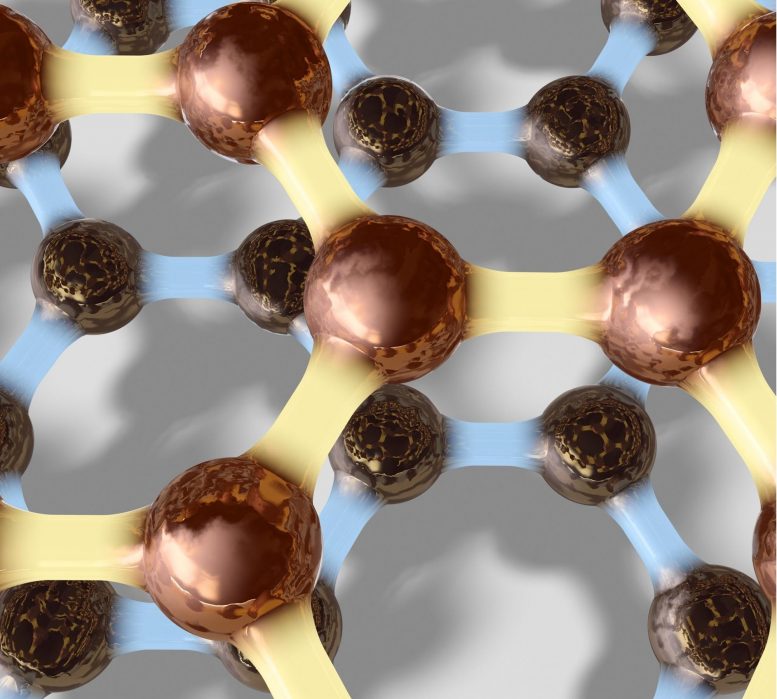
Researchers have used a technique similar to MRI to follow the movement of individual atoms in real time as they cluster together to form two-dimensional materials, which are a single atomic layer thick.
The results, reported in the journal Physical Review Letters, could be used to design new types of materials and quantum technology devices. The researchers, from the University of Cambridge, captured the movement of the atoms at speeds that are eight orders of magnitude too fast for conventional microscopes.
Two-dimensional materials, such as graphene, have the potential to improve the performance of existing and new devices, due to their unique properties, such as outstanding conductivity and strength. Two-dimensional materials have a wide range of potential applications, from bio-sensing and drug delivery to quantum information and quantum computing. However, in order for two-dimensional materials to reach their full potential, their properties need to be fine-tuned through a controlled growth process.
“This technique isn’t a new one, but it’s never been used in this way, to measure the growth of a two-dimensional material.” Nadav Avidor
These materials normally form as atoms ‘jump’ onto a supporting substrate until they attach to a growing cluster. Being able to monitor this process gives scientists much greater control over the finished materials. However, for most materials, this process happens so quickly and at such high temperatures that it can only be followed using snapshots of a frozen surface, capturing a single moment rather than the whole process.
A Breakthrough with Helium Spin-Echo
Now, researchers from the University of Cambridge have followed the entire process in real time, at comparable temperatures to those used in industry.
The researchers used a technique known as ‘helium spin-echo’, which has been developed in Cambridge over the last 15 years. The technique has similarities to magnetic resonance imaging (MRI), but uses a beam of helium atoms to ‘illuminate’ a target surface, similar to light sources in everyday microscopes.
“Using this technique, we can do MRI-like experiments on the fly as the atoms scatter,” said Dr Nadav Avidor from Cambridge’s Cavendish Laboratory, the paper’s senior author. “If you think of a light source that shines photons on a sample, as those photons come back to your eye, you can see what happens in the sample.”
Instead of photons, however, Avidor and his colleagues use helium atoms to observe what happens on the surface of the sample. The interaction of the helium with atoms at the surface allows the motion of the surface species to be inferred.
Using a test sample of oxygen atoms moving on the surface of ruthenium metal, the researchers recorded the spontaneous breaking and formation of oxygen clusters, just a few atoms in size, and the atoms that quickly diffuse between the clusters.
New Frontiers in Atomic Spectroscopy
“This technique isn’t a new one, but it’s never been used in this way, to measure the growth of a two-dimensional material,” said Avidor. “If you look back on the history of spectroscopy, light-based probes revolutionized how we see the world, and the next step – electron-based probes – allowed us to see even more.
“We’re now going another step beyond that, to atom-based probes, allowing us to observe more atomic scale phenomena. Besides its usefulness in the design and manufacture of future materials and devices, I’m excited to find out what else we’ll be able to see.”
Reference: “Ultrafast Diffusion at the Onset of Growth: O/Ru(0001)” by Jack Kelsall, Peter S. M. Townsend, John Ellis, Andrew P. Jardine and Nadav Avidor, 12 April 2021, Physical Review Letters.
DOI: 10.1103/PhysRevLett.126.155901
The research was conducted in the Cambridge Atom Scattering Centre and supported by the Engineering and Physical Sciences Research Council (EPSRC).
Never miss a breakthrough: Join the SciTechDaily newsletter.
Follow us on Google and Google News.