
Vaccines that balance gut microbial communities may one day be used to improve gastrointestinal health.
Bacteria’s role in gut health has received a lot of attention in recent years. But new research led by scientists at University of Utah Health shows that fungi — another microorganism that lives within us — may be equally important in health and disease.
Fungi thrive in the healthy gut, but they can also cause intestinal damage that may contribute to inflammatory bowel disease (IBD), according to the study published in Nature on July 14, 2021. Experiments with mice show that normally, the immune system keeps fungi in check, targeting the microbe when it switches into a state that can cause harm. When the system is off-balance, disease is more likely to occur.
“Fungi have been wholly understudied in part because they are vastly outnumbered by bacteria,” says June Round, Ph.D., professor of pathology at U of U Health and the study’s senior author. New tools and technologies are starting to make investigations like this one possible, she adds. “This work adds an important piece to the bigger picture.”
These insights open new avenues for developing therapeutics to improve gut health. The study shows proof of concept that, one day, vaccines could be used to curb gastrointestinal disease by enhancing natural immune responses that encourage a healthy balance of fungi and other gut microbiota.
A Quest for Balance
Round became interested in this line of research after noting that a common medical test for diagnosing Crohn’s disease, a type of IBD, works by detecting antibodies against fungi. And yet, how antibodies affect fungi’s influence on disease had yet to be explored.
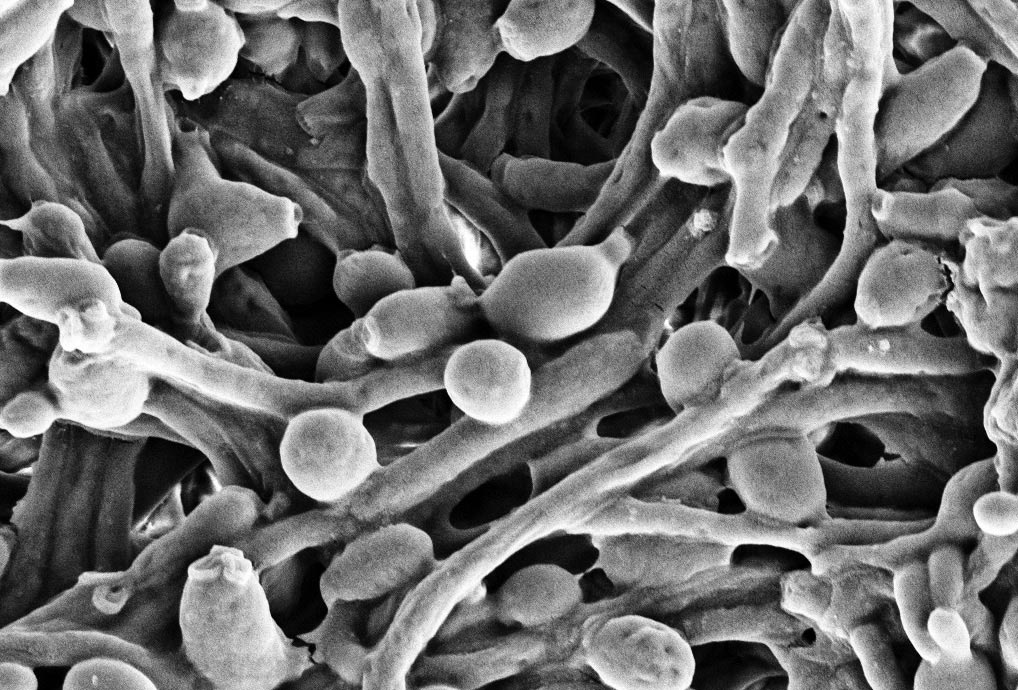
To dig deeper, her team searched for the trigger of the immune response. Working with patient samples and carrying out tests with mice, they determined that the yeast Candida albicans — one of the main species of fungi that reside in the human gut — elicited the strongest immune response. Further investigation showed that antibodies zeroed in on elongated fungal cell types called hyphae, specifically binding to proteins called adhesins that help microbes stick to surfaces and become invasive.
With this target in hand, the researchers could more definitively probe the fungi’s role in gut health. They found that mice populated with the yeast in its normal, rounded state remained healthy. In contrast, mice populated with Candida in its invasive form caused intestinal damage that resembled IBD. The results show that normal antibody responses in the gut inhibit disease by recognizing the harmful, hyphal form of fungi.
IBD isn’t the only health condition associated with fungi. Another is vaginal yeast infections. The researchers determined that a vaccine being investigated as a remedy for yeast infection triggered an immune reaction against adhesin proteins that is similar to the reaction in Crohn’s patients. When inoculated with the vaccine, mice normally prone to an IBD-like condition were less likely to develop disease.
The researchers are now investigating whether vaccines could help mitigate IBD in people — and whether the same approach can be applied more broadly to shape other microbial communities in the gut. “We aim to exploit interactions with commensal microbes and the host immune system to harness microbial products for therapies,” Round says.
Healthy Competition
In addition to implications for disease, the findings also suggest fungi may be important in the healthy gut. Typically, the immune system’s job is to clear infections by getting rid of invasive organisms. In this case, fungi benefit from their interaction with antibodies. The immune reaction prods fungi from their invasive state into their rounded, budding state, which improves their survival in the gut.
“The immune system is constraining Candida to its least pathogenic form,” says Kyla Ost, Ph.D., a postdoctoral researcher in Round’s lab and the study’s lead author. “This is showing us that the communication between host and microbe can be friendly, as opposed to antagonistic, in order to benefit both.”
Reference: “p53 convergently activates Dux/DUX4 in embryonic stem cells and in facioscapulohumeral muscular dystrophy cell models” by Edward J. Grow, Bradley D. Weaver, Christina M. Smith, Jingtao Guo, Paula Stein, Sean C. Shadle, Peter G. Hendrickson, Nicholas E. Johnson, Russell J. Butterfield, Roberta Menafra, Susan L. Kloet, Silvère M. van der Maarel, Carmen J. Williams and Bradley R. Cairns 15 July 2021, Nature Genetics.
DOI: 10.1038/s41588-021-00893-0
Collaborating institutions include University of Michigan, Yale University, University of California, Los Angeles, John’s Hopkins University, Brigham Young University and University of California, San Francisco.
The research published as “Adaptive immunity promotes a mutually beneficial interaction between commensal eukaryotes” and was supported by the National Institutes of Health, Helen Hay Whitney Foundation, W.M Keck Foundation and the Burrough’s Wellcome Foundation.
Never miss a breakthrough: Join the SciTechDaily newsletter.
Follow us on Google and Google News.
1 Comment
I think the reference here might be incorrect. Should it point to this article instead? Adaptive immunity induces mutualism between commensal eukaryotes https://doi.org/10.1038/s41586-021-03722-w