
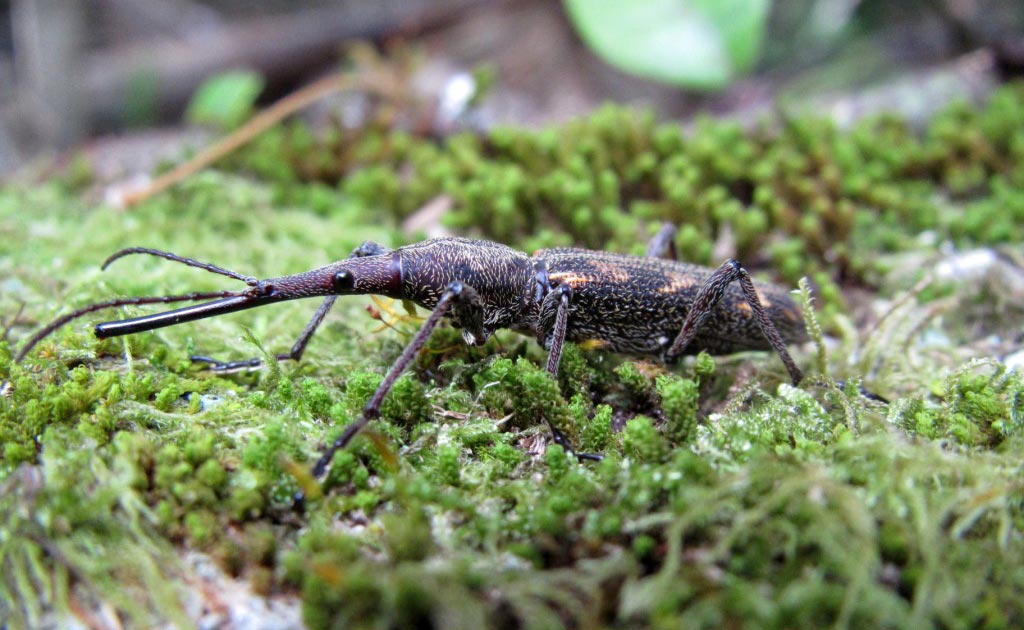
New research reveals large giraffe weevils use less energy per gram to maintain their oversized snouts, thanks to efficient structural design.
Nepalese craftsman, Chandra Bahadur Dangi, holds the record as the world’s shortest adult, at 54.6 cm (1 ft 9 ½ inches). The tallest human is Sultan Kösen, a Turkish farmer, almost five times taller at 2.52 meters (8 feet 3 ¼ inches). In nature, size differences among males of a single species are not uncommon, but in a new paper, a team from the Smithsonian Tropical Research Institute (STRI), The University of Auckland and the University of Arizona, discovered a case of male beetles that are not only extremely different in size, but also provide an answer to a long-standing puzzle in evolutionary biology: how can larger animals afford the energetic cost of making and maintaining disproportionately large weapons?
Almost one in every four species in the world is a beetle: about 350,000 beetle species have been identified so far. Male New Zealand giraffe weevils, Lasiorhynchus barbicornis, were known to be the longest beetles in the world, but when researchers measured the differences in the weight of the smallest and largest beetles, they were in for a surprise:
“When I first saw the weights of the smallest and largest males, I thought someone had made a mistake,” said Ummat Somjee, Earl S. Tupper fellow at STRI. “But we weighed them again and got the same results. The largest males are 30 times larger than the smallest ones. This is the biggest adult size-range we know of any beetle species in the world.”
Two Mating Strategies, One Evolutionary Outcome
And like many other animals with fighting weapons (like elephants with tusks and antelopes with horns), the big males have snouts that are disproportionately larger than the snouts of tiny males. A big male lords over a female as she lays an egg, using his extra-long snout as a lance to fend off rivals as he fertilizes her. But as massive males vie for position above, one of the smallest males may be sneaking in underfoot to fertilize the female. Because both of these mating strategies result in offspring, both large and small males persist.
In tropical forests, every bit of energy expenditure may mean the difference between life and death. Somjee is fascinated by the economics of energy—and looks to insects for inspiration. The male giraffe weevils, literally embody energetic trade-offs. The snouts of big males are disproportionately larger than the snouts of their smaller counterparts: so at first glance it seems that big males invest relatively more materials and energy in their weapons than smaller males. But is this really the case?
Somjee teamed up with Chrissie Painting, now senior lecturer at the University of Waikato and local expert on these beetles in New Zealand, to take a closer look at the economics of beetle weaponry. To measure how much energy large and small males use they placed them each in little chambers and measured their oxygen consumption. They found that larger males pay lower, not higher, costs—in terms of energy—per gram of tissue in their bodies compared to smaller ones. How do these large males carry relatively larger weapons, and still pay lower relative metabolic costs?

The Physics of Snout Architecture
“The big males are like very fuel–efficient cars—the Prius of the beetle world (58 miles per gallon)—and the small ones are more like Rolls Royce Phantom Coupes (14 miles per gallon). How can large males be so energy efficient and still bear the additional energy costs of a larger weapon?” Somjee said.
The secret, they discovered, lies in the architecture of the weapon itself. Small snouts are made up of a high proportion of living tissue, which is relatively more expensive to maintain—like our muscles—but big snouts are made of a higher proportion of cuticle—like the keratin in our hair and fingernails, which is much cheaper to maintain. So the big males are actually using less energy to maintain their disproportionately big weapons than the small males are using to maintain their small weapons.
Rewriting Evolutionary Theory
The finding that large individuals often carry disproportionately large weapons has been a puzzle in biology for almost a century. These bizarre weevils demonstrate that large animals can cut the costs of large structures. Now Ummat is back in Panama looking for other insect species to find out if other insects with extreme structures also find creative ways to minimize their maintenance costs.
“It is precisely because of the Giraffe weevils unusually large size variation that we were able to answer this long-standing evolutionary question,” Somjee said. “Giraffe weevils don’t somehow find extra energy to sustain their giant heads, they change the architecture of their heads to make them more efficient and thus save energy.”
Reference: “Exaggerated sexually selected weapons maintained with disproportionately low metabolic costs in a single species with extreme size variation” by Ummat Somjee, Erin C. Powell, Anthony J. Hickey, Jon F. Harrison and Christina J. Painting, 22 July 2021, Functional Ecology.
DOI: 10.1111/1365-2435.13888
Funding: Journal of Functional Ecology, Royal Society of New Zealand, Rutherford Foundation.
Never miss a breakthrough: Join the SciTechDaily newsletter.
Follow us on Google and Google News.