
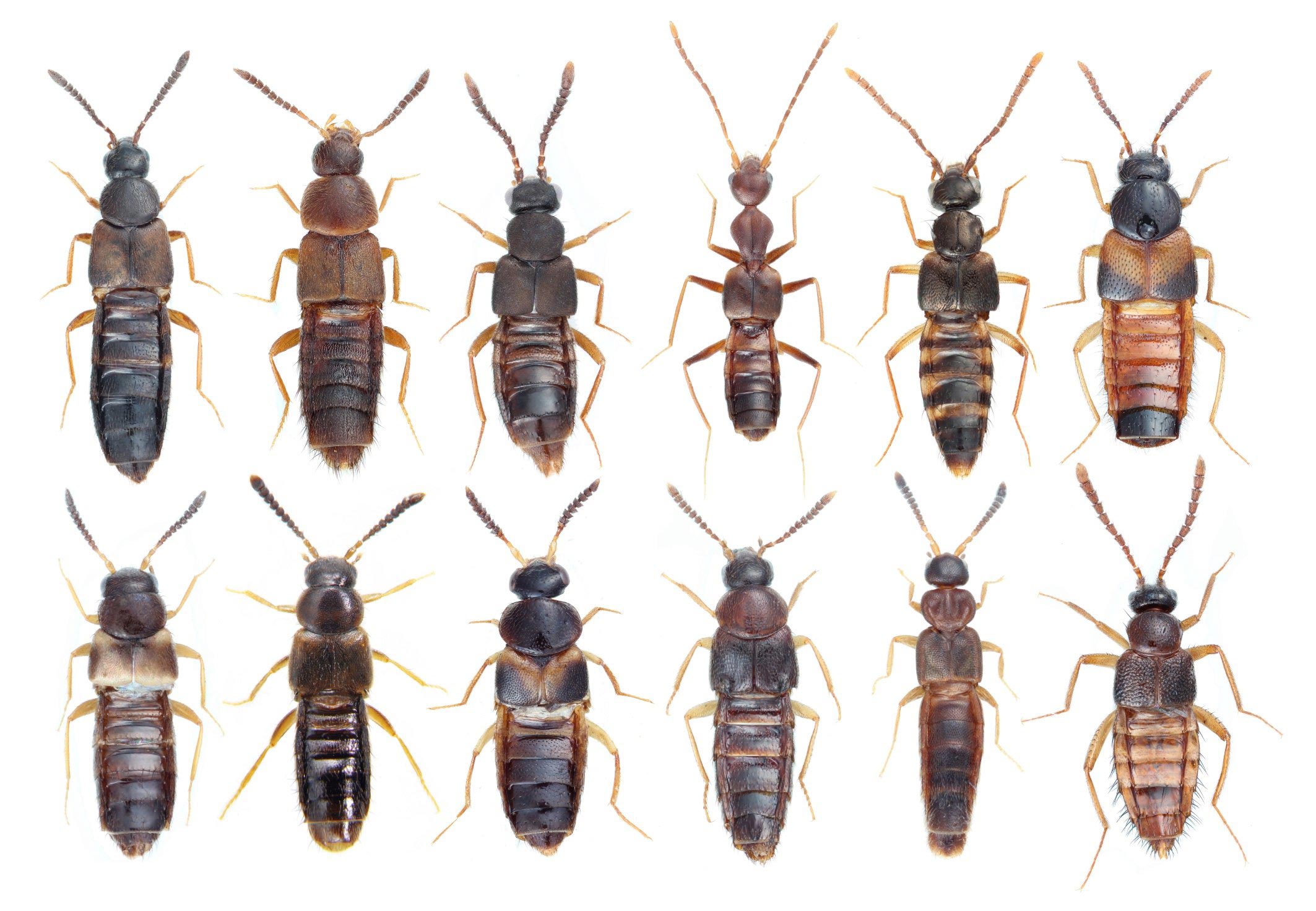
Beetles are an evolutionary success, with rove beetles’ diversification largely due to their unique tergal gland that synthesizes defensive chemicals.
This adaptation, evolving over millions of years, has allowed them to occupy diverse ecological niches, underlining the impact of cellular changes on species evolution.
Evolutionary Mysteries and Beetle Diversity
As life on Earth evolved, some groups of organisms became incredibly diverse, while others remained relatively limited—or even disappeared entirely. Understanding why evolution favored certain groups over others has been a key question for scientists studying the history of life.
Beetles are a prime example of evolutionary success. With about 400,000 known species—roughly a quarter of all described life forms—and countless more likely undiscovered, their diversity is unmatched. Their beauty and variety captivated a young Charles Darwin and intrigued Alfred Russell Wallace, both co-discoverers of natural selection.
But what makes beetles so prolific? One popular explanation is their evolution of elytra—hardened, shield-like structures that protect their delicate flight wings. This adaptation allows beetles to thrive in environments inaccessible to many other insects. Another theory suggests that beetles co-evolved with flowering plants, diversifying alongside them as they adapted to feed on these plants.
Joe Parker’s decades-long fascination with bugs and beetles led to his recent appointment as an assistant professor at Caltech. As an entomologist, he studies particular species of beetle that can help us answer some of the fundamental questions of evolution.
The Unique Traits of Rove Beetles
Yet, both these ideas fall short in explaining the biggest beetle group of all—the rove beetles (Staphylinidae) a sprawling radiation of over 66,000 species—not just the largest beetle family, but the largest family in the entire animal kingdom. Rove beetles are an enigma: they seem to have both forsaken strongly protective elytra and are mostly predatory instead of feeding on plants. Yet, they exploded across Earth’s biosphere, invading every terrestrial niche imaginable over the past 200 million years.
What drove this remarkable success is the focus of a new study by researchers in the laboratory of Joe Parker, assistant professor of biology and biological engineering, Chen Scholar, and director of Caltech’s Center for Evolutionary Science. Led by former postdoctoral scholar Sheila Kitchen, the study, appearing online on June 17 in the journal Cell, pinpoints evolution of two cell types that form a chemical defense gland within these beetles’ bodies as a catalyst behind their global radiation.
The Power of the Tergal Gland
In 2021, researchers in the Parker lab studied a gland in rove beetles called the “tergal gland,” a structure at the tip of their flexible abdomens. The team showed how the tergal gland is made up of two unique cell types: one that makes toxic compounds called benzoquinones, and another that makes a liquid mixture (or solvent) into which the benzoquinones dissolve, creating a potent cocktail that the beetle discharges at predators.
In the new work, Kitchen, Parker and their collaborators assembled whole genomes from a diverse set of species spanning the rove beetle evolutionary tree, and analyzed the genes expressed with the gland’s two cell types. Doing so enabled them to uncover an ancient genetic toolkit that evolved over 100 million years ago, equipping these insects with their powerful chemical defenses.
“In piecing together the genomes, we were amazed by how similar the genetic architecture of the gland was across this massive group of beetles,” says Kitchen, who is now an assistant professor at Texas A&M University. “It was when we started to look at specific gene families, we found hundreds of ancient genes that had found new functions within the gland, and a small but essential set of evolutionarily new genes. These new genes were key to rove beetles evolving their amazing chemistry. Telling this story was made possible by our fantastic interdisciplinary team of evolutionary biologists, chemical ecologists, protein biochemists, and microscopists.”
Evolutionary Innovations and Species Radiation
Retracing the molecular steps in gland evolution, the team identified a major evolutionary innovation in the way the beetles evolved to safely manufacture the poisonous benzoquinones. They found that rove beetles hit upon a mechanism of toxin secretion that is strikingly similar to how plants control the release of chemical compounds that deter herbivores. They bind the toxin to a sugar molecule, rendering it inactive, and then cleave the toxin from the sugar only when the chemical is secreted safely outside of the beetle’s own cells.
“It’s pretty remarkable that chemically-defended beetles stitched together pretty much the same cellular mechanism as plants for not poisoning themselves with their own nasty chemicals,” says Parker.
This mechanism evolved in the Early Cretaceous; after they evolved it, the beetles started to radiate into tens or possibly hundreds of thousands of species. “It’s the archetypal key innovation. Once they hit upon this solution, it really took them places, evolutionarily speaking,” Parker says. Related rove beetle lineages that lack the gland have not had the same evolutionary diversification, numbering only tens to hundreds of species.
Chemical Evolution and Ecological Adaptation
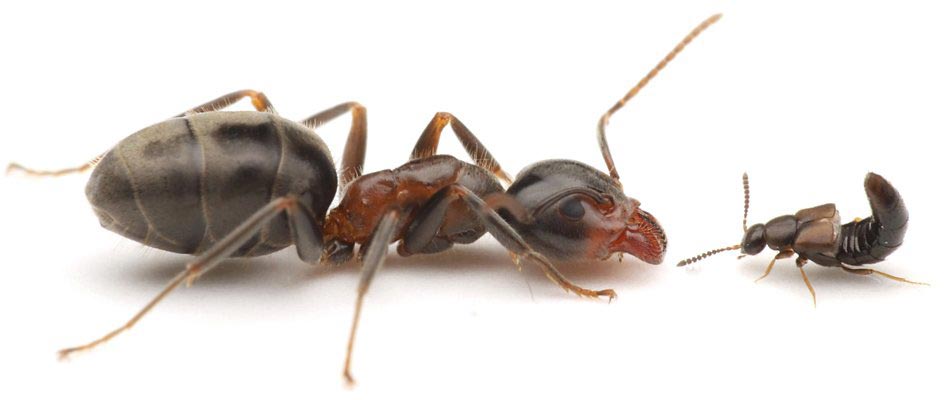
By exploring the chemistries of different species, the researchers found that, remarkably, while the two cell types comprising the gland have stayed largely the same, the chemicals they produce can evolve dramatically, adapting rove beetles to different ecological niches. The gland can be thought of as a kind of chemical laboratory in which a beetle species can synthesize the compounds needed to live in new environments. For example, one group of rove beetles evolved to prey on mites and repurposed the gland to secrete mite sex pheromones; another lives inside ant colonies, and produces chemicals that pacify the otherwise highly aggressive worker ants, enabling the beetle to live symbiotically with the ants, and even prey upon them.
“The rove beetle tergal gland is this incredible, reprogrammable device for making new chemistries and evolving new interactions,” says Parker. “It enabled these beetles to achieve extreme forms of ecological specialization. Without the gland, there would have been no getting into the weird and wonderful niches that these beetles have found themselves.”
The Irony of Evolutionary Adaptations
Ironically, the team found that in one beetle group, the gland was surplus to requirements. According to Kitchen, “Apparently, once you have lived inside an army ant colony of millions of aggressive ants for long enough, you no longer need the gland. We found that beetles that have managed to trick ants into accepting them into their societies had lost their glands during evolution. Their gland toolkit genes had accumulated lots of inactivating mutations. An ant colony is a terrifying place for most species, but for these beetles it’s a danger-free fortress — they’ve conned the ants into protecting them instead.”
The new study highlights how evolutionary changes at the cellular level can have major, long-term consequences for ecological and evolutionary diversification. In this case, contributing to nature’s inordinate fondness for beetles.
Reference: “The genomic and cellular basis of biosynthetic innovation in rove beetles” by Sheila A. Kitchen, Thomas H. Naragon, Adrian Brückner, Mark S. Ladinsky, Sofia A. Quinodoz, Jean M. Badroos, Joani W. Viliunas, Yuriko Kishi, Julian M. Wagner, David R. Miller, Mina Yousefelahiyeh, Igor A. Antoshechkin, K. Taro Eldredge, Stacy Pirro, Mitchell Guttman, Steven R. Davis, Matthew L. Aardema and Joseph Parker, 17 June 2024, Cell.
DOI: 10.1016/j.cell.2024.05.012
In addition to Kitchen and Parker, Caltech coauthors are graduate students Thomas Naragon, Jean Badroos, Joani Viliunas, Yuriko Kishi, and Julian Wagner (PhD ’24); former postdoctoral scholar Adrian Brückner; electron microscopy scientist Mark Ladinsky; former graduate students Sofia Quinodoz (PhD ’20) and David Miller (PhD ’22); former lab manager Mina Yousefelahiyeh; Director of the Caltech Genomics Facility Igor Antoshechkin; and Professor of Biology Mitch Guttman. Additional co-authors are K. Taro Eldredge of the University of Michigan, Stacy Pirro of Iridian Genomes, Steven Davis of the American Museum of Natural History, and Matthew Aardema of Montclair State University.
Funding was provided by Caltech’s Center for Evolutionary Science, the Life Sciences Research Foundation, the National Science Foundation, the National Institutes of Health, the Shurl and Kay Curci Foundation, Rita Allen Foundation Scholarship, Pew Biomedical Scholarship, Alfred P. Sloan Fellowship, Iridian Genomes, Caltech’s Millard and Muriel Jacobs Genetics and Genomics Laboratory, and the American Museum of Natural History. Parker is an affiliated faculty member with the Tianqiao and Chrissy Chen Institute for Neuroscience at Caltech.
Never miss a breakthrough: Join the SciTechDaily newsletter.
Follow us on Google and Google News.