
Close Menu
    Facebook X (Twitter) Instagram
    SciTechDaily
    • Biology
    • Chemistry
    • Earth
    • Health
    • Physics
    • Science
    • Space
    • Technology
    Facebook X (Twitter) Pinterest YouTube RSS
    SciTechDaily
    Home»Health»Johns Hopkins: Anti-Parasitic Drug Slows Pancreatic Cancer in Mice
    Health

    Johns Hopkins: Anti-Parasitic Drug Slows Pancreatic Cancer in Mice

    By Johns Hopkins MedicineSeptember 14, 2021No Comments3 Mins Read
    Facebook Twitter Pinterest Telegram LinkedIn WhatsApp Email Reddit
    Share
    Facebook Twitter LinkedIn Pinterest Telegram Email Reddit
    Mouse Pancreas With Cancer
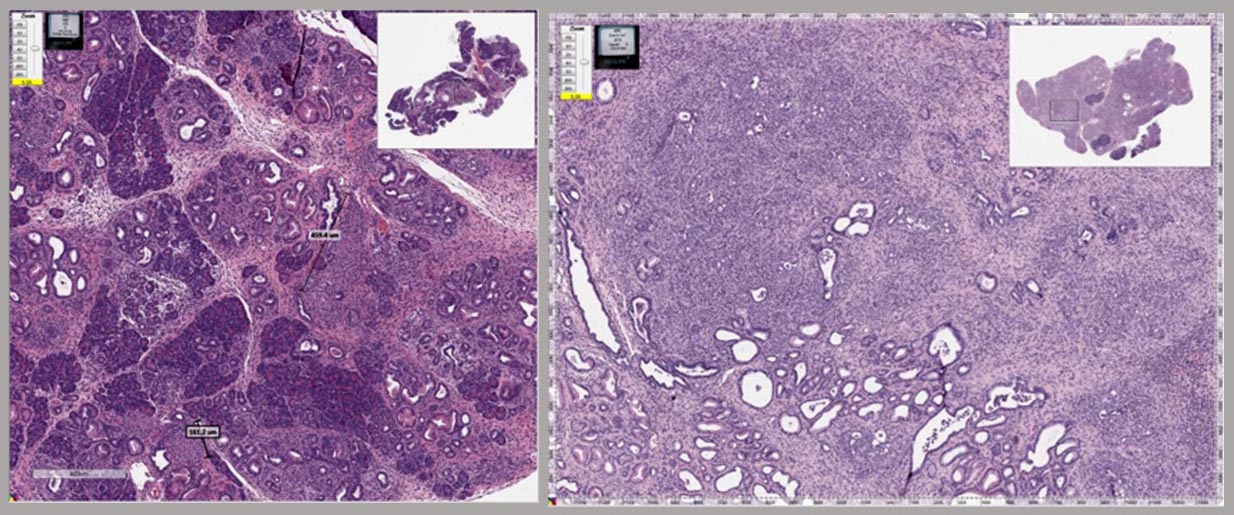
    The image on the left (Control) is a magnified view of an example mouse pancreas that has developed pancreatic cancer due to mutations in cancer susceptibility genes and an inflammatory agent. On the right (MBZ) is the same mouse strain treated with the same inflammatory agent, but mebendazole was added to the same mouse feed, and it has little or no microscopic evidence of cancer or pathology. Credit: Tara Williamson

    The anti-parasitic drug mebendazole shows promise in stopping pancreatic cancer growth, potentially leading to new treatments.

    As the third-most lethal cancer in the United States, with only a 1% five-year survival rate for people with its most aggressive form, pancreatic cancer has long been a target of researchers who search for ways to slow or stop its growth and spread. Now, a team of Johns Hopkins Medicine researchers have found that an anti-parasitic drug prevents pancreatic cancer’s initiation, progression, and metastasis in genetically engineered mice.

    In a study published in the journal Oncotarget, Gregory Riggins, M.D., Ph.D., professor of neurosurgery and oncology at the Johns Hopkins University School of Medicine, and his team used two different mouse models to determine that the anti-parasitic drug mebendazole could slow or stop the growth and spread of both early and late-stage pancreatic cancer.

    “We think that mebendazole could have a role in all stages,” Riggins says. “It was particularly effective for pancreatic cancer that was detected early.”

    Drug Action and Early Detection Impact

    Riggins and his team administered mebendazole to mice that were genetically engineered to develop pancreatic cancer. The team measured the inflammation and the change in tissue, as well as the stage, grade and metastatic status in each tumor.

    Originally used to fight roundworm, hookworm and other parasitic infections by cutting off the parasites’ supply of nutrition, mebendazole inhibits the formation of tubulin. Tubulin, Riggins explains, is both a micro-skeleton of the inner cell and a highway for transport. The drug gets into the parasite’s gut and collapses the tubulin, starving the parasite to death. The study shows that mebendazole may act similarly in pancreatic cancer by collapsing cancer cells’ structure, along with other mechanisms such as reducing inflammation.

    Riggins says he hopes to continue his team’s research through human clinical trials.

    “We are advocating for use of mebendazole as a therapy for those diagnosed before metastasis to see if we can slow or prevent pancreatic cancer,” Riggins says. “For those with more advanced cancers, it could be an alternative to certain surgeries. Mebendazole may have utility as a therapy after initial treatment to prevent tumor recurrence in the 15% to 20% of pancreatic adenocarcinoma patients who undergo surgery. It may also increase the durability of response to standard chemotherapy in the remaining 80% to 85% of patients with advanced disease.”

    Reference: “Mebendazole disrupts stromal desmoplasia and tumorigenesis in two models of pancreatic cancer” by Tara Williamson, Michelle Carvalho de Abreu, Dimitri G. Trembath, Cory Brayton, Byunghak Kang, Thais Biude Mendes, Paulo Pimentel de Assumpção, Janete M. Cerutti and Gregory J. Riggins, 6 July 2021, Oncotarget.
    DOI: 10.18632/oncotarget.28014

    The Virginia and D.K. Ludwig Fund for Cancer Research provided funding for the research.  

    Other scientists who conducted the research include Tara Williamson, Michelle Carvalho de Abreu, Dimitri G. Trembath, Cory Brayton, Byunghak Kang, Thais Biude Mendes, Paulo Pimentel de Assumpção and Janete M. Cerutti.

    Riggins and Williamson are inventors on intellectual property related to mebendazole owned and managed by Johns Hopkins University conflict of interest policies. Riggins has a financial interest in Benizole Therapeutics, PBC.

    Never miss a breakthrough: Join the SciTechDaily newsletter.
    Follow us on Google and Google News.

    Cancer Johns Hopkins Medicine Oncology Pharmaceuticals
    Share. Facebook Twitter Pinterest LinkedIn Email Reddit

    Related Articles

    Johns Hopkins Study Uncovers Master Gene Supercharging Pancreatic Cancer Metastasis

    Scientists “Supercharge” the Immune System To Stop Cancer From Coming Back

    New Cancer-Fighting Structure Discovered in Liver Tumors Could Revolutionize Treatment

    New Drug Shows Promise in Slowing Growth of Bowel Cancer Tumors

    New Medicine Shows Promise in Treating Early-Stage Breast Cancer

    UCLA Researchers ID New Kidney Cancer Subtypes

    Study Finds a New Target in Childhood Brain Cancer

    Researchers Find a New Target to Treat a Wide Spectrum of Cancers

    New Study Questions the Benefits of Mammograms

    Leave A Reply Cancel Reply

    • Facebook
    • Twitter
    • Pinterest
    • YouTube

    Don't Miss a Discovery

    Subscribe for the Latest in Science & Tech!

    Trending News

    Mezcal “Worm” in a Bottle Mystery: DNA Testing Reveals a Surprise

    New Research Reveals That Your Morning Coffee Activates an Ancient Longevity Switch

    This Is What Makes You Irresistible to Mosquitoes

    Shockingly Powerful Giant Octopuses Ruled the Seas 100 Million Years Ago

    Scientists Stunned by New Organic Molecules Found on Mars

    Rewriting Dinosaur Evolution: Scientists Unearth Remarkable 150-Million-Year-Old Stegosaur Skull

    Omega-3 Supplements Linked to Cognitive Decline in Surprising New Study

    First-of-Its-Kind Discovery: Homer’s Iliad Found Embedded in a 1,600-Year-Old Egyptian Mummy

    Follow SciTechDaily
    • Facebook
    • Twitter
    • YouTube
    • Pinterest
    • Newsletter
    • RSS
    SciTech News
    • Biology News
    • Chemistry News
    • Earth News
    • Health News
    • Physics News
    • Science News
    • Space News
    • Technology News
    Recent Posts
    • Male Birth Control Breakthrough: Scientists Find Way To Turn Sperm Production Off and Back On
    • A Common Vitamin Could Hold the Key to Treating Fatty Liver Disease
    • New Research Shows Vitamin B12 May Hold the Key to Healthy Aging
    • Scientists Map Thousands of Brain Connections With RNA Barcodes
    • This Gene Tweak Turns Strawberries Into Healthier, Tastier Superfruit
    Copyright © 1998 - 2026 SciTechDaily. All Rights Reserved.
    • Science News
    • About
    • Contact
    • Editorial Board
    • Privacy Policy
    • Terms of Use

    Type above and press Enter to search. Press Esc to cancel.