
Close Menu
    Facebook X (Twitter) Instagram
    SciTechDaily
    • Biology
    • Chemistry
    • Earth
    • Health
    • Physics
    • Science
    • Space
    • Technology
    Facebook X (Twitter) Pinterest YouTube RSS
    SciTechDaily
    Home»Space»NASA’s Juno Spacecraft Captures Stunning View of Jupiter’s Moons Io and Europa – And a Crater on Ganymede
    Space

    NASA’s Juno Spacecraft Captures Stunning View of Jupiter’s Moons Io and Europa – And a Crater on Ganymede

    By NASAMarch 23, 20222 Comments3 Mins Read
    Facebook Twitter Pinterest Telegram LinkedIn WhatsApp Email Reddit
    Share
    Facebook Twitter LinkedIn Pinterest Telegram Email Reddit
    NASA Juno Jupiter Southern Hemisphere Io Europa
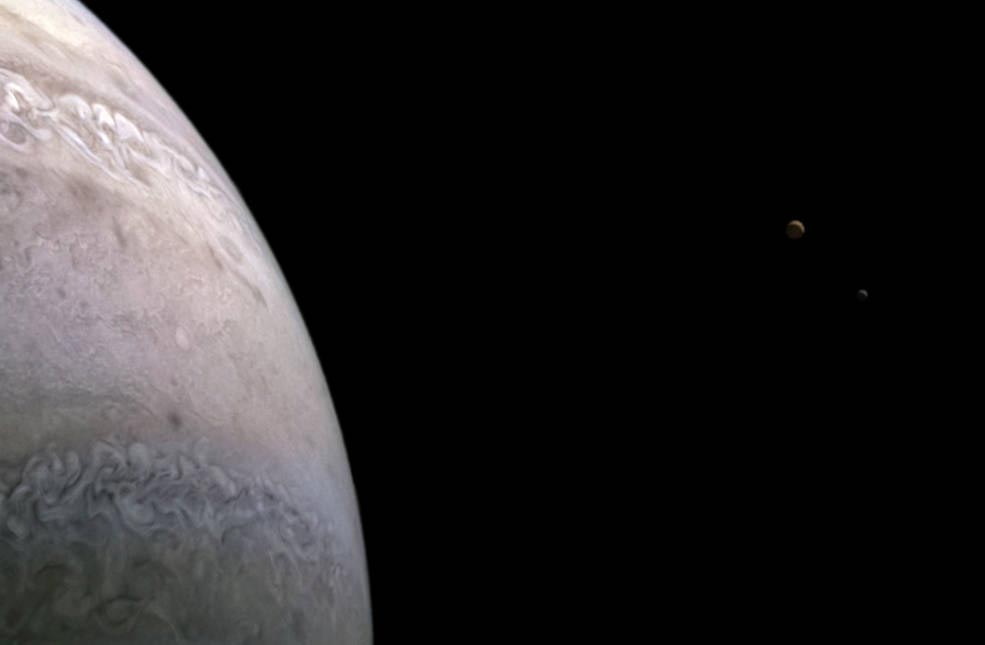
    NASA’s Juno mission captured this view of Jupiter’s southern hemisphere during the spacecraft’s 39th close flyby of the planet on January 12, 2022. Credit: NASA/JPL-Caltech/SwRI/MSSS, Image processing by Andrea Luck

    NASA’s Juno mission captured this view of Jupiter’s southern hemisphere during the spacecraft’s 39th close flyby of the planet on January 12, 2022. Zooming in on the right portion of the image (see image below) reveals two more worlds in the same frame: Jupiter’s intriguing moons Io (left) and Europa (right).
    NASA Juno Jupiter Southern Hemisphere Moon's Io Europa
    Zooming in on the right portion of the image at the top of the article reveals two more worlds in the same frame: Jupiter’s intriguing moons Io (left) and Europa (right). Credit: NASA/JPL-Caltech/SwRI/MSSS, Image processing by Andrea Luck

    Io is the solar system’s most volcanic body, while Europa’s icy surface hides a global ocean of liquid water beneath. Juno will have an opportunity to capture much more detailed observations of Europa – using several scientific instruments – in September 2022, when the spacecraft makes the closest fly-by of the enigmatic moon in decades. The mission will also make close approaches to Io in late 2023 and early 2024.

    At the time this image was taken, the Juno spacecraft was about 38,000 miles (61,000 kilometers) from Jupiter’s cloud tops, at a latitude of about 52 degrees south. Citizen scientist Andrea Luck created the image using raw data from the JunoCam instrument.

    Juno captured another stunning image not too long ago — this time of Jupiter’s moon Ganymede, the largest and most massive moon in the Solar System.

    Ganymede Crater
    NASA’s Juno mission captured this look at the complex surface of Jupiter’s moon Ganymede during a close pass by the giant moon in June 2021. At closest approach, the spacecraft came within just 650 miles (1,046 kilometers) of Ganymede’s surface. Credit: NASA/JPL-Caltech/SwRI/MSSS, Image processing by Thomas Thomopoulos

    A Striking Crater on Jupiter’s Moon Ganymede

    This look at the complex surface of Jupiter’s moon Ganymede came from NASA’s Juno mission during a close pass by the giant moon in June 2021. At closest approach, the spacecraft came within just 650 miles (1,046 kilometers) of Ganymede’s surface.

    Most of Ganymede’s craters have bright rays extending from the impact scar, but about 1 percent of the craters have dark rays. This image taken by JunoCam during the close Ganymede pass shows one of the dark-rayed craters. The crater, named Kittu, is about 9 miles (15 kilometers) across, surrounded by darker material ejected during the impact that formed the crater. Scientists believe that contamination from the impactor produced the dark rays. As time passes, the rays stay dark because they are a bit warmer than the surroundings, so ice is driven off to condense on nearby colder, brighter terrain.

    Ganymede is the largest moon in our solar system, larger even than the planet Mercury. It’s the only moon known to have its own magnetic field, which causes auroras that circle the moon’s poles. Evidence also indicates Ganymede may hide a liquid water ocean beneath its icy surface.

    Citizen scientist Thomas Thomopoulos created this enhanced-color image using data from the JunoCam camera. The original image was taken on June 7, 2021.

    Never miss a breakthrough: Join the SciTechDaily newsletter.
    Follow us on Google and Google News.

    Astronomy Europa Ganymede Io JPL Jupiter Moons NASA Planets Popular
    Share. Facebook Twitter Pinterest LinkedIn Email Reddit

    Related Articles

    Ganymede Casts a Massive Shadow Across Jupiter in Spectacular New Image From NASA’s Juno Spacecraft

    Hear the Eerie Radio Emissions NASA’s Juno Spacecraft Recorded From Jupiter and Its Moon Io

    “Beautiful!” – Ride With NASA’s Juno Spacecraft As It Flies Past the Solar System’s Biggest Moon and Jupiter

    See the Dramatic First Images NASA’s Juno Spacecraft Captured As It Sailed by the Icy Orb, Ganymede

    Close Encounters of the Jovian Kind: NASA’s Juno to Get a Close Look at Jupiter’s Moon Ganymede

    Jupiter’s Moon Europa May Have an Interior Hot Enough to Fuel Seafloor Volcanoes

    NASA’s Juno Mission Expands Into the Future – To Explore Jupiter and Its Rings and Moons

    Jupiter’s Icy Moon Europa Glows in the Dark

    Jupiter’s Moons Could be Warming Each Other through Tidal Resonance

    2 Comments

    1. Sekar on March 23, 2022 10:49 am

      Very Interesting.

      1. On a lighter note Fly-By reminds me of fly-by operators. Found in plenty on planet Earth.
      2. Seriosly, why can’t we put in place Other Solar System Planet “Planet/ Moon” ‘Geo-Stationary’ Sattelits in place to gather data on a ongoing basis.
      3. If we are going to be dependent on Citizen Satteits equip them with Telecopes much much better than Galileo had!
      4. The PC , Visicaclc. Microsoft, Apple, revolution we all lived through in late seventies and early eighties, as we moved from an Era of Mini and Mainframe computing to the era of personal desktops, laptops etc. needs to become a world-wide phenomenon in the field of obsrvatonal devices like telescopes etc., to gather data and also create databases of the observations annd data gathered online, for aggregation, anlysis, synthesis by other Citizen Scientists,

      Views expressed are personal and not binding on anyone.

      Reply
    2. k.g.r. on September 2, 2022 3:16 pm

      Look… I’m just a simple stone mason by day and an armchair astrobiologist by night. but it seems like sending an adequately shaped projectile with a high yield thermonuclear devise encapsulated in it directly into a specific part of Europa might put the contents of the inner oceans into orbit for a trailing probe to gather the contents of said ocean… Would that work? would it get adequate penetration? can we get such a heavy projectile off of earth?

      Reply
    Leave A Reply Cancel Reply

    • Facebook
    • Twitter
    • Pinterest
    • YouTube

    Don't Miss a Discovery

    Subscribe for the Latest in Science & Tech!

    Trending News

    Breakthrough Bowel Cancer Trial Leaves Patients Cancer-Free for Nearly 3 Years

    Natural Compound Shows Powerful Potential Against Rheumatoid Arthritis

    100,000-Year-Old Neanderthal Fossils in Poland Reveal Unexpected Genetic Connections

    Simple “Gut Reset” May Prevent Weight Gain After Ozempic or Wegovy

    2.8 Days to Disaster: Scientists Warn Low Earth Orbit Could Suddenly Collapse

    Common Food Compound Shows Surprising Power Against Superbugs

    5 Simple Ways To Remember More and Forget Less

    The Atomic Gap That Could Cost the Semiconductor Industry Billions

    Follow SciTechDaily
    • Facebook
    • Twitter
    • YouTube
    • Pinterest
    • Newsletter
    • RSS
    SciTech News
    • Biology News
    • Chemistry News
    • Earth News
    • Health News
    • Physics News
    • Science News
    • Space News
    • Technology News
    Recent Posts
    • After 37 Years, the World’s Longest-Running Soil Warming Experiment Uncovers a Startling Climate Secret
    • NASA Satellite Captures First-Ever High-Res View of Massive Pacific Tsunami
    • ADHD Isn’t Just a Deficit: Study Reveals Powerful Hidden Strengths
    • Scientists Uncover “Astonishing” Hidden Property of Light
    • Scientists Discover Stem Cells That Could Regrow Teeth and Bone
    Copyright © 1998 - 2026 SciTechDaily. All Rights Reserved.
    • Science News
    • About
    • Contact
    • Editorial Board
    • Privacy Policy
    • Terms of Use

    Type above and press Enter to search. Press Esc to cancel.