
Close Menu
    Facebook X (Twitter) Instagram
    SciTechDaily
    • Biology
    • Chemistry
    • Earth
    • Health
    • Physics
    • Science
    • Space
    • Technology
    Facebook X (Twitter) Pinterest YouTube RSS
    SciTechDaily
    Home»Technology»Duke University Creates “Perfect” Microwave Cloak
    Technology

    Duke University Creates “Perfect” Microwave Cloak

    By SciTechDailyNovember 14, 2012No Comments2 Mins Read
    Facebook Twitter Pinterest Telegram LinkedIn WhatsApp Email Reddit
    Share
    Facebook Twitter LinkedIn Pinterest Telegram Email Reddit
    duke-unversity-microwave-cloak
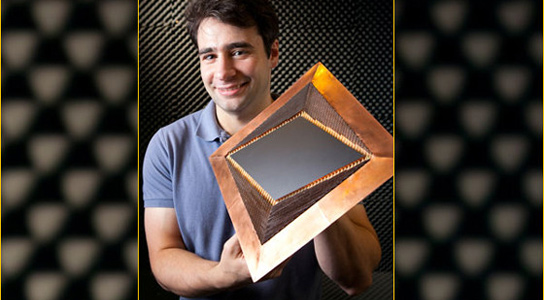
    Perfect invisibility cloak built by Duke University graduate engineering students. Credit: Duke University

    Scientists have been able to successfully cloak an object, rendering a centimeter-scale cylinder invisible to microwaves. Many different invisibility cloaks have been demonstrated, but all of those reflect some of the incidental light, making the illusion incomplete. This is the first to cloak an object perfectly.

    The scientists published their findings in the journal Nature Materials. This illusion does have drawbacks. It only works from one direction, and would be difficult to achieve with visible light. The initial invisibility cloaking papers from 2006 sparked a flurry of activity to move the work on to different wavelengths.
    microwave-cloak
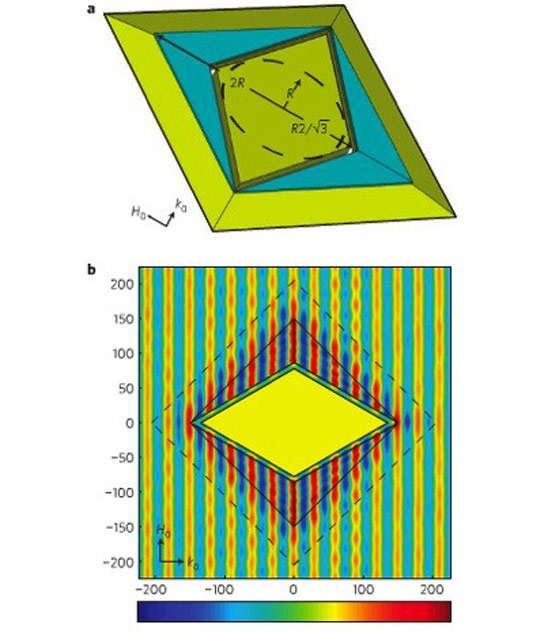
    Simulations of the fabricated cloak design. Credit: Figure by Nathan Landy & David R. Smith

    No effort has been able to achieve a perfect cloak, as was described by the original theory. The structures needed to pull that off are difficult to manufacture, and each attempt has resulted in an approximation to the theoretical idea that results in reflections.

    The scientists at Duke University took a different approach. They tried to rework the edge of a microwave cloak so that they line up, ensuring that the light passes around with no reflections.

    A diamond-shaped cloak, with properties carefully matched at its corners, was used to shuttle light perfectly around a cylinder 7.5 cm in diameter and 1 cm tall.

    While the illusion is perfect, it only works in one direction. It would also be difficult to replicate this at optical wavelengths. However, microwaves have many applications, primarily in telecommunications and radar, and improved versions of cloaking could vastly improve microwave performance.

    Reference: “A full-parameter unidirectional metamaterial cloak for microwaves” by Nathan Landy and David R. Smith, 11 November 2012, Nature Materials.
    DOI: 10.1038/nmat3476

    Never miss a breakthrough: Join the SciTechDaily newsletter.
    Follow us on Google and Google News.

    Duke University Materials Science Metamaterials Popular
    Share. Facebook Twitter Pinterest LinkedIn Email Reddit

    Related Articles

    Supernatural Strength: 3D Printed Titanium Structure Is 50% Stronger Than Aerospace Alloy

    Engineering the Impossible: How Metamaterials and AI Redefine Material Science

    Fourth Dimension Breakthrough: New Metamaterial Controls Energy Waves

    Ultra-High Energy Absorption Breakthrough: Chinese Researchers Unveil Game-Changing Nanolattice Metamaterials

    Surprising New Material Invented That Can Absorb and Release Massive Amounts of Energy

    MIT Engineers Create 3D-Printed Objects That Sense How a User Is Interacting With Them

    Transforming Circles Into Squares: Researchers Reconfigure Material Topology on the Microscale

    3D Kirigami Building Blocks Designed To Make Dynamic Metamaterial Structures

    Controlled Graphene Crumpling Used as Artificial Muscle Actuators

    Leave A Reply Cancel Reply

    • Facebook
    • Twitter
    • Pinterest
    • YouTube

    Don't Miss a Discovery

    Subscribe for the Latest in Science & Tech!

    Trending News

    AI Could Detect Early Signs of Alzheimer’s in Under a Minute – Far Before Traditional Tests

    What if Dark Matter Has Two Forms? Bold New Hypothesis Could Explain a Cosmic Mystery

    This Metal Melts in Your Hand – and Scientists Just Discovered Something Strange

    Beef vs. Chicken: Surprising Results From New Prediabetes Study

    Alzheimer’s Breakthrough: Scientists Discover Key Protein May Prevent Toxic Protein Clumps in the Brain

    Quantum Reality Gets Stranger: Physicists Put a Lump of Metal in Two Places at Once

    Scientists May Have Found the Key to Jupiter and Saturn’s Moon Mystery

    Scientists Uncover Brain Changes That Link Pain to Depression

    Follow SciTechDaily
    • Facebook
    • Twitter
    • YouTube
    • Pinterest
    • Newsletter
    • RSS
    SciTech News
    • Biology News
    • Chemistry News
    • Earth News
    • Health News
    • Physics News
    • Science News
    • Space News
    • Technology News
    Recent Posts
    • Ancient “Rock” Microbes May Reveal How Complex Life Began
    • Hidden “Trade Winds” Inside Cells Could Explain Cancer Spread
    • Humans Owe Their Eyes to a Tiny One-Eyed “Cyclops”
    • Researchers Capture Quantum Interference in One of Nature’s Rarest Atoms
    • Ancient DNA Reveals Irish Goats Have a 3,000-Year-Old Lineage Still Alive Today
    Copyright © 1998 - 2026 SciTechDaily. All Rights Reserved.
    • Science News
    • About
    • Contact
    • Editorial Board
    • Privacy Policy
    • Terms of Use

    Type above and press Enter to search. Press Esc to cancel.