
The long-term trend for sea ice in the south is flat, while the global trend points downward.
In February 2022, sea ice around Antarctica reached the lowest extent ever observed since the start of the satellite record in 1979. It marks the first time that the ice was observed to shrink below 2 million square kilometers.
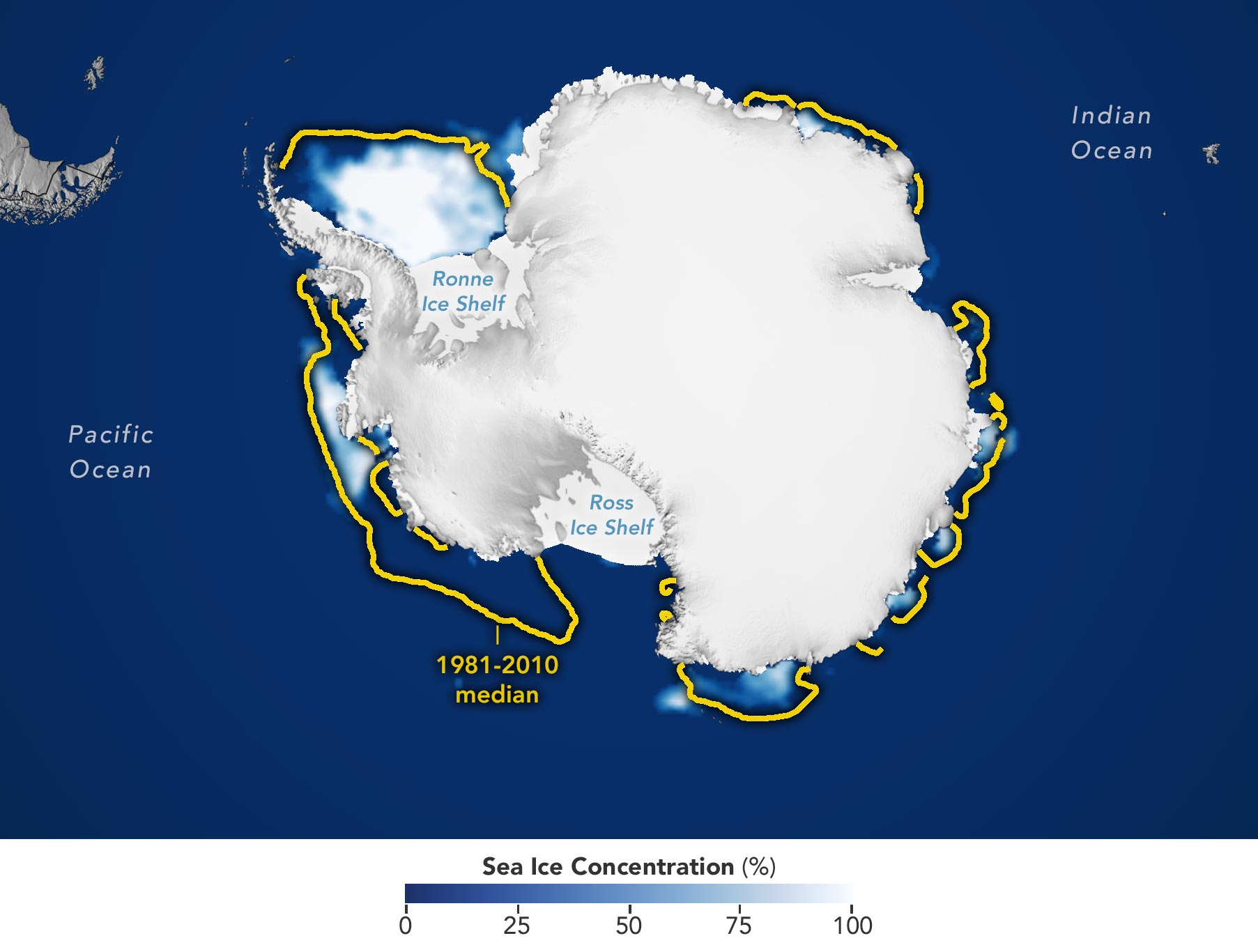
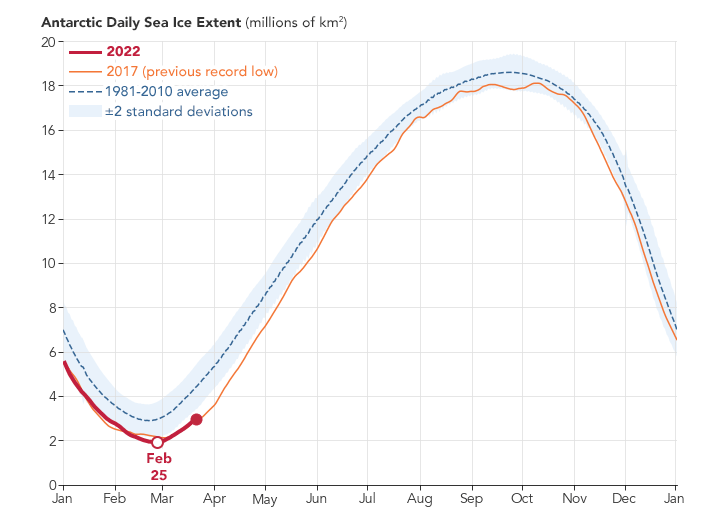
Sea ice in southern polar waters reached its lowest extent on February 25, 2022, at 1.92 million square kilometers (741,000 square miles). That’s 190,000 square kilometers (73,000 square miles) below the previous record-low reached on March 3, 2017. Compared to the average minimum, the sea ice this year is missing an area about twice the size of California.
The map above shows the ice extent on the day of its record low. Extent is defined as the total area in which the ice concentration is at least 15 percent. The yellow outline shows the median sea ice extent for February from 1981–2010. A median is the middle value: That is, half of the extents were larger than the yellow line and half were smaller.
Causes of the Decline
The 2021-2022 melting season began earlier than usual, after the ice reached its seasonal maximum extent on September 1, 2021, and then quickly declined through the austral spring and summer. According to Walt Meier, a sea ice researcher at the National Snow and Ice Data Center, winds were the main reason for the low ice conditions this year. He explained that the winds around the continent were “much stronger than normal,” which quickly pushed ice north into warmer waters where it melted. An exception was in the Weddell Sea, where winds pushed the ice edge south.
Now, one month after sea ice reached its annual minimum, Meier said that the rate of growth looks normal. Even the heatwave that sent Antarctica’s air temperatures soaring in the third week of March does not seem to have slowed the growth. “It is really the ocean temperatures that count,” Meier said, “and a brief heat wave won’t affect things too much in that regard.”
It remains to be seen how much ice will regrow this year. While it is common for Antarctic sea ice to melt nearly all the way back to the coastline during the austral summer, the ice grows unconstrained through autumn and winter. After months of growth (February to September), new sea ice typically spans an area of ocean about twice the size of the continental United States.
Antarctic vs. Arctic Sea Ice Trends
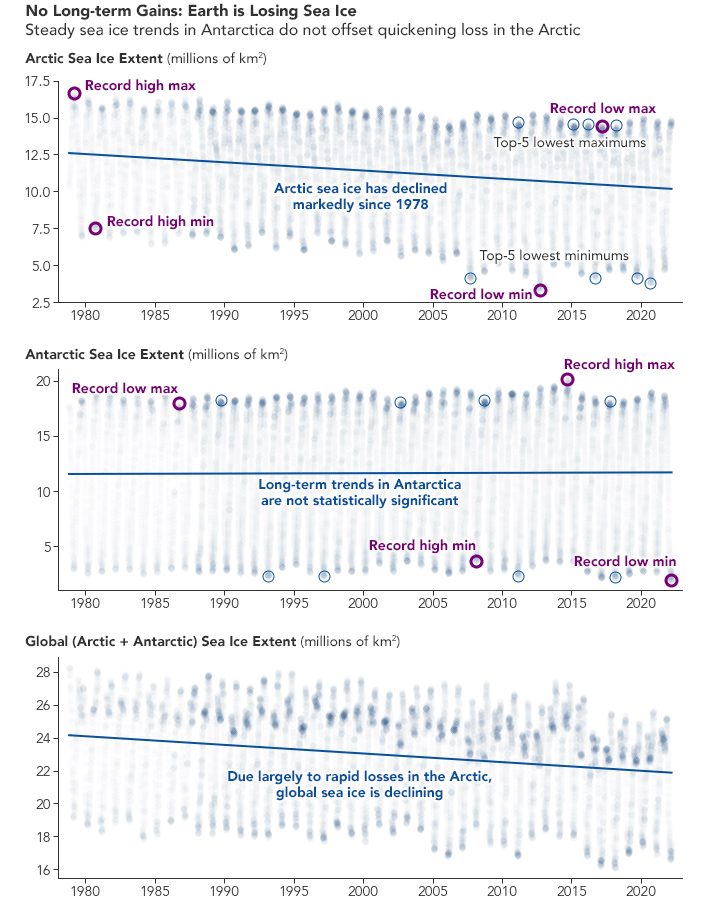
From year to year, Antarctic sea ice can be highly variable; since 2013 it has reached its highest high and its lowest low since record keeping began. A surge of sea ice growth in 2014 and 2015 enhanced a small upward trend in the long-term record. But over the past seven years, sea ice has generally been at or below average, including record-low minimums in 2017 and 2022. The long-term trend now appears flat, and because of the variability, is not considered statistically significant.
In contrast, sea ice in the Arctic shows a clear downward trend. That means that globally, the planet is losing sea ice. “Overall, for the Arctic and Antarctic combined,” Meier said, “the trend is definitely still downward.”
NASA Earth Observatory images by Joshua Stevens, using data from the National Snow and Ice Data Center.
Never miss a breakthrough: Join the SciTechDaily newsletter.
Follow us on Google and Google News.
1 Comment
“In February 2022, sea ice around Antarctica reached the lowest extent ever observed since the start of the satellite record in 1979.”
1979 is a strange start date. Landsat 1 (ERTS-1) was launched in 1972. A higher spatial resolution Landsat 4 was launched in 1982. I don’t understand why the data don’t go back to 1972 or at least 1973.
“In contrast, sea ice in the Arctic shows a clear downward trend.”
Actually, the minimum annual coverage was in 2012, and every year since then has been higher. Also, the blue-colored regression line doesn’t seem to be a good fit for the annual data. The line appears to be too high for the period of 1979 through 2021, and the trend appears to be essentially flat since 2012. I don’t think “quickening loss” properly characterizes what is happening in the Arctic, particulatly for the last decade.