
Close Menu
    Facebook X (Twitter) Instagram
    SciTechDaily
    • Biology
    • Chemistry
    • Earth
    • Health
    • Physics
    • Science
    • Space
    • Technology
    Facebook X (Twitter) Pinterest YouTube RSS
    SciTechDaily
    Home»Space»Hubble Space Telescope Spies a Serpentine Spiral Galaxy
    Space

    Hubble Space Telescope Spies a Serpentine Spiral Galaxy

    By ESA/HubbleApril 3, 2022No Comments2 Mins Read
    Facebook Twitter Pinterest Telegram LinkedIn WhatsApp Email Reddit
    Share
    Facebook Twitter LinkedIn Pinterest Telegram Email Reddit
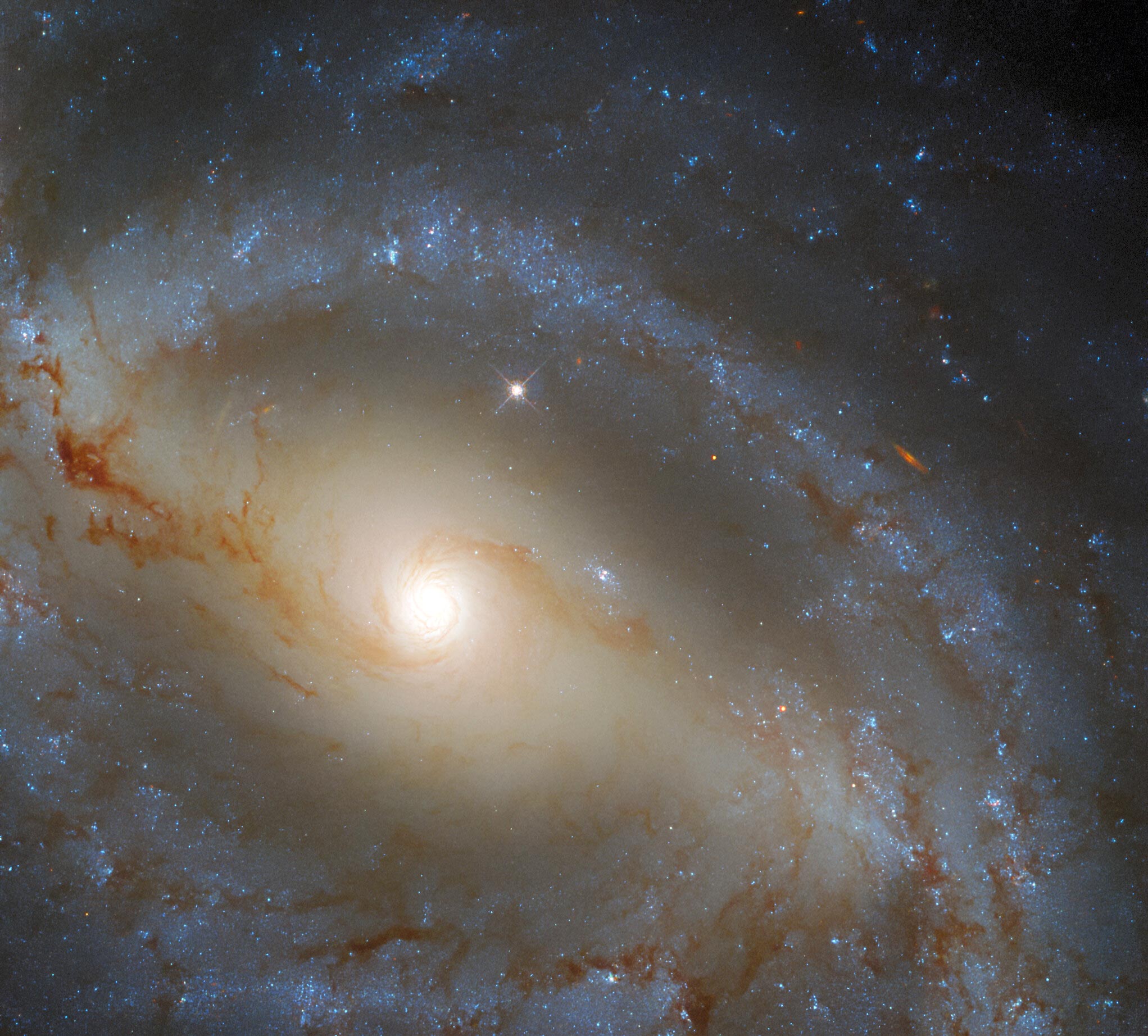
    Galaxy NGC 5921
    Hubble Space Telescope image of NGC 5921, a galaxy that lies approximately 80 million light-years from Earth. Credit: ESA/Hubble & NASA, J. Walsh, Acknowledgment: R. Colombari

    The barred spiral galaxy NGC 5921 resides in the constellation Serpens, its arms winding like a serpent. A study combining observations from the Hubble and Gemini observatories aimed to better understand the relationship between galaxies and their supermassive black holes.

    The lazily winding spiral arms of the galaxy NGC 5921 snake across this image from the NASA/ESA Hubble Space Telescope. This galaxy lies approximately 80 million light-years from Earth, and much like our own galaxy, the Milky Way, contains a prominent bar. Roughly half of all spiral galaxies are thought to contain bars, and these bars affect their parent galaxies by fueling star formation and affecting the motion of stars and interstellar gas. 

    Appropriately, given NGC 5921’s serpentine spiral arms, this galaxy resides in the constellation Serpens in the northern celestial hemisphere. Serpens is the only one of the 88 modern constellations to consist of two unconnected regions — Serpens Caput and Serpens Cauda. These two regions — whose names mean the Serpent’s Head and the Serpent’s Tail, respectively — are separated by Ophiuchus, the Serpent Bearer. 

    The scientific study behind this image was also split into two parts — observations from Hubble’s Wide Field Camera 3 and observations from the ground-based Gemini Observatory. These two observatories joined forces to better understand the relationship between galaxies like NGC 5921 and the supermassive black holes they contain. Hubble’s contribution to the study was to determine the masses of stars in the galaxies and also to take measurements that help calibrate the observations from Gemini. Together, the Hubble and Gemini observations provided astronomers with a census of nearby supermassive black holes in a diverse variety of galaxies.

    Never miss a breakthrough: Join the SciTechDaily newsletter.
    Follow us on Google and Google News.

    Astronomy European Space Agency Hubble Space Telescope NASA
    Share. Facebook Twitter Pinterest LinkedIn Email Reddit

    Related Articles

    Hubble’s Newest Discovery Isn’t a Star, It’s a Window Into the Dark Universe

    This Nearby Galaxy Shows How Frozen Clouds Ignite Into Stars

    This Chaotic Spiral Galaxy Is Still Recovering From a Cosmic Collision

    This Strange Spiral Galaxy Is Hiding a Massive Black Hole

    Hubble Zooms In on a Galaxy That Maps the Universe’s Expansion

    Hubble Captures a Dazzling Spiral Galaxy Alive With Birth and Destruction

    Hubble Spots a Glowing “Ring of Fire” in a Distant Spiral Galaxy

    Dust, Light & Ancient Collisions: The Sombrero Galaxy Like You’ve Never Seen It

    Star Formation in Motion: Hubble Reveals Spiraling Stars and Sculpted Nebulae

    Leave A Reply Cancel Reply

    • Facebook
    • Twitter
    • Pinterest
    • YouTube

    Don't Miss a Discovery

    Subscribe for the Latest in Science & Tech!

    Trending News

    Scientists Discover How Coffee Impacts Memory, Mood, and Gut Health

    Why Did the Neanderthals Disappear? Scientists Reveal Humans Had a Hidden Advantage

    Physicists Propose Strange Experiment Where Time Goes Quantum

    Magnesium Magic: New Drug Melts Fat Even on a High-Fat, High-Sugar Diet

    Weight-Loss Drugs Like Ozempic May Come With an Unexpected Cost

    Mezcal “Worm” in a Bottle Mystery: DNA Testing Reveals a Surprise

    New Research Reveals That Your Morning Coffee Activates an Ancient Longevity Switch

    This Is What Makes You Irresistible to Mosquitoes

    Follow SciTechDaily
    • Facebook
    • Twitter
    • YouTube
    • Pinterest
    • Newsletter
    • RSS
    SciTech News
    • Biology News
    • Chemistry News
    • Earth News
    • Health News
    • Physics News
    • Science News
    • Space News
    • Technology News
    Recent Posts
    • Harvard Scientists Reveal Secret Structure Behind How You Smell
    • Scientists Just Discovered the Hidden Trick That Keeps Your Cells Alive
    • This Simple Movement Could Be Secretly Cleaning Your Brain
    • Male Birth Control Breakthrough: Scientists Find Way To Turn Sperm Production Off and Back On
    • A Common Vitamin Could Hold the Key to Treating Fatty Liver Disease
    Copyright © 1998 - 2026 SciTechDaily. All Rights Reserved.
    • Science News
    • About
    • Contact
    • Editorial Board
    • Privacy Policy
    • Terms of Use

    Type above and press Enter to search. Press Esc to cancel.