
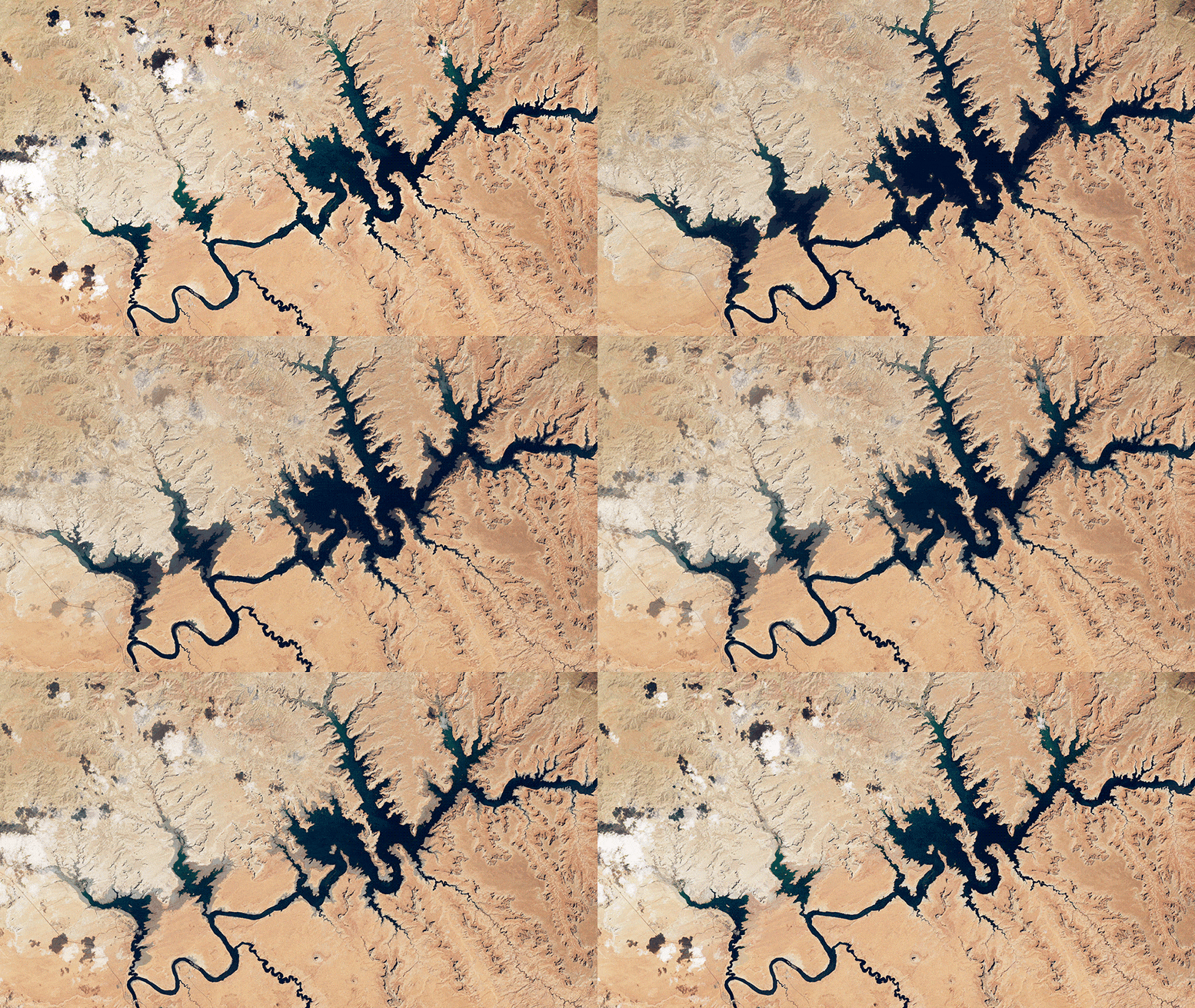
The second largest reservoir in the United States now stands at its lowest level since it was filled in the mid-1960s.
Lake Powell, the second-largest reservoir in the United States, now stands at its lowest level since it was filled in the mid-1960s. The view from above is sobering.
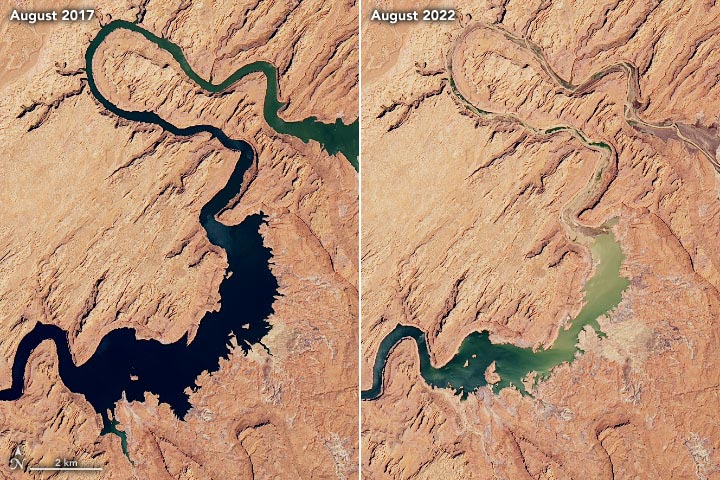
A key component of the western U.S. water system, Lake Powell is currently filled to just 26 percent of capacity. This is its lowest point since 1967. On August 22, 2022, the water elevation of the lake’s surface was 3,533.3 feet (1,076.9 meters). This is more than 166 feet (50.6 meters) below “full pool” (elevation 3,700 feet or 1,128 meters ).
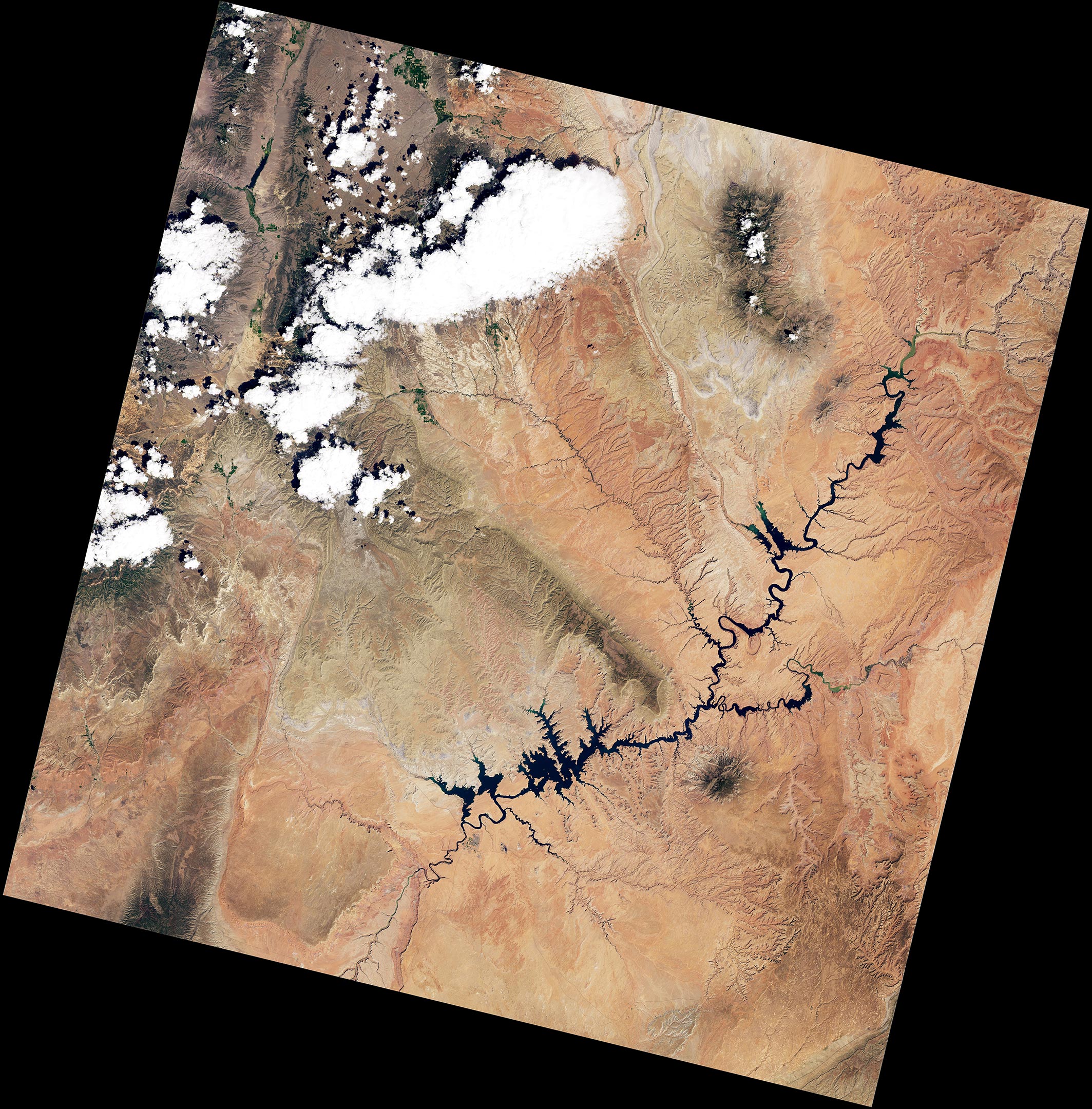
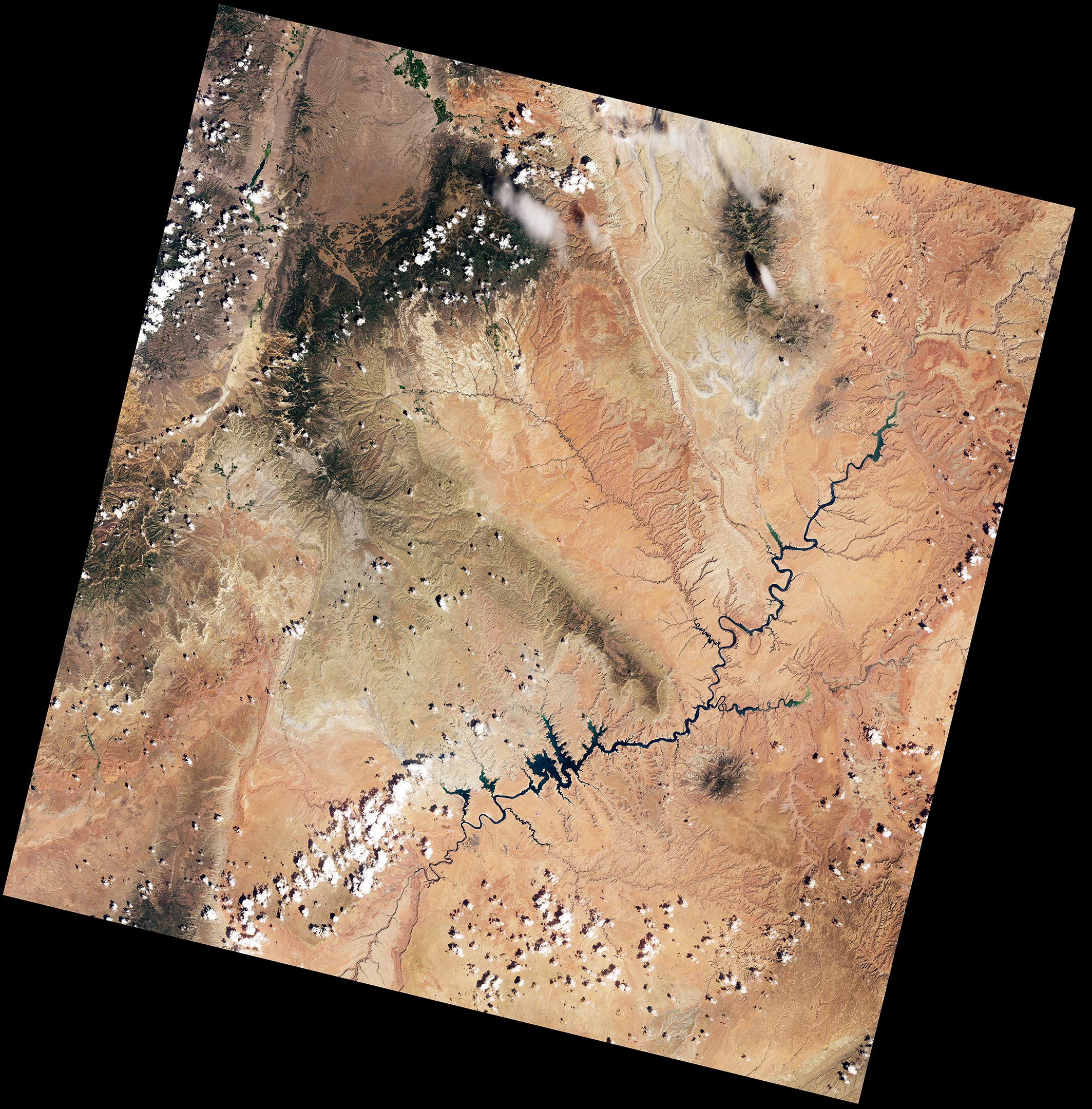
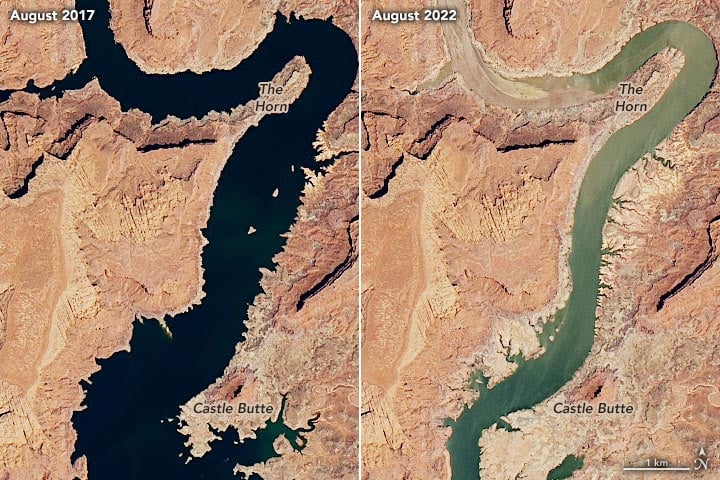
The natural-color satellite images on this page show portions of Lake Powell in the summers of 2017 and 2022, as observed by Landsat spacecraft. The Operational Land Imager on Landsat 8 acquired the 2017 images, while the 2022 images were acquired by Operational Land Imager-2 on Landsat 9. Lake Powell straddles the border of southeastern Utah and northeastern Arizona; most of the area shown is in Utah. (For a year-by-year view, visit the Earth Observatory feature World of Change: Water Level in Lake Powell.)
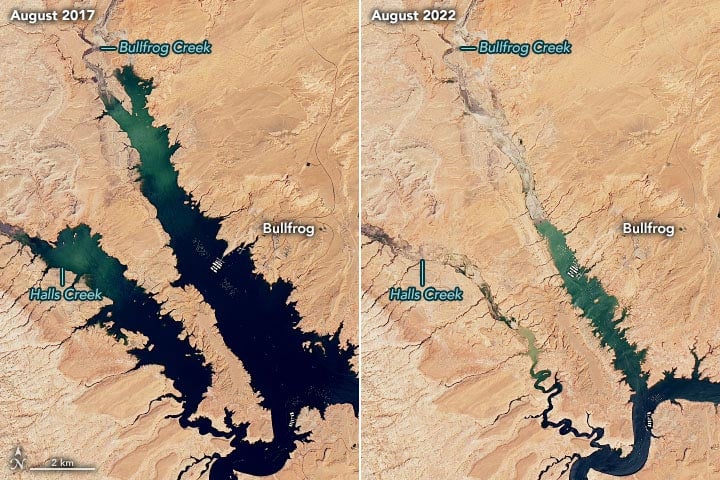
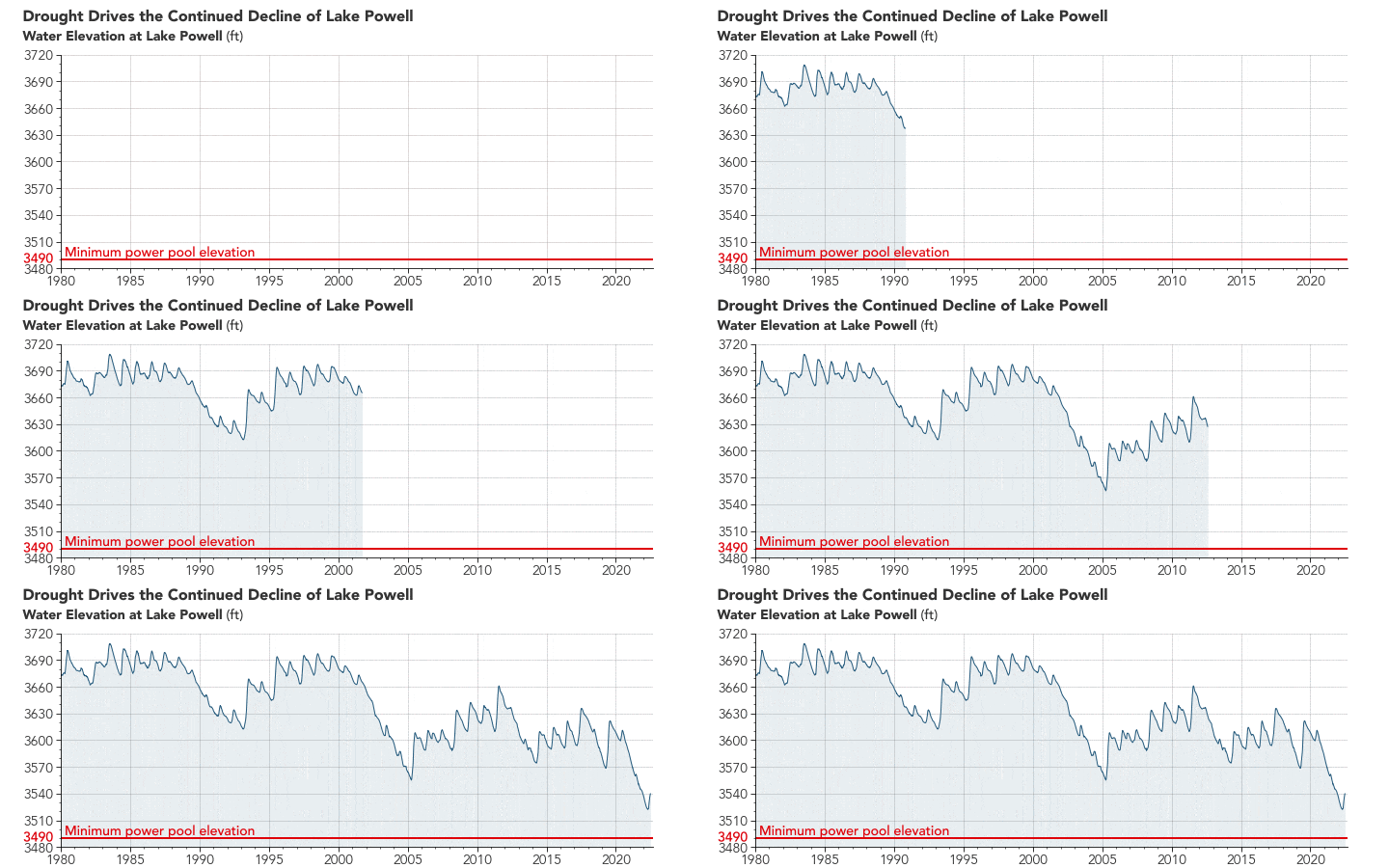
The August 2017 images were chosen because they represent one of the highest water levels of the past decade. On August 16, 2017, the water elevation on the lake, as measured at Glen Canyon Dam, was 3,633.04 feet (1,107.35 meters). On August 6, 2022, it stood at 3,535.38 feet (1,077.58), nearly 98 feet (30 meters)lower. The animated line plot below shows water levels at the dam since 1980, when Lake Powell was nearly full. The red line marks the “minimum power pool elevation.” Below that water level, hydroelectric turbines at the dam can no longer generate energy effectively.
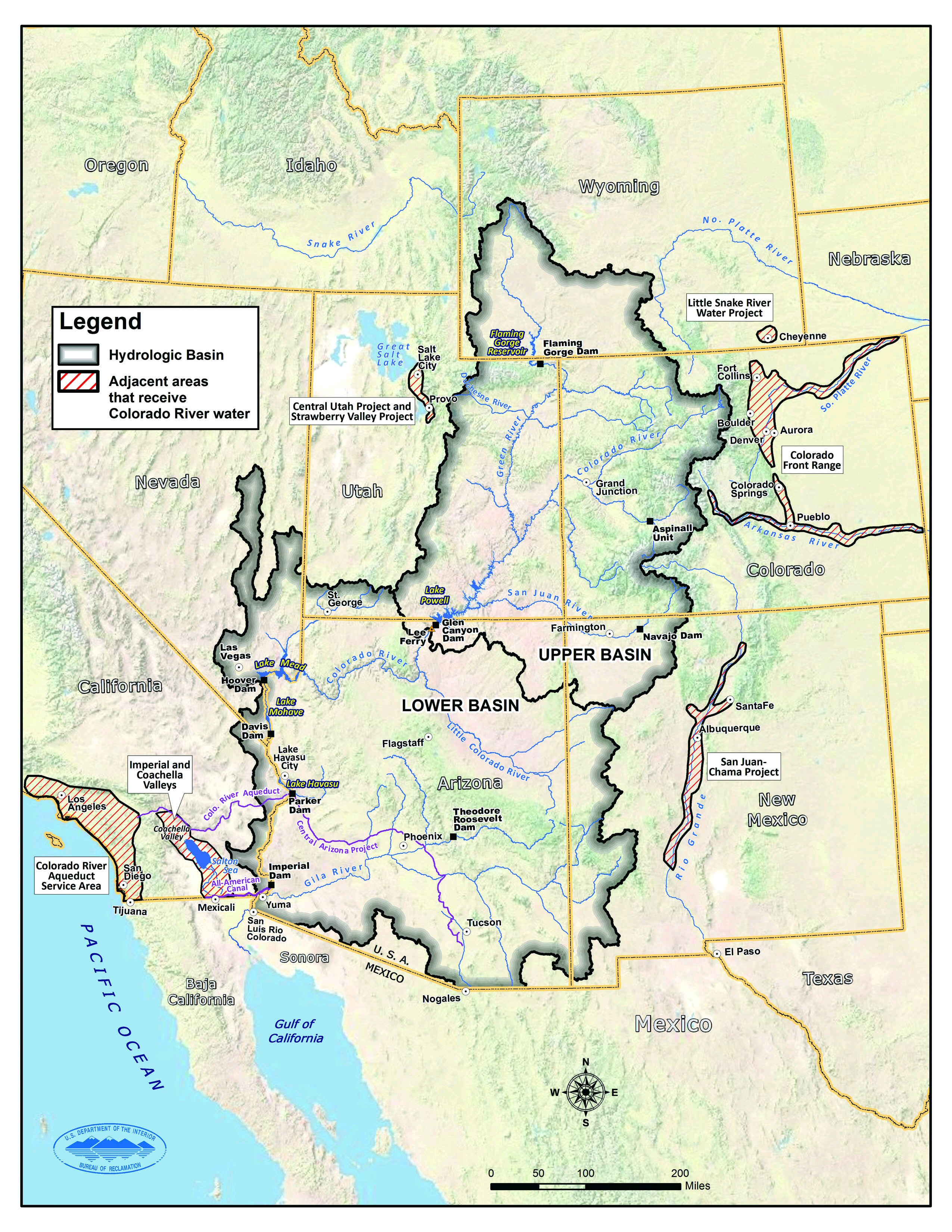
The Colorado River basin is managed by the U.S. Bureau of Reclamation (USBR) and other agencies to provide electric power and water to roughly 40 million people. This includes, most notably, the cities of Las Vegas, Phoenix, Los Angeles, and San Diego—as well as 4 to 5 million acres of farmland in the Southwest. River water is allotted to states (including tribal lands) and Mexico through laws such as the 1922 Colorado River Compact.
Downstream from Lake Powell, water storage at Lake Mead on August 22 stood at 28 percent of capacity, and the entire Colorado river system held just 34 percent. At the same time, approximately 86 percent of the land area across nine western states was affected by some level of drought. This is according to the August 16 report from the U.S. Drought Monitor.
Federal water managers have been forced to reduce the amount of water that will be portioned out to states around the Colorado River watershed in the 2023 water year, after three years of intense drought and two decades of long-term drought in the American Southwest. According to an August 16 announcement from the U.S. Department of the Interior, Arizona will receive 21 percent less water from the Colorado River system next year; Nevada will receive 8 percent less; and Mexico will get 7 percent less.
Based on August 2022 modeling projections, USBR expects total inflows to Lake Powell to be just 62 percent of the average for the year. Hydrologists predict that by January 1, 2023, Lake Powell levels could drop to about 3,522 feet (1,074 meters).
In an August 16 status report for Glen Canyon Dam, USBR noted that “two separate urgent drought response actions…will help prop up Lake Powell by nearly 1 million acre-feet of water…through April 2023. To protect Lake Powell, more water will flow into the lake from upstream reservoirs and less water will be released downstream.” Specifically, more water will be released from Flaming Gorge Reservoir, about 455 river miles (732 river kilometers) upstream of Lake Powell; and less water will be released from Lake Powell downstream to Lake Mead.
NASA Earth Observatory images by Joshua Stevens, using Landsat data from the U.S. Geological Survey and lake elevation data from the Bureau of Reclamation.
Never miss a breakthrough: Join the SciTechDaily newsletter.
Follow us on Google and Google News.
2 Comments
Very few in the west seem to be willing to make the sacrifices nessecary to save water. People still insist on watering their wasteful lawns, hotels refuse to ask guest to conserve, industry still demands their share and people are unconscious of the dilema and ignorant.
Mayebe the west deserves to run out.
What is happening in 2026?