
Close Menu
    Facebook X (Twitter) Instagram
    SciTechDaily
    • Biology
    • Chemistry
    • Earth
    • Health
    • Physics
    • Science
    • Space
    • Technology
    Facebook X (Twitter) Pinterest YouTube RSS
    SciTechDaily
    Home»Space»How Jupiter and Saturn Formed and Evolved
    Space

    How Jupiter and Saturn Formed and Evolved

    By Carnegie Institution for ScienceMarch 6, 2013No Comments3 Mins Read
    Facebook Twitter Pinterest Telegram LinkedIn WhatsApp Email Reddit
    Share
    Facebook Twitter LinkedIn Pinterest Telegram Email Reddit
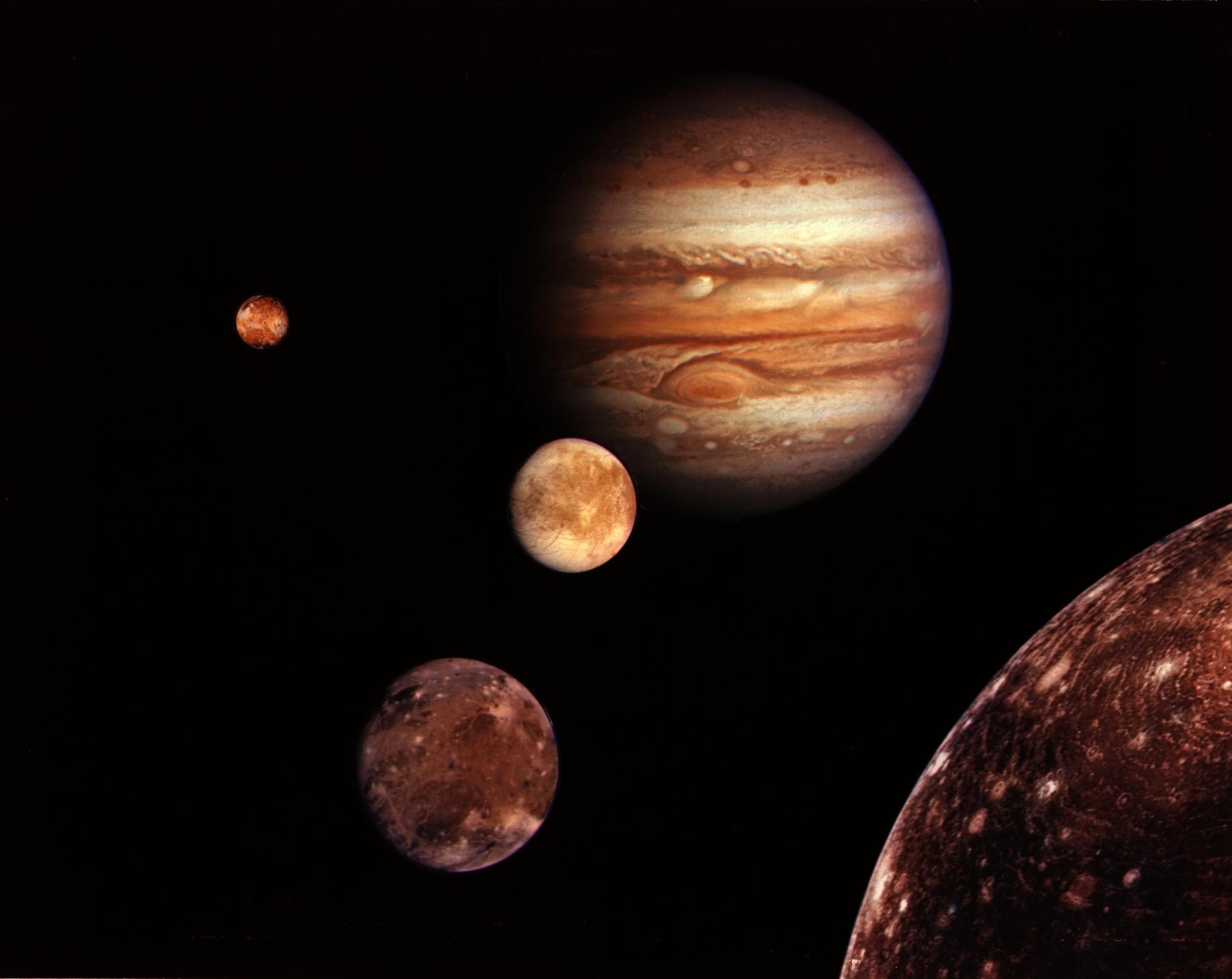
    Jupiter System Montage
    Jupiter and its four planet-size moons, called the Galilean satellites, were photographed in early March by Voyager 1 and assembled into this collage. They are not to scale but are in their relative positions. Credit: NASA/JPL

    In newly published research from the Carnegie Institution for Science, Alan Boss uses highly detailed, three dimensional models to help explain how the gas giant planets Jupiter and Saturn may have formed and evolved.

    New theoretical modeling by Carnegie’s Alan Boss provides clues to how the gas giant planets in our solar system—Jupiter and Saturn—might have formed and evolved. His work was published recently by The Astrophysical Journal.

    New stars are surrounded by rotating gas disks during the early stages of their lives. Gas giant planets are thought to form in the presence of these disks.

    Observations of young stars that still have these gas disks demonstrate that sun-like stars undergo periodic outbursts, lasting about 100 years, which transfer mass from the disk onto the young star, increasing its luminosity. It is thought that these short bursts of mass accretion are driven by marginal gravitational instability in the gas disk.

    There are competing theories for how gas giant planets form around proto-suns. One proposes that the planets formed from slowly growing ice and rock cores, followed by rapid accretion of gas from the surrounding disk. The other theory proposes that clumps of dense gas form in spiral arms, increasing in mass and density, forming a gas giant planet in a single step.

    Boss developed highly detailed, three dimensional models demonstrating that regardless of how gas giant planets form, they should have been able to survive periodic outbursts of mass transfer from the gas disk onto the young star. One model similar to our own Solar System was stable for more than 1,000 years, while another model containing planets similar to our Jupiter and Saturn was stable for more than 3,800 years. The models showed that these planets were able to avoid being forced to migrate inward to be swallowed by the growing proto-sun, or being tossed completely out of the planetary system by close encounters with each other.

    “Gas giant planets, once formed, can be hard to destroy,” said Boss, “even during the energetic outbursts that young stars experience.”

    Given that searches for extrasolar gas giant planets have found them to be present around about 20% of sun-like stars, this is a reassuring outcome. It suggests that our improved theoretical understanding of the formation and orbital evolution of gas giants is on the right track.

    Reference: “Orbital Migration of Protoplanets in a Marginally Gravitationally Unstable Disk” by Alan P. Boss, 6 February 2013, The Astrophysical Journal.
    DOI: 10.1088/0004-637X/764/2/194

    This research was supported in part by the NASA Origins of Solar Systems Program and contributed to in part to the NASA Astrobiology Institute. The calculations were performed on the Carnegie Alpha Cluster, the purchase of which was partially supported by a NSF Major Research Instrumentation grant.

    Never miss a breakthrough: Join the SciTechDaily newsletter.
    Follow us on Google and Google News.

    Astronomy Carnegie Institution for Science Jupiter Planetary Science Saturn
    Share. Facebook Twitter Pinterest LinkedIn Email Reddit

    Related Articles

    Scientists May Have Found the Key to Jupiter and Saturn’s Moon Mystery

    An Additional Planet Between Saturn and Uranus Was Kicked Out of the Solar System

    Astronomers Discover a Dozen New Moons Around Jupiter, Including One ‘Oddball’

    New Physical Model Explains the Origin of Water in Our Solar System

    Impact May Have Deformed Saturn’s Moon Iapetus

    Jupiter’s Atmosphere Experiencing Large Scale Changes

    Simulation May Explain Saturnian System

    Titan Experiences Seasonal Changes

    Diogenites Provide Clues of the Earliest Days of Our Solar System

    Leave A Reply Cancel Reply

    • Facebook
    • Twitter
    • Pinterest
    • YouTube

    Don't Miss a Discovery

    Subscribe for the Latest in Science & Tech!

    Trending News

    Wasp Colonies Explode Into Violence After Losing Their Queen

    Scientists Create “Living Plastic” That Self-Destructs in Just Six Days

    Your Blood May Carry a 700-Million-Year-Old Secret

    Scientists Discover Some “Zombie Cells” May Actually Help You Live Longer

    Earth May Be Seeding Venus With Life, According to New Research

    What Scientists Found Inside a 117-Year-Old Woman Reveals New Clues to Long Life

    Scientists Discover Mysterious Creature Living in the Great Salt Lake – and It Exists Nowhere Else on Earth

    It’s Alive? Surprising Discovery Changes What We Know About Fog

    Follow SciTechDaily
    • Facebook
    • Twitter
    • YouTube
    • Pinterest
    • Newsletter
    • RSS
    SciTech News
    • Biology News
    • Chemistry News
    • Earth News
    • Health News
    • Physics News
    • Science News
    • Space News
    • Technology News
    Recent Posts
    • A Psychologist Explains Why 40% of People Are Avoiding the News
    • Scientists Discover Alzheimer’s-Linked Proteion’s Surprising Role in Making Memories Last
    • Vitamin D Drug Shows Surprising Promise Against One of the Deadliest Cancers
    • Scientists Crack Major Ammonia Problem With a Platinum Catalyst Breakthrough
    • MIT Engineers Solve a Major Lidar Problem That Has Stumped Researchers for Years
    Copyright © 1998 - 2026 SciTechDaily. All Rights Reserved.
    • Science News
    • About
    • Contact
    • Editorial Board
    • Privacy Policy
    • Terms of Use

    Type above and press Enter to search. Press Esc to cancel.