
Close Menu
    Facebook X (Twitter) Instagram
    SciTechDaily
    • Biology
    • Chemistry
    • Earth
    • Health
    • Physics
    • Science
    • Space
    • Technology
    Facebook X (Twitter) Pinterest YouTube RSS
    SciTechDaily
    Home»Space»Hubble Spots an Astronomical Intruder in a Distant Galaxy
    Space

    Hubble Spots an Astronomical Intruder in a Distant Galaxy

    By ESA/HubbleJanuary 15, 20232 Comments2 Mins Read
    Facebook Twitter Pinterest Telegram LinkedIn WhatsApp Email Reddit
    Share
    Facebook Twitter LinkedIn Pinterest Telegram Email Reddit
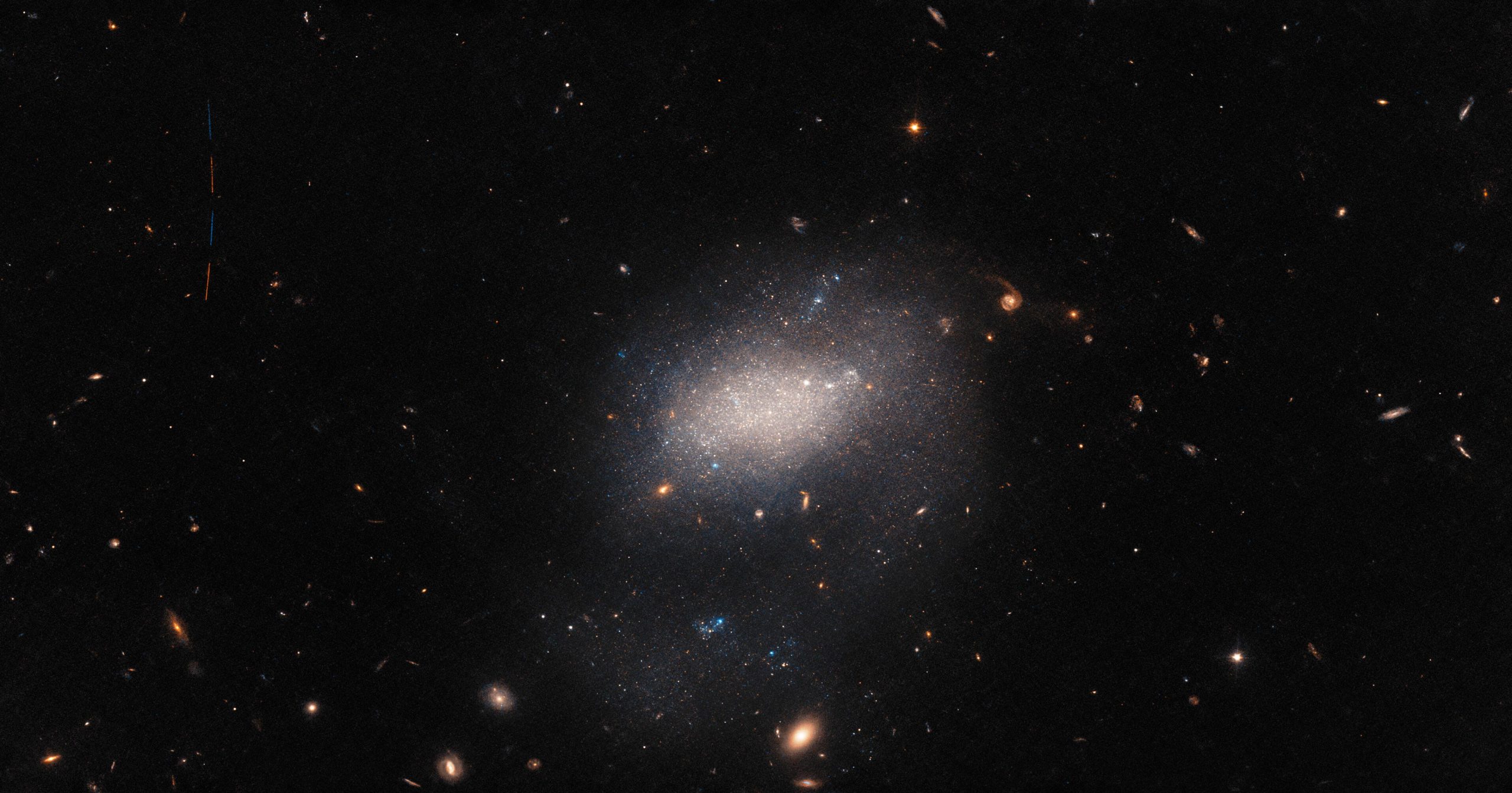
    Galaxy UGC 7983
    This Hubble Space Telescope image includes a host of astronomical objects. Strewn across the image are background galaxies ranging from stately spirals to fuzzy ellipticals. Also present are bright foreground stars much closer to Earth, surrounded by diffraction spikes. In the center of the frame, the faint outline of the tiny galaxy UGC 7983 can be seen as a blurry cloud of light. But hidden within this image lies an unexpected cosmic intruder. Credit: ESA/Hubble & NASA, R. Tully

    A host of astronomical objects throng this image from the Hubble Space Telescope. Background galaxies ranging from stately spirals to fuzzy ellipticals are strewn across the image, and bright foreground stars much closer to home are also present, surrounded by diffraction spikes. In the center of the image, the vague shape of the small galaxy UGC 7983 appears as a hazy cloud of light. UGC 7983 is around 30 million light-years from Earth in the constellation Virgo, and is a dwarf irregular galaxy — a type thought to be similar to the very earliest galaxies in the Universe.

    This image also conceals an astronomical interloper. A minor asteroid, only a handful of kilometers across, can be seen streaking across the upper left-hand side of this image. The trail of the asteroid is visible as four streaks of light separated by small gaps. These streaks of light represent the four separate exposures that were combined to create this image, the small gaps between each observation being necessary to change the filters inside NASA/ESA Hubble’s Advanced Camera for Surveys (ACS).

    Capturing an asteroid was a fortunate side effect of a larger effort to observe every known galaxy close to the Milky Way. When this project was first proposed, roughly 75% of all the Milky Way’s near galactic neighbors had been imaged by Hubble. A group of astronomers proposed using the gaps between longer Hubble observations to capture images of the remaining 25%. The project was an elegantly efficient way to fill out some gaps not only in Hubble’s observing schedule, but also in our knowledge of nearby galaxies.

    Never miss a breakthrough: Join the SciTechDaily newsletter.
    Follow us on Google and Google News.

    Astronomy European Space Agency Hubble Space Telescope
    Share. Facebook Twitter Pinterest LinkedIn Email Reddit

    Related Articles

    A Diamond Necklace of Cosmic Proportions

    Hubble Snaps a Stunning Close-Up of a Magnificent Spiral Galaxy

    Extraordinary Hubble Image: Light Bends From the Beyond

    Hubble Space Telescope Sees Volcanic Activity Reforming the Atmosphere on a Rocky Exoplanet

    Hubble Spies a Luminous Heart With Dark Tendrils

    Spectacular Return to the Veil Nebula

    Hubble Spots a Peculiar Sight: Unusual Spiral Galaxy With a Heavy Arm

    A Flash of Life: Hubble Spies an Unusual Planetary Nebula

    Through the Cosmic Clouds: Hubble Spots a Beautiful Stellar Nursery

    2 Comments

    1. Michael McGlone on January 16, 2023 2:00 pm

      I think that something amazing is going to be discovered soon.

      Reply
    2. Stacy k on January 19, 2023 3:05 am

      Me too

      Reply
    Leave A Reply Cancel Reply

    • Facebook
    • Twitter
    • Pinterest
    • YouTube

    Don't Miss a Discovery

    Subscribe for the Latest in Science & Tech!

    Trending News

    Scientists Just Found a Smiling “Happy-Face” Spider in the Himalayas

    A Colossal Moon Impact May Have Left Ancient Secrets Near Future Artemis Landing Sites

    Earthquake Researchers Discover Dangerous Stress Levels Building Beneath Southern California

    NASA Satellites Spot Rare Underwater Volcano Eruption That Could Create Earth’s Newest Island

    520-Million-Year-Old Fossils Solve One of Evolution’s Biggest Mysteries

    This Popular Workout Supplement May Give Cancer Immunotherapy a Big Boost

    Scientists Discover Quantum Entanglement in a Crystal You Can Hold

    New Nonsurgical Knee Treatment Delivers Lasting Pain Relief

    Follow SciTechDaily
    • Facebook
    • Twitter
    • YouTube
    • Pinterest
    • Newsletter
    • RSS
    SciTech News
    • Biology News
    • Chemistry News
    • Earth News
    • Health News
    • Physics News
    • Science News
    • Space News
    • Technology News
    Recent Posts
    • Scientists Unravel a Century-Old Mystery About Hybrid Male Sterility
    • These 567-Million-Year-Old Fossils Are Rewriting the Story of Life on Earth
    • Scientists Discover 250+ Genes That Could Lead to New Ways To Prevent Melanoma
    • This Gut Microbe Could Be the Secret to Staying Strong as You Age
    • The Spider-Like Creatures Helping Scientists Decode the Origins of Fatherhood
    Copyright © 1998 - 2026 SciTechDaily. All Rights Reserved.
    • Science News
    • About
    • Contact
    • Editorial Board
    • Privacy Policy
    • Terms of Use

    Type above and press Enter to search. Press Esc to cancel.