
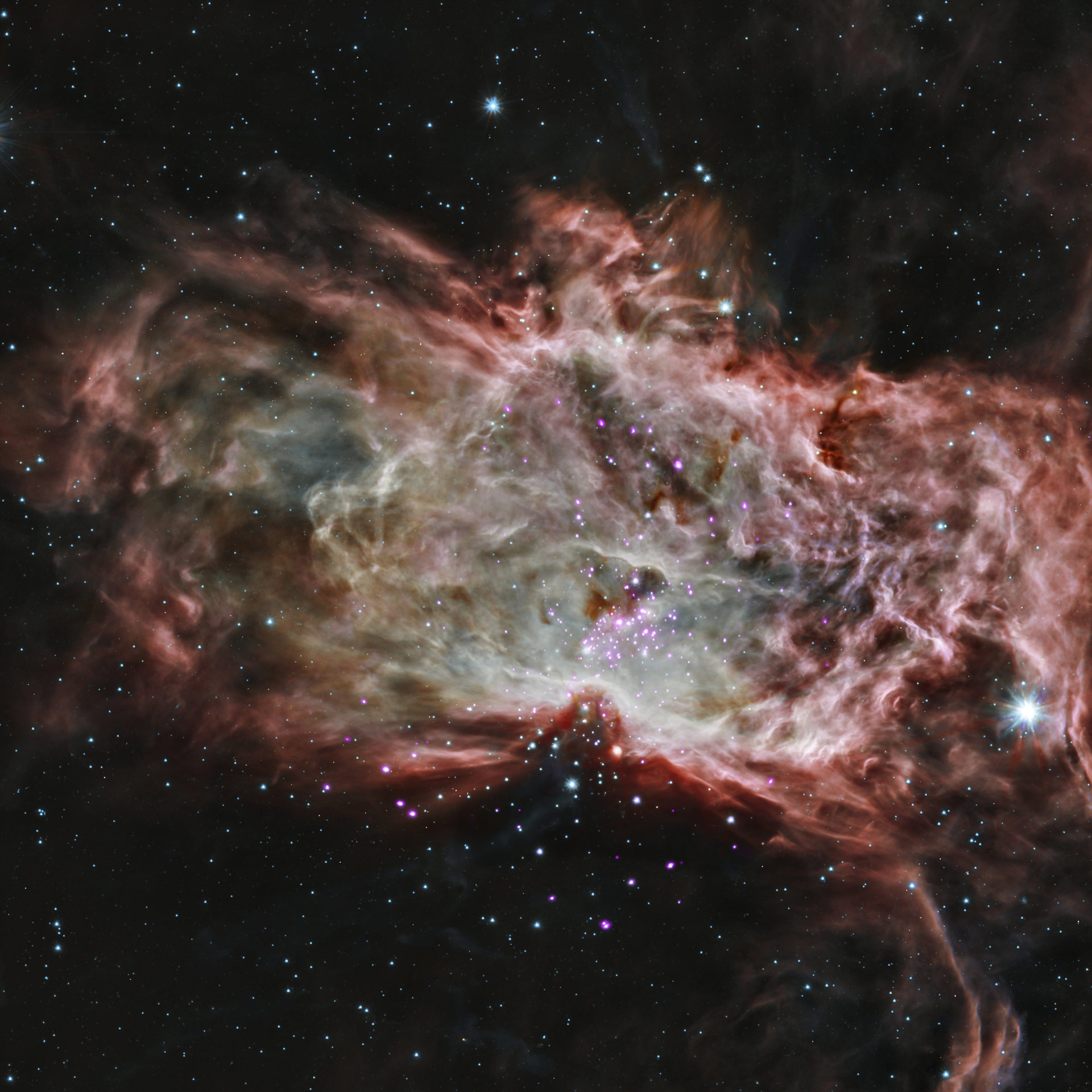
Astronomers developed a new technique using data from Chandra and infrared telescopes that furthers our understanding of how clusters of stars like our Sun form.
A new study of NGC 2024 and the Orion Nebula Cluster show stars on the outskirts of these clusters are older than those in the middle. This differs from predictions of the simplest ideas for how stars like our Sun should form in these clusters.
The data show early notions of how star clusters are formed cannot be correct. The simplest idea is stars form into clusters when a giant cloud of gas and dust condenses. The center of the cloud pulls in material from its surroundings until it becomes dense enough to trigger star formation. This process occurs in the center of the cloud first, implying that the stars in the middle of the cluster form first and, therefore, are the oldest.
However, the latest data from Chandra suggest something else is happening. Researchers studied two clusters where sun-like stars currently are forming – NGC 2024, located in the center of the Flame Nebula, and the Orion Nebula Cluster. From this study, they discovered the stars on the outskirts of the clusters actually are the oldest.
“Our findings are counterintuitive,” said Konstantin Getman of Penn State University, who led the study. “It means we need to think harder and come up with more ideas of how stars like our sun are formed.”
Getman and his colleagues developed a new two-step approach that led to this discovery. First, they used Chandra data on the brightness of the stars in X-rays to determine their masses. Then they determined how bright these stars were in infrared light using ground-based telescopes and data from NASA’s Spitzer Space Telescope. By combining this information with theoretical models, the ages of the stars throughout the two clusters were estimated.
The results were contrary to what the basic model predicted. At the center of NGC 2024, the stars were about 200,000 years old, while those on the outskirts were about 1.5 million years in age. In the Orion Nebula, star ages ranged from 1.2 million years in the middle of the cluster to almost 2 million years near the edges.
“A key conclusion from our study is we can reject the basic model where clusters form from the inside out,” said co-author Eric Feigelson, also of Penn State. “So we need to consider more complex models that are now emerging from star formation studies.”
Explanations for the new findings can be grouped into three broad notions. The first is star formation continues to occur in the inner regions because the gas in the inner regions of a star-forming cloud is denser — contains more material from which to build stars — than the more diffuse outer regions. Over time, if the density falls below a threshold where it can no longer collapse to form stars, star formation will cease in the outer regions, whereas stars will continue to form in the inner regions, leading to a concentration of younger stars there.
Another idea is old stars have had more time to drift away from the center of the cluster, or be kicked outward by interactions with other stars. One final notion is the observations could be explained if young stars are formed in massive filaments of gas that fall toward the center of the cluster.
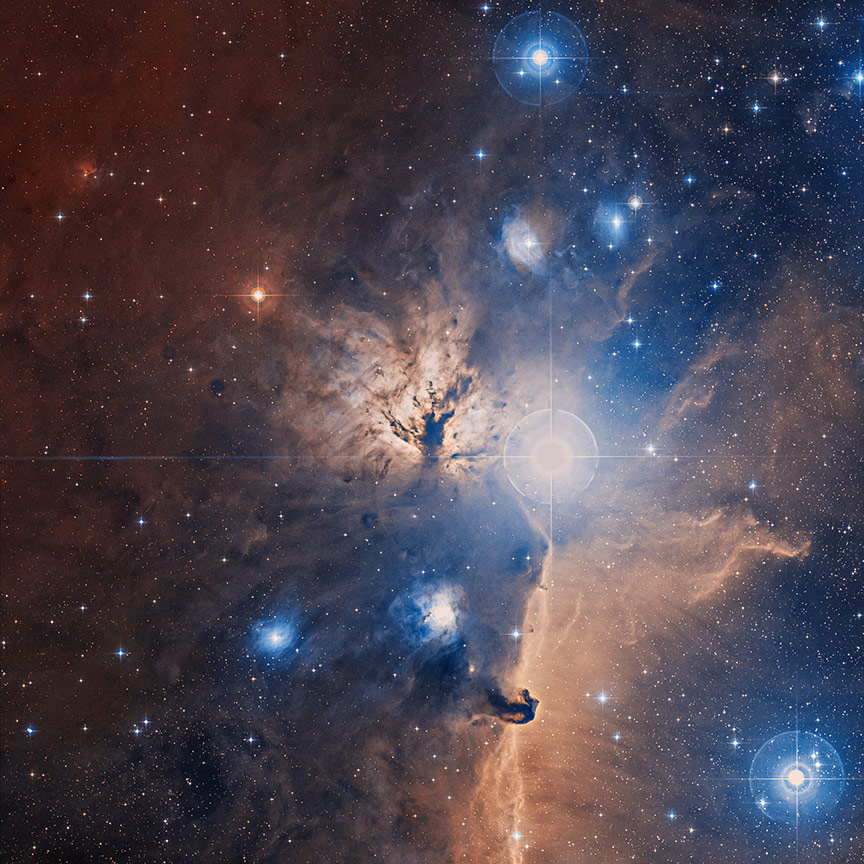
Previous studies of the Orion Nebula Cluster revealed hints of this reversed age spread, but these earlier efforts were based on limited or biased star samples. This latest research provides the first evidence of such age differences in the Flame Nebula.
“The next steps will be to see if we find this same age range in other young clusters,” said Penn State graduate student Michael Kuhn, who also worked on the study.
These results will be published in two separate papers in The Astrophysical Journal and are available online. They are part of the MYStIX (Massive Young Star-Forming Complex Study in Infrared and X-ray) project led by Penn State astronomers.
NASA’s Marshall Space Flight Center in Huntsville, Alabama, manages the Chandra program for NASA’s Science Mission Directorate in Washington. The Smithsonian Astrophysical Observatory in Cambridge, Massachusetts, controls Chandra’s science and flight operations.
References:
“Age Gradients in the Stellar Populations of Massive Star Forming Regions Based on a New Stellar Chronometer” by Konstantin V. Getman, Eric D. Feigelson, Michael A. Kuhn, Patrick S. Broos, Leisa K. Townsley, Tim Naylor, Matthew S. Povich, Kevin L. Luhman and Gordon P. Garmire, 9 May 2014, The Astrophysical Journal.
DOI: 10.1088/0004-637X/787/2/108
arXiv: 1403.2741
“Core-Halo Age Gradients and Star Formation in the Orion Nebula and NGC~2024 Young Stellar Clusters” by Konstantin V. Getman, Eric D. Feigelson and Michael A. Kuhn, 9 May 2014, The Astrophysical Journal.
DOI: 10.1088/0004-637X/787/2/109
arXiv:1403.2742
Never miss a breakthrough: Join the SciTechDaily newsletter.
Follow us on Google and Google News.