
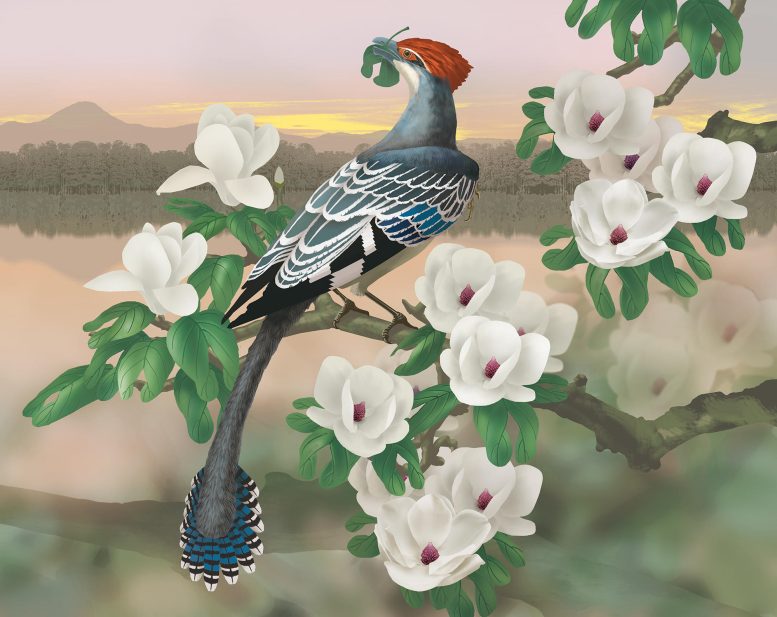
A fossilized Jeholornis provides the first evidence of leaf-eating birds, revealing their early ties to flowering plants over 100 million years ago.
New findings from the analysis of a 120-million-year-old fossil skeleton of the extinct bird Jeholornis, unearthed from northeastern China, present the earliest known evidence of leaf-eating birds, marking the earliest known evolution of arboreal plant-eating among birds.
The pheasant-sized Jeholornis, a member of the second most primitive lineage of known birds, has teeth and a long bony tail like its predatory, feathered dinosaur relatives. However, microscopic analysis of the fossilized residues in the stomach of this juvenile, arboreal (tree-living) bird demonstrates that Jeholornis was not a predator. It had eaten tree leaves from a group of flowering plants called magnoliids that includes the living magnolia, cinnamon, and avocado trees.
The study, published in Nature Communications on July 28, was conducted by researchers from the Institute of Vertebrate Paleontology and Paleoanthropology (IVPP) of the Chinese Academy of Sciences and their collaborators.
Ancient Bird-Plant Relationship
Close relationships between birds and flowering plants (angiosperms) are commonplace today and include birds pollinating angiosperm flowers, eating their fruits, and dispersing their seeds. However, the fossil record has not provided much evidence about the evolutionary origins of these close ecological relationships.
The presence of gizzard stones (gastroliths) used to grind plant parts during digestion in the stomach areas of fossil skeletons allow paleontologists to determine that the diets of some early birds included plant parts. More direct evidence of plants in the diet of the earliest lineages of birds comes from other fossil skeletons of Jeholornis with fossilized fruit and seeds preserved in their digestive system.
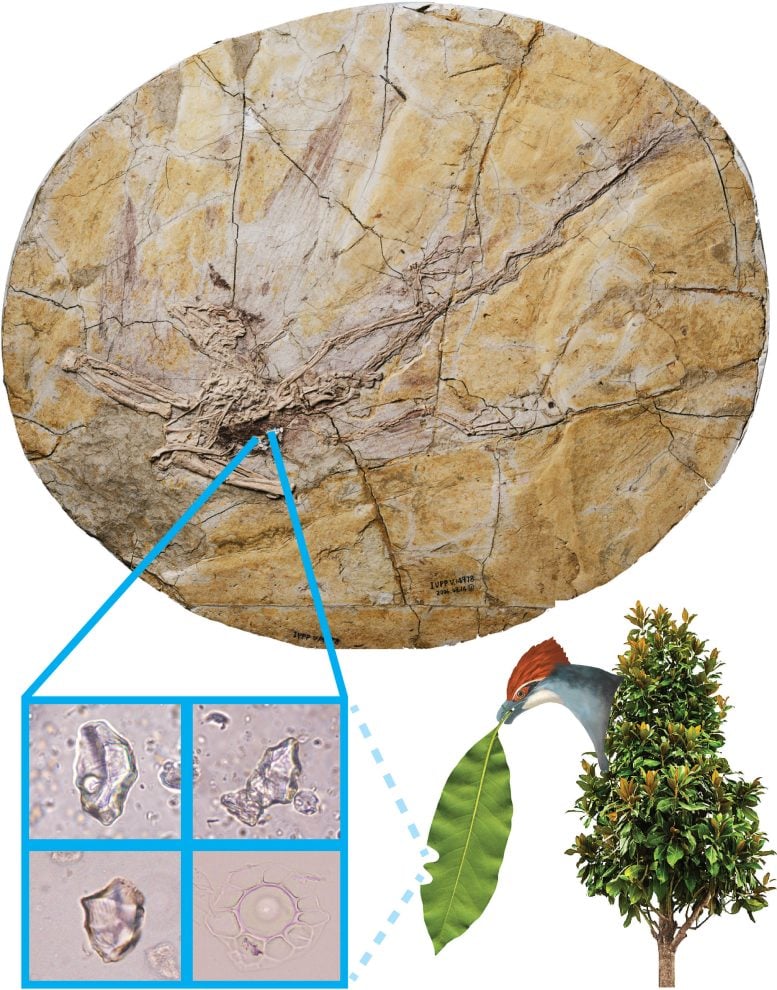
“The fossils from the Jehol Biota in China show us that very early in bird evolution they switched from predatory behaviors to using their wings to fly into trees so they could eat the fruits, seeds, and leaves of plants like so many species do today,” said Dr. LI Zhiheng from IVPP, corresponding author of the study.
To better understand early bird diets, this international group of scientists searched for the microscopic fossilized remnants of plants within the remains of the ancient stomach contents inside the bird skeleton, a method not attempted before. They aimed to find phytoliths, which are rigid microscopic structures made of opaline silica (silicon dioxide) produced by plants within and between their cells.
The researchers sampled the fossilized stomach area around the gastroliths to try to find the phytolith remains of long-decayed plants. They recovered hundreds of phytoliths after processing the tiny samples with acid and other chemicals to remove nearly everything that is not a phytolith.
“After comparison with over 4,000 kinds of modern phytoliths, we can see that most of the identifiable fossil phytoliths from the stomach come from the leaves of magnoliids,” said Dr. Wu Yan from IVPP, first author of the study. Similar samples of the rock surrounding the fossil bird skeleton produced no phytolith remains at all, helping to confirm that the recovered phytoliths represent part of the bird’s diet.
To further support their hypothesis of leaf-eating in this early bird, the paleontologists also compared the lower jaw of this bird to living birds with a wide range of diets. Coauthor Dr. Hu Han from Oxford University said, “A more detailed statistical analysis of the three-dimensional shape of the lower jaw of Jeholornis shows similarities to the shapes of living birds that eat mostly plants including the living leaf specialist, the hoatzin from tropical forests in South America.”
A Longstanding Evolutionary Connection Between Birds and Plants
Flowering plants are key to living bird diversity because many use nectar and various plant parts to fuel their energetic flight and rapid growth, and many bright feather colors come from eating plants.
“As we can see with this extinct, vegetarian, tree-living bird, the evolution of birds has been linked to flowering plants for over 100 million years with fruits, seeds, and even leaves serving as main courses on the bird menu starting originally when birds still had teeth and long, bony dinosaurian tails,” said Dr. Thomas Stidham from the IVPP, co-author of the study.
Reference: “Intra-gastric phytoliths provide evidence for folivory in basal avialans of the Early Cretaceous Jehol Biota” by Yan Wu, Yong Ge, Han Hu, Thomas A. Stidham, Zhiheng Li, Alida M. Bailleul and Zhonghe Zhou, 28 July 2023, Nature Communications.
DOI: 10.1038/s41467-023-40311-z
Never miss a breakthrough: Join the SciTechDaily newsletter.
Follow us on Google and Google News.