
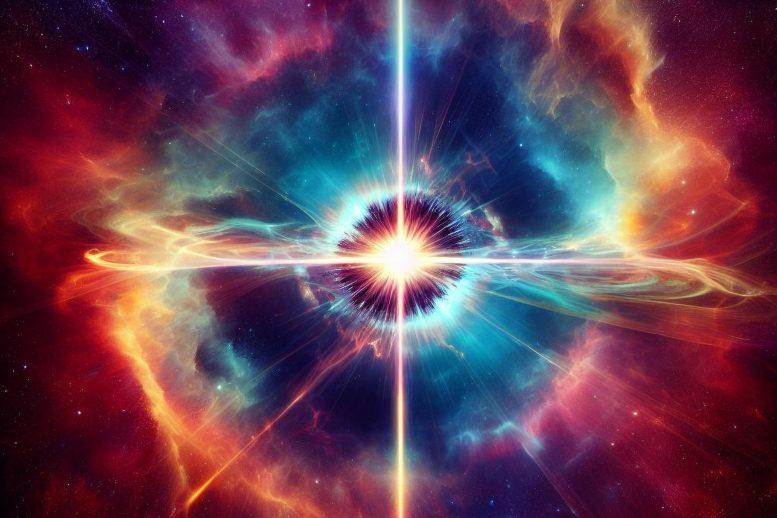
H.E.S.S. observatory records 20 tera-electronvolts photons from the Vela pulsar.
Scientists using the H.E.S.S. observatory in Namibia have detected the highest energy gamma rays ever from a dead star called a pulsar. The energy of these gamma rays clocked in at 20 tera-electronvolts, or about ten trillion times the energy of visible light. This observation is hard to reconcile with the theory of the production of such pulsed gamma rays, as the international team reports today (October 5) in the journal Nature Astronomy.
The Nature of Pulsars
Pulsars are the left-over corpses of stars that spectacularly exploded in a supernova. The explosions leave behind a tiny, dead star with a diameter of just some 20 kilometers, rotating extremely fast and endowed with an enormous magnetic field. “These dead stars are almost entirely made up of neutrons and are incredibly dense: a teaspoon of their material has a mass of more than five billion tonnes, or about 900 times the mass of the Great Pyramid of Giza,” explains H.E.S.S. scientist Emma de Oña Wilhelmi, a co-author of the publication working at DESY.
Radiation From Pulsars
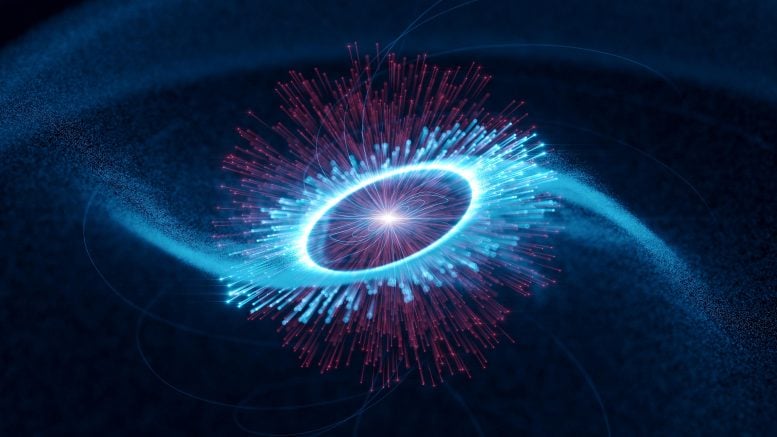
Pulsars emit rotating beams of electromagnetic radiation, somewhat like cosmic lighthouses. If their beam sweeps across our solar system, we see flashes of radiation at regular time intervals. These flashes, also called pulses of radiation, can be searched for in different energy bands of the electromagnetic spectrum. Scientists think that the source of this radiation are fast electrons produced and accelerated in the pulsar’s magnetosphere, while traveling toward its periphery. The magnetosphere is made up of plasma and electromagnetic fields that surround and co-rotate with the star. “On their outward journey, the electrons acquire energy and release it in the form of the observed radiation beams,” says Bronek Rudak from the Nicolaus Copernicus Astronomical Center (CAMK PAN) in Poland, also a co-author.
The Vela pulsar, located in the Southern sky in the constellation Vela (sail of the ship), is the brightest pulsar in the radio band of the electromagnetic spectrum and the brightest persistent source of cosmic gamma rays in the giga-electronvolts (GeV) range. It rotates about eleven times per second. However, above a few GeV, its radiation ends abruptly, presumably because the electrons reach the end of the pulsar’s magnetosphere and escape from it.
But this is not the end of the story: using deep observations with H.E.S.S., a new radiation component at even higher energies has now been discovered, with energies of up to tens of tera-electronvolts (TeV). “That is about 200 times more energetic than all radiation ever detected before from this object,” says co-author Christo Venter from the North-West University in South Africa. This very high-energy component appears at the same phase intervals as the one observed in the GeV range. However, to attain these energies, the electrons might have to travel even farther than the magnetosphere, yet the rotational emission pattern needs to remain intact.
Challenging Established Knowledge
“This result challenges our previous knowledge of pulsars and requires a rethinking of how these natural accelerators work,” says Arache Djannati-Atai from the Astroparticle & Cosmology (APC) laboratory in France, who led the research.
“The traditional scheme according to which particles are accelerated along magnetic field lines within or slightly outside the magnetosphere cannot sufficiently explain our observations. Perhaps we are witnessing the acceleration of particles through the so-called magnetic reconnection process beyond the light cylinder, which still somehow preserves the rotational pattern? But even this scenario faces difficulties in explaining how such extreme radiation is produced.”
Whatever the explanation, next to its other superlatives, the Vela pulsar now officially holds the record as the pulsar with the highest-energy gamma rays discovered to date. “This discovery opens a new observation window for detection of other pulsars in the tens of teraelectronvolt range with current and upcoming more sensitive gamma-ray telescopes, hence paving the way for a better understanding of the extreme acceleration processes in highly magnetized astrophysical objects,” says Djannati-Atai.
Reference: “Discovery of a radiation component from the Vela pulsar reaching 20 teraelectronvolts” by The H.E.S.S. Collaboration et al., R. Zanin, M. Kerr, S. Johnston, R. M. Shannon and D. A. Smith, 5 October 2023, Nature Astronomy.
DOI: 10.1038/s41550-023-02052-3
Never miss a breakthrough: Join the SciTechDaily newsletter.
Follow us on Google and Google News.
1 Comment
Harnessing this could make a nice military death ray!