
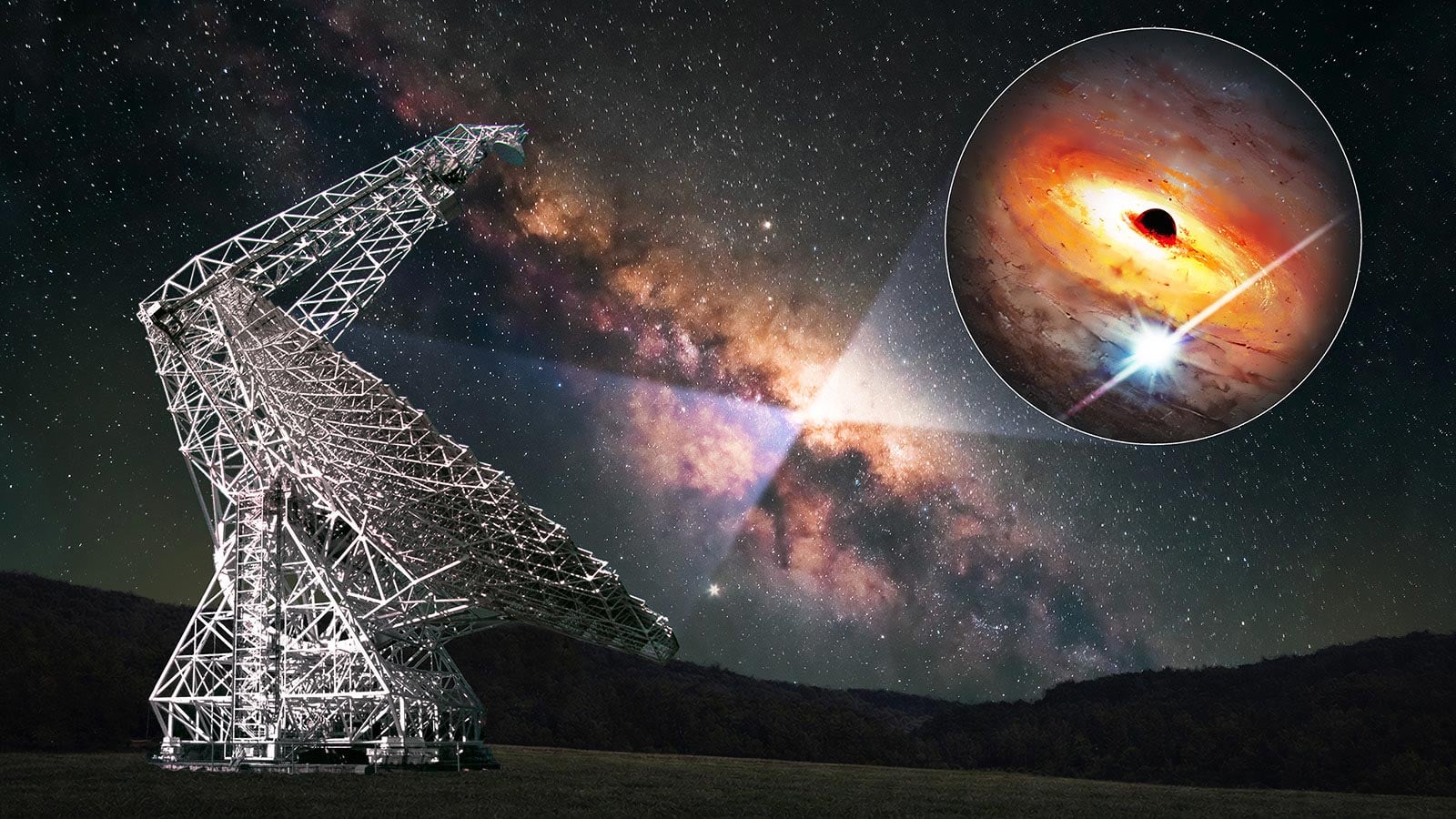
A lightning-fast pulsar near our galaxy’s black hole could unlock new secrets about gravity and spacetime.
Scientists at Columbia University working with Breakthrough Listen, a research initiative dedicated to searching for evidence of civilizations beyond Earth, have announced new findings from the Breakthrough Listen Galactic Center Survey. This project represents one of the most sensitive radio efforts ever undertaken to hunt for pulsars in the crowded and turbulent core of the Milky Way. The study was led by recent Columbia PhD graduate Karen I. Perez and appears in The Astrophysical Journal.
During the survey, researchers identified a promising 8.19-millisecond pulsar (MSP) candidate located close to Sagittarius A*, the supermassive black hole at the center of our galaxy.
A Pulsar Near a Supermassive Black Hole
Confirming the object and precisely tracking the timing of its pulses could open the door to powerful new tests of General Relativity. A pulsar in this extreme region would allow scientists to measure the behavior of space-time in the intense gravitational field surrounding a supermassive black hole.
Pulsars are dense neutron stars left behind after massive stars explode. They spin rapidly and generate strong magnetic fields, producing focused beams of radio waves that sweep through space like lighthouse beams.
When unaffected by outside forces, a pulsar’s signals reach telescopes with extraordinary consistency. Because of this steady rhythm, pulsars function as remarkably precise cosmic clocks. Millisecond pulsars spin especially quickly, giving them an even more stable and predictable timing pattern.
How Gravity Can Distort a Pulsar’s Signals
“Any external influence on a pulsar, such as the gravitational pull of a massive object, would introduce anomalies in this steady arrival of pulses, which can be measured and modeled,” said Slavko Bogdanov, a research scientist at the Columbia Astrophysics Laboratory who was a co-author on the study. “In addition, when the pulses travel near a very massive object, they may be deflected and experience time delays due to the warping of space-time, as predicted by Einstein’s General Theory of Relativity.”
Sagittarius A* contains about 4 million times the mass of the Sun, giving it an enormous gravitational influence over its surroundings.
Follow-Up Observations and Public Data Release
Because of the possible scientific importance of this candidate, researchers are now analyzing additional follow-up observations to determine whether the signal truly comes from a pulsar.
To encourage wider participation from the scientific community, Breakthrough Listen is making the observational data publicly available. This will allow scientists around the world to conduct independent studies and explore related research questions.
“We’re looking forward to what follow-up observations might reveal about this pulsar candidate,” Perez said. If confirmed, it could help us better understand both our own Galaxy, and General Relativity as a whole.”
Reference: “On the Deepest Search for Galactic Center Pulsars and an Examination of an Intriguing Millisecond Pulsar Candidate” by Karen I. Perez, Vishal Gajjar, Slavko Bogdanov, Jules P. Halpern, Paul B. Demorest, Steve Croft, Matt Lebofsky, David H. E. MacMahon and Andrew P. V. Siemion, 9 February 2026, The Astrophysical Journal.
DOI: 10.3847/1538-4357/ae336c
Never miss a breakthrough: Join the SciTechDaily newsletter.
Follow us on Google and Google News.
3 Comments
The fun part of all of the research into stars in the Milky Way is that all we find out is what happened years ago. Mostly, it’s hundreds of millennia ago. The truth is that, for all we know, the universe, as was predicted in the Bible, is well on the way to ” rolling up like a scroll”. We won’t even know that the nearest star went nova until 6 years after it happens. Probably around the same time that Christ returns. (Or, if you prefer, the apocalypse). That depends on your interpretation of prophesy.
thanks
Memo 2602231305_Source 1. Reinterpretation []
Source 1.
https://scitechdaily.com/something-is-ticking-near-the-milky-ways-supermassive-black-hole/
1. Something is moving near the Milky Way’s supermassive black hole.
_A superfast pulsar near our galaxy’s black hole may reveal new secrets about gravity and space-time.
_Columbia University scientists participating in Breakthrough Listen, a research project searching for evidence of extraterrestrial civilization, have announced new findings from the Breakthrough Listen Galactic Center Survey.
1-1.
_This project is one of the most sensitive radio surveys ever conducted to search for pulsars in the dense, turbulent region of the Milky Way’s center. The study, led by Karen I. Perez, who recently received her Ph.D. from Columbia University, was published in The Astrophysical Journal.
_In this survey, the researchers discovered a promising candidate for an 8.19-millisecond pulsar (MSP) near Sagittarius A*, the supermassive black hole at the center of our galaxy.
1-2. Pulsars near supermassive black holes
_Identifying this object and precisely tracking the pulse’s origin could open the way to powerful new tests of general relativity. Pulsars in these extreme regions would allow scientists to measure how spacetime behaves in the intense gravitational field surrounding a supermassive black hole.
_Pulsars are dense neutron stars left over from the explosion of a massive star. They rapidly rotate, generating powerful magnetic fields and emitting focused radio waves that travel across the universe like a lighthouse.
ㅡa1.[[ Neutron star pulsars are defined as vixxa. Vixxa, controlled by a black hole vixer, forms a powerful magnetic tokamak confinement and emits radio waves into space. Nuclear fusion occurs, and stars are born. Hehe. 2602231236.
ㅡIronically, the only remaining units in the universe from stellar collapse are vixer.blackhole and vixxa.neutronstars.
ㅡㅡGood point about editing.
Stars have differentiated into smaller particle stars (qqcell.tsp quark stars, Higgs stars, mbxell.zsp.stars), and have penetrated even into the quantum field. Hehe. 1302.09.
ㅡIf you look at the types of vixxa in pulsar light, qpeoms.system.sample1.2.3, there are countless. 1339.
Elementary particles that don’t belong to magnetic fields belong to the strong or weak field, the grand unified field, and complex quantum fields. There are also pulsars, and there may be even more types of susqars. Hmm. Hehe. 1332.
sample1. msbase12.qpeoms.2square.vector
oms.vix.a’6,vixx.a(b1,g3,k3,o5,n6)
b0acfd|0000e0
000ac0|f00bde
0c0fab|000e0d
e00d0c|0b0fa0
f000e0|b0dac0
d0f000|cae0b0
0b000f|0ead0c
0deb00|ac000f
ced0ba|00f000
a0b00e|0dc0f0
0ace00|df000b
0f00d0|e0bc0a
sample2.qoms(standard)
0 0 0 0 0 0 0 0 1 1=2,0
0 0 0 0 0 0 1 1 0 0
0 0 0 0 0 0 1 1 0 0
0 0 0 0 0 1 0 0 1 0
0 0 0 1 1 0 0 0 0 0
0 1 0 1 0 0 0 0 0 0
0 0 1 0 0 1 0 0 0 0
0 1 0 0 1 0 0 0 0 0
2 0 0 0 0 0 0 0 0
0 0 1 0 0 0 0 0 0 1
sample3.pms (standard)
q0000000000
00q00000000
0000q000000
0000000q00
0000000000q
0q0000000000
000000000q0
000000000q0
000000000q0
]]
2.
_Under no external influence, the signals from pulsars reach the telescope with remarkable consistency. This stable rhythm allows pulsars to act as extremely precise cosmic clocks. Millisecond pulsars, in particular, exhibit even more stable and predictable time patterns due to their extremely fast rotation speeds.
2-1. How Gravity Distorts Pulsar Signals
“External influences, such as the gravity of massive objects, can cause anomalies in the steady pulses emitted by pulsars, which can be measured and modeled,” said study co-author Slavko Bogdanov, a researcher at the Columbia Astrophysics Laboratory.
-a2.[[ Pulsar Vixxa can exhibit anomalies in its radio streams due to gravity, which distorts spacetime. The time delay can cause the msbase.banc to slow down or speed up. This is due to the unexpected shift in the entanglement duality of the susqer’s radio speed due to the black hole vixxer.
((_”Also, when a pulse passes near a very massive object, the pulse can be bent and time-delayed due to spacetime distortions, as predicted by Einstein’s theory of general relativity.”)
_Sagittarius A* has a mass of about 4 million times the mass of the Sun, exerting an enormous gravitational influence on its surroundings.
3. Follow-up Observations and Public Data
_Due to the potential scientific significance of this candidate object, researchers are analyzing additional follow-up observations to confirm that the signal actually came from a pulsar.
_To encourage broad participation from the scientific community, Breakthrough Listen is making the observations public, allowing scientists around the world to conduct independent studies and explore relevant research questions.
_”We are excited to see what follow-up observations reveal about this pulsar candidate,” Perez said. “If confirmed, this could help us better understand our galaxy and general relativity as a whole.”))
ㅡㅡMagnetic field When a pulsar vixxa.msp forms a magnetic field, it can cause distortions in spacetime. As the dwell time increases and the distortion in observations worsens, it becomes unclear which black hole vixer it belongs to. 1247.51.
– -However, the important fact is that, whether late or early, the signal sent by the vixer always appears in ‘magicsum.value.data.’ 1254.
]]