
Close Menu
    Facebook X (Twitter) Instagram
    SciTechDaily
    • Biology
    • Chemistry
    • Earth
    • Health
    • Physics
    • Science
    • Space
    • Technology
    Facebook X (Twitter) Pinterest YouTube RSS
    SciTechDaily
    Home»Space»This Chaotic Spiral Galaxy Is Still Recovering From a Cosmic Collision
    Space

    This Chaotic Spiral Galaxy Is Still Recovering From a Cosmic Collision

    By ESA/HubbleNovember 16, 2025No Comments2 Mins Read
    Facebook Twitter Pinterest Telegram LinkedIn WhatsApp Email Reddit
    Share
    Facebook Twitter LinkedIn Pinterest Telegram Email Reddit
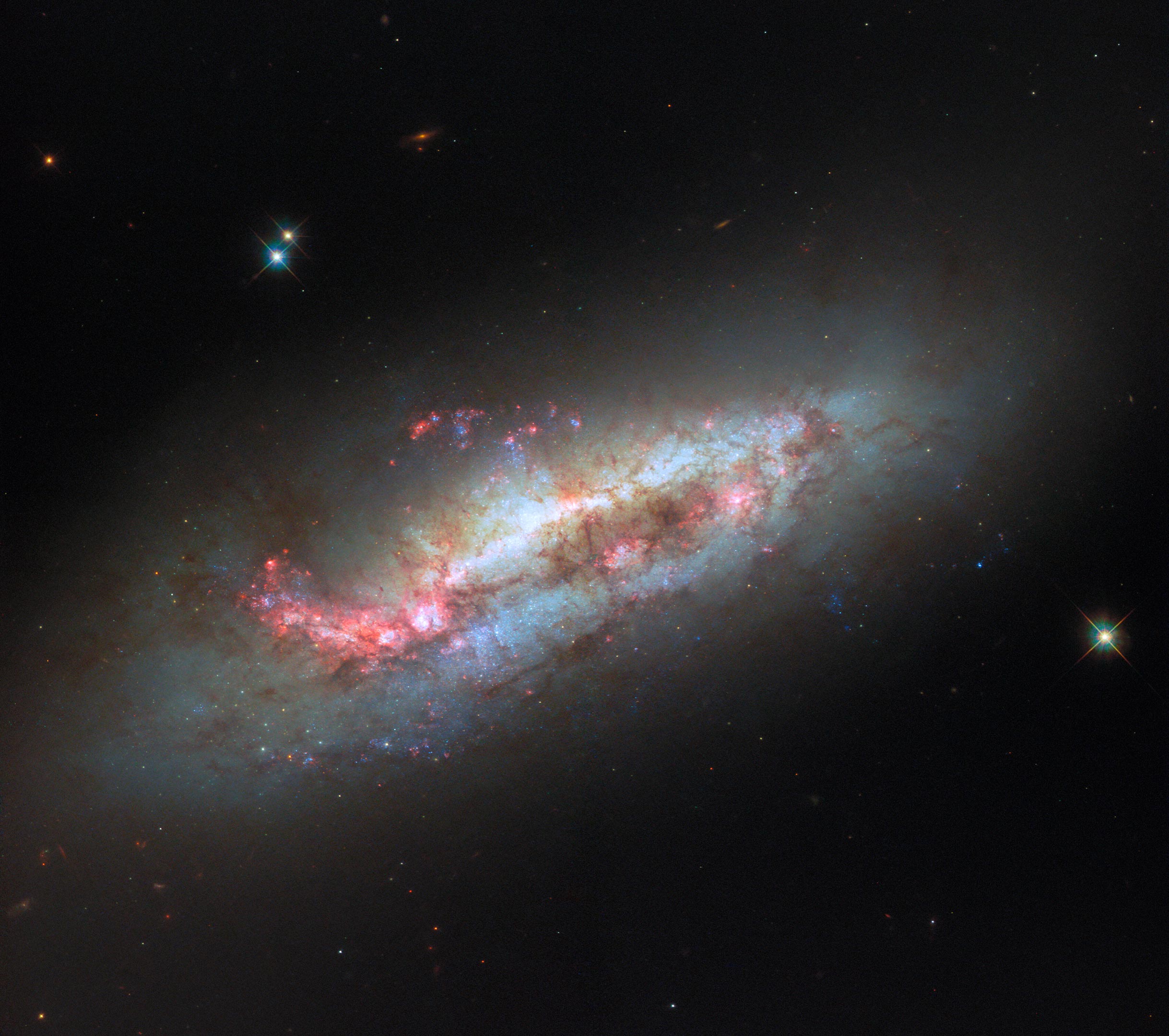
    Peculiar Spiral Galaxy NGC 1511
    Hubble’s striking view of NGC 1511 reveals a spiral galaxy shaped by cosmic turmoil. Once locked in dramatic encounters with its smaller neighbors, the galaxy still bears the scars—twisted arms, distorted gas, and a faint hydrogen bridge linking it to a nearby companion. These past clashes have ignited a burst of new stars, lighting up its dusty disk with fresh brilliance. Credit: ESA/Hubble & NASA, D. Thilker

    NGC 1511’s chaotic history with nearby galaxies has left it connected by gas streams and littered with warped structures.

    Its energetic star-forming regions offer astronomers a chance to study how gas cycles between clouds and stars.

    A Peculiar Spiral in Hydrus

    Although NGC 1511 is striking in appearance, it is not the kind of galaxy most would hope to live beside. Featured in this Hubble Picture of the Week, NGC 1511 is an unusual spiral galaxy located about 50 million light-years from Earth in the constellation Hydrus.

    Companion Galaxies and Past Encounters

    NGC 1511 moves through space with two smaller neighbors known as NGC 1511A and NGC 1511B, which lie beyond the borders of this particular Hubble view. NGC 1511B is the closest of the pair, and studies suggest that it and NGC 1511 collided long ago; a thin filament of hydrogen gas still links the two, and NGC 1511B shows clear signs of being stretched and distorted by the event.

    Researchers have also uncovered evidence that NGC 1511 once interacted with another small companion galaxy, which now appears to have been completely torn apart.

    Star Formation Fueled by Turbulence

    These encounters have shaped NGC 1511 as well. The galaxy is currently undergoing a burst of star formation, and its disk contains unusual arcs, loops, and plumes that may be remnants of earlier interactions. Astronomers will use Hubble’s detailed imagery to investigate the star clusters nestled within the galaxy’s dusty regions, hoping to trace how gas moves from interstellar clouds into new stars and later returns to the galactic environment.

    Never miss a breakthrough: Join the SciTechDaily newsletter.
    Follow us on Google and Google News.

    Astronomy European Space Agency Hubble Space Telescope NASA
    Share. Facebook Twitter Pinterest LinkedIn Email Reddit

    Related Articles

    NASA’s Hubble Accidentally Witnesses a Comet Shattering in Space

    Hubble’s Newest Discovery Isn’t a Star, It’s a Window Into the Dark Universe

    This Nearby Galaxy Shows How Frozen Clouds Ignite Into Stars

    This Strange Spiral Galaxy Is Hiding a Massive Black Hole

    Hubble Zooms In on a Galaxy That Maps the Universe’s Expansion

    Hubble Captures a Dazzling Spiral Galaxy Alive With Birth and Destruction

    Hubble Spots a Glowing “Ring of Fire” in a Distant Spiral Galaxy

    Dust, Light & Ancient Collisions: The Sombrero Galaxy Like You’ve Never Seen It

    Star Formation in Motion: Hubble Reveals Spiraling Stars and Sculpted Nebulae

    Leave A Reply Cancel Reply

    • Facebook
    • Twitter
    • Pinterest
    • YouTube

    Don't Miss a Discovery

    Subscribe for the Latest in Science & Tech!

    Trending News

    This Experimental Drug Repaired the Gut and Reversed Severe Fatty Liver Disease

    Physicists Just Turned a Black Hole Energy Theory Into Reality

    Stanford Scientists Solve a 252-Million-Year-Old Mass Extinction Mystery

    The Ancient Survival Mechanism Making Weight Loss So Difficult

    Just 3,000 Steps a Day May Help Protect the Brain From Alzheimer’s

    “Weird Clams” Reveal a New Invasion Along the U.S. Northeast Coast

    Archaeologists Decapitated Tutankhamun and Glued His Body Back Together

    New Black Hole Theory Solves a 50-Year-Old Problem

    Follow SciTechDaily
    • Facebook
    • Twitter
    • YouTube
    • Pinterest
    • Newsletter
    • RSS
    SciTech News
    • Biology News
    • Chemistry News
    • Earth News
    • Health News
    • Physics News
    • Science News
    • Space News
    • Technology News
    Recent Posts
    • The Oldest Known Right-Handed Animal May Have Lived 550 Million Years Ago
    • MIT’s Tiny Flying Robot Just Learned To Move Like a Real Insect
    • Why Are Bees Struggling To Survive This Summer?
    • Antarctic Meltwater Is Making Glaciers Slide Faster Toward the Ocean
    • Ancient Dog Skulls Rewrite the Story of Canine Evolution
    Copyright © 1998 - 2026 SciTechDaily. All Rights Reserved.
    • Science News
    • About
    • Contact
    • Editorial Board
    • Privacy Policy
    • Terms of Use

    Type above and press Enter to search. Press Esc to cancel.