
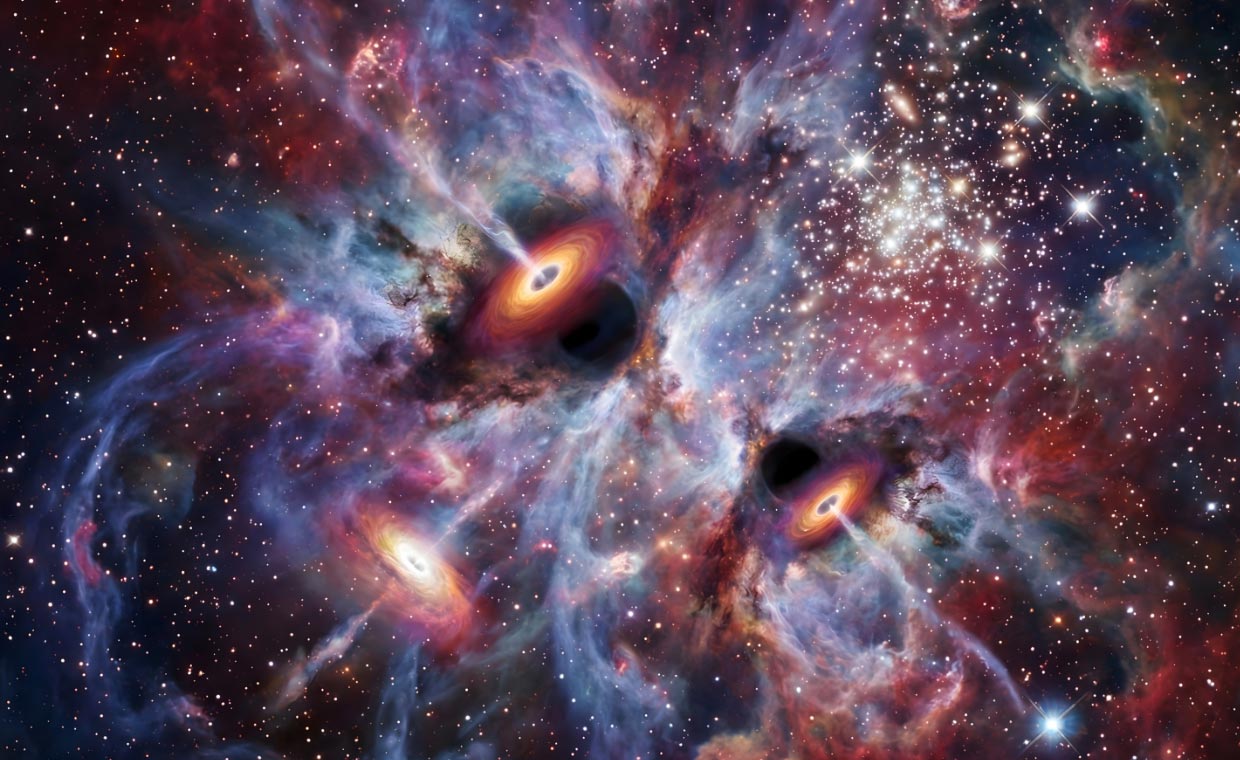
Black holes in the early Universe appear to have grown far faster than scientists once believed.
Astronomers have long struggled to explain how black holes became enormous so early in the Universe’s history. Observations show that some reached supermassive proportions in a cosmic blink of an eye, leaving scientists searching for a mechanism powerful enough to drive such rapid growth. New research from Ireland’s Maynooth University (MU), published in Nature Astronomy, offers a compelling explanation.
The study suggests that the early Universe was far more violent and unpredictable than previously assumed. In this turbulent setting, small black holes formed shortly after the Big Bang were surrounded by vast amounts of dense gas, allowing them to grow at extraordinary speeds.
“We found that the chaotic conditions that existed in the early Universe triggered early, smaller black holes to grow into the super-massive black holes we see later following a feeding frenzy which devoured material all around them,” says Daxal Mehta, a PhD candidate in Maynooth University’s Department of Physics, who led the research.
To test this idea, the team relied on detailed computer simulations capable of tracking how matter behaved around young black holes in the first few hundred million years of cosmic time.
“We revealed, using state-of-the-art computer simulations, that the first generation of black holes – those born just a few hundred million years after the Big Bang – grew incredibly fast, into tens of thousands of times the size of our Sun.”
Solving a Long-Standing Astronomical Puzzle
“This breakthrough unlocks one of astronomy’s big puzzles,” says Dr Lewis Prole, a postdoctoral fellow at MU and research team member. “That being how black holes born in the early Universe, as observed by the James Webb Space Telescope, managed to reach such super-massive sizes so quickly.”
This process occurs when a black hole pulls in matter at a rate far higher than what is usually considered stable. Under normal conditions, the intense light produced should push surrounding material away. Yet in the early Universe, these black holes continued to consume matter despite that barrier, allowing them to gain mass at remarkable speeds.
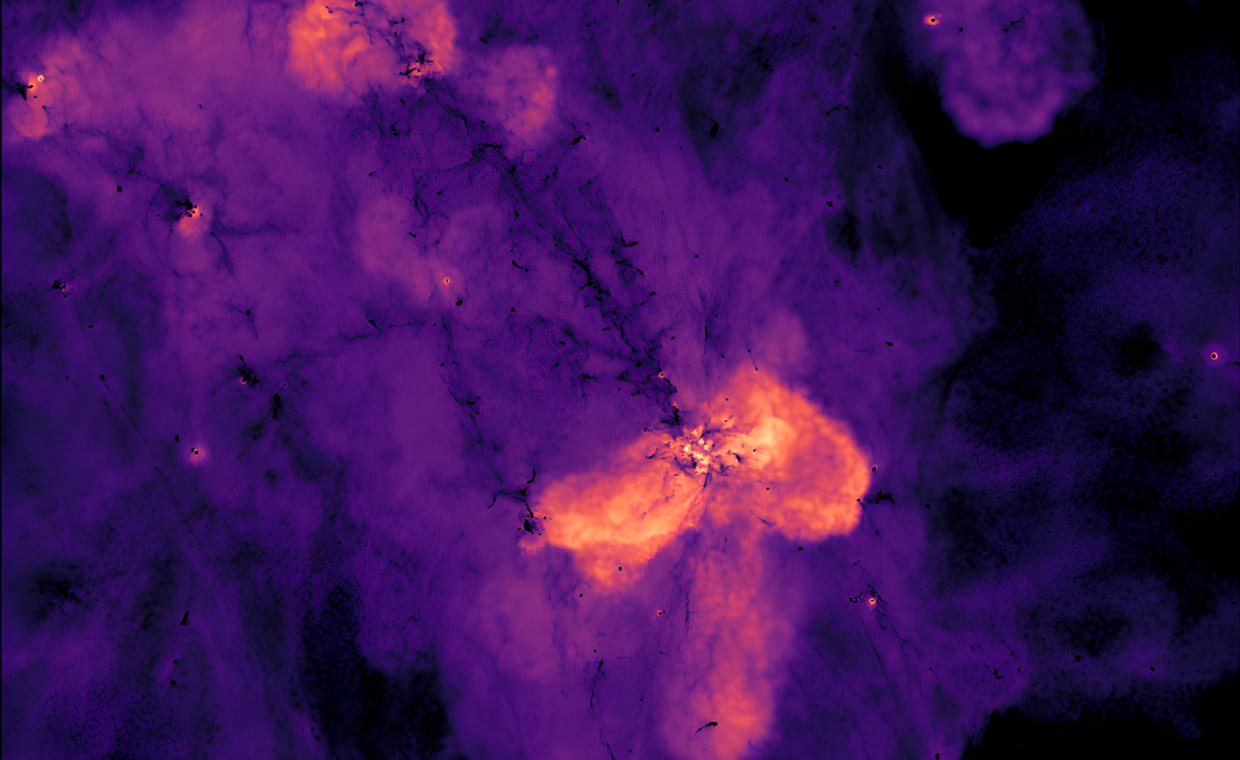
The results provided a ‘missing link’ between the first stars and the supermassive black holes that came much later.
“These tiny black holes were previously thought to be too small to grow into the behemoth black holes observed at the center of early galaxies,” says Daxal Mehta. “What we have shown here is that these early black holes, while small, are capable of growing spectacularly fast, given the right conditions,” he adds.
Rethinking Black Hole “Seeds”
Black holes are generally grouped into two main categories known as ‘light seed’ and ‘heavy seed’ types. Light seed black holes form with relatively modest masses, typically ranging from about ten to a few hundred times the mass of our Sun. To become ‘supermassive’, reaching millions of times the Sun’s mass, these smaller objects must undergo long periods of growth.
Heavy seed black holes follow a very different path. They are thought to form already enormous, with initial masses that may reach as high as one hundred thousand times the mass of the Sun.
For many years, astronomers believed that only these heavy seed black holes could account for the super-massive black holes found at the centers of most large galaxies, since their large starting size made rapid growth easier to explain.
“Now we’re not so sure,” says Dr John Regan of MU’s Physics Department and research group leader. “Heavy seeds are somewhat more exotic and may need rare conditions to form. Our simulations show that your ‘garden variety’ stellar mass black holes can grow at extreme rates in the early Universe.”
The MU research reshapes the understanding of black hole origins but also highlights the importance of high-resolution simulations in uncovering the Universe’s earliest secrets.
“The early Universe is much more chaotic and turbulent than we expected, with a much larger population of massive black holes than we anticipated too,” says Dr Regan.
Implications for Future Space Missions
The results also have implications for the important joint European Space Agency-NASA Laser Interferometer Space Antenna (LISA) mission, scheduled to launch in 2035.
“Future gravitational wave observations from that mission may be able to detect the mergers of these tiny, early, rapidly growing baby black holes,” says Dr Regan.
Reference: “The growth of light seed black holes in the early Universe” by Daxal H. Mehta, John A. Regan and Lewis Prole, 21 January 2026, Nature Astronomy.
DOI: 10.1038/s41550-025-02767-5
Never miss a breakthrough: Join the SciTechDaily newsletter.
Follow us on Google and Google News.
4 Comments
Memo 2601241414_Source 1. Reinterpretation []
Source 1.
https://scitechdaily.com/astronomers-solve-the-mystery-of-how-black-holes-got-big-so-fast/
1.
_Astronomers have solved the mystery of how black holes grew so fast.
_Black holes in the early universe appear to have grown much faster than scientists previously thought.
ㅡa【msbase.size increases naturally, resulting in the formation of massive black holes. 0953.
>>>The smallest size is example1., a galactic nucleus AGN.oms4, which contains a single black hole, vixer, and a single neutron star, vixxa. 1133.
example1.AGN.oms4
01000000>vixer.a3.black_hole
00000100>
00000001<vixxa.a6.neutron_star
00010000>> Of course, the largest size would be oms.n, but even simple propagation by expanding AGN.oms4. would increase the number and mass of black holes in a manner similar to the diffusion of hydrogen or helium in the early universe. This is expressed as AGN.oms4.power. Hmm. 1142.
】
_Astronomers have long struggled to explain how black holes grew so massive in the early universe.
_Observations show that some black holes reached supermassive sizes in the blink of an eye in cosmic time, and scientists are searching for a powerful mechanism that enables this rapid growth.
A new study from Maynooth University (MU) in Ireland, published in Nature Astronomy, offers a compelling explanation.
1-1.
,_This study suggests that the early universe was far more turbulent and unpredictable than previously thought. In this turbulent environment, small black holes formed shortly after the Big Bang, surrounded by massive amounts of dense gas, could grow at incredible speeds.
ㅡa2【 That’s the theory of the eye of a hurricane, a theory that explains the origin of vortices in astronomical and physical terms. Based on my theory, if we understand it fundamentally, it can be explained by the geometrical structure example1.(*)domain. Oh, 1012.
1-2. “We found that the chaotic environment of the early universe triggered these initially smaller black holes to grow into the supermassive black holes we observe later, through a frenzied process of devouring surrounding matter,” said Daxal Mehta, a PhD student in physics at Maynooth University who led the research.
-a3. [Hmm. That’s not true. Black hole vixers didn’t start randomly; they had a sophisticated energy supply system. 1018.
1-3.
“Using cutting-edge computer simulations, we’ve revealed that the first generation of black holes, born just a few hundred million years after the Big Bang, grew incredibly rapidly, reaching sizes tens of thousands of times the size of the Sun.”
>>>The 01 in example1. is believed to have originated from qqcell.nqvixer.eqpms.dark><<>>mbshell gogo!!backback!! 1146. 1223.
s#1)<<<<>> This series of processes seems simple in the process of decomposing msbase4. into oms4. However, if you look at the banc decomposition of msbase.n into qpeoms.n or the nk decay process, you realize how arduous the reverse path is. Ugh. 1209.
s#3.)>>> In any case, the process of creating and collapsing msbase.galaxy from the quantum unit qpeoms involves a simple path, along with a very complex scenario path. Ugh. 1220.
】
_Under normal circumstances, the intense light emitted from a black hole should repel surrounding matter. However, in the early universe, these black holes could continue to absorb matter despite these barriers, accreting their mass at an astonishing rate.
2-1.
_This research provides the “missing link” between the first stars and the supermassive black holes that emerged much later.
_”Previously, these small black holes were thought to be too small to grow into the massive black holes observed in the centers of early galaxies,” says Daxal Mehta.
_But with this study, we’ve shown that these early black holes, despite their small size, can grow surprisingly quickly given the right conditions,” he added.
2-2. Rethinking Black Hole “Seeds”
_Black holes are generally classified into two main categories: “light seed” and “heavy seed.” Light seed black holes form with relatively small masses, typically between tens and hundreds of times the mass of the Sun. These small celestial bodies must grow over a long period of time to become “supermassive black holes” with masses millions of times that of the Sun.
_Massive seed black holes follow a very different path. They are believed to form already with enormous masses, possibly as much as 100,000 times that of the Sun.
ㅡb2【If there’s a seed black hole, there are other types. The large seed is likely the nk2.seed that triggered the qqcell.bigbang… Hehe.
Of course, the very small black hole seed sver(*1236) tsk… Hehe: sbs(small.blackhole.seed).vox(*void.origin.zz’x) is in qpeoms.qqcell.intro.
If you consider a neutrino, smaller than an electron, as the size of the universe? The elementary particle nqvixer.tsp.qqcell(quasi.quark.cell) could be that size. Hehe. 1229.
】
2-3.
_For a long time, astronomers believed that only these massive early black holes could explain the supermassive black holes found at the centers of most large galaxies, because their large initial sizes made their rapid growth easier to explain.
_”We’re no longer so sure,” says Dr. John Regan, a professor of physics at the University of Missouri and leader of the research group. “Heavy seeds are somewhat unusual and may require unusual conditions to form. Our simulations suggest that even ‘ordinary’ stellar-mass black holes can grow extremely rapidly in the early universe.”
3.
_This study from the University of Missouri not only redefines our understanding of black hole origins, but also highlights the importance of high-resolution simulations in unlocking the secrets of the early universe.
_”The early universe was much more chaotic and turbulent than we anticipated, and the number of massive black holes was much higher than anticipated,” says Dr. Regan.
Implications for Future Space Missions
These results also have important implications for the crucial joint Laser Interferometer Space Antenna (LISA) mission of the European Space Agency (ESA) and the National Aeronautics and Space Administration (NASA), scheduled for launch in 2035.
3-1.
“Gravitational wave observations from that mission in the future could allow us to detect the mergers of these small, nascent, and rapidly growing baby black holes,” says Dr. Regan.
Black holes are the Minds insurance policy against mans ego when he thinks he can outsmart the Creator and becomes too big for his own britches! You can run but you can’t hide l,RBCH Theory of Romulus and Remus
Always thought of space as flat similar to how a crystalin mica layers from a two dimensional to a three dimensional could this be how space grows as the expansion grows in time layers .
None of these people do not know the actual cosmology (everyone suffers the normal fate of believing what someone said, when ‘someone’ was just quoting someone else and that someone else was adlibbing) ; and all their models lack. 100% – swing and a miss. How are they gonna feel?