
Close Menu
    Facebook X (Twitter) Instagram
    SciTechDaily
    • Biology
    • Chemistry
    • Earth
    • Health
    • Physics
    • Science
    • Space
    • Technology
    Facebook X (Twitter) Pinterest YouTube RSS
    SciTechDaily
    Home»Space»Magnetic Fields May Solve a Longstanding Binary Star Mystery
    Space

    Magnetic Fields May Solve a Longstanding Binary Star Mystery

    By National Institutes of Natural SciencesJune 8, 2026No Comments3 Mins Read
    Facebook Twitter Pinterest Telegram LinkedIn WhatsApp Email Reddit
    Share
    Facebook Twitter LinkedIn Pinterest Telegram Email Reddit
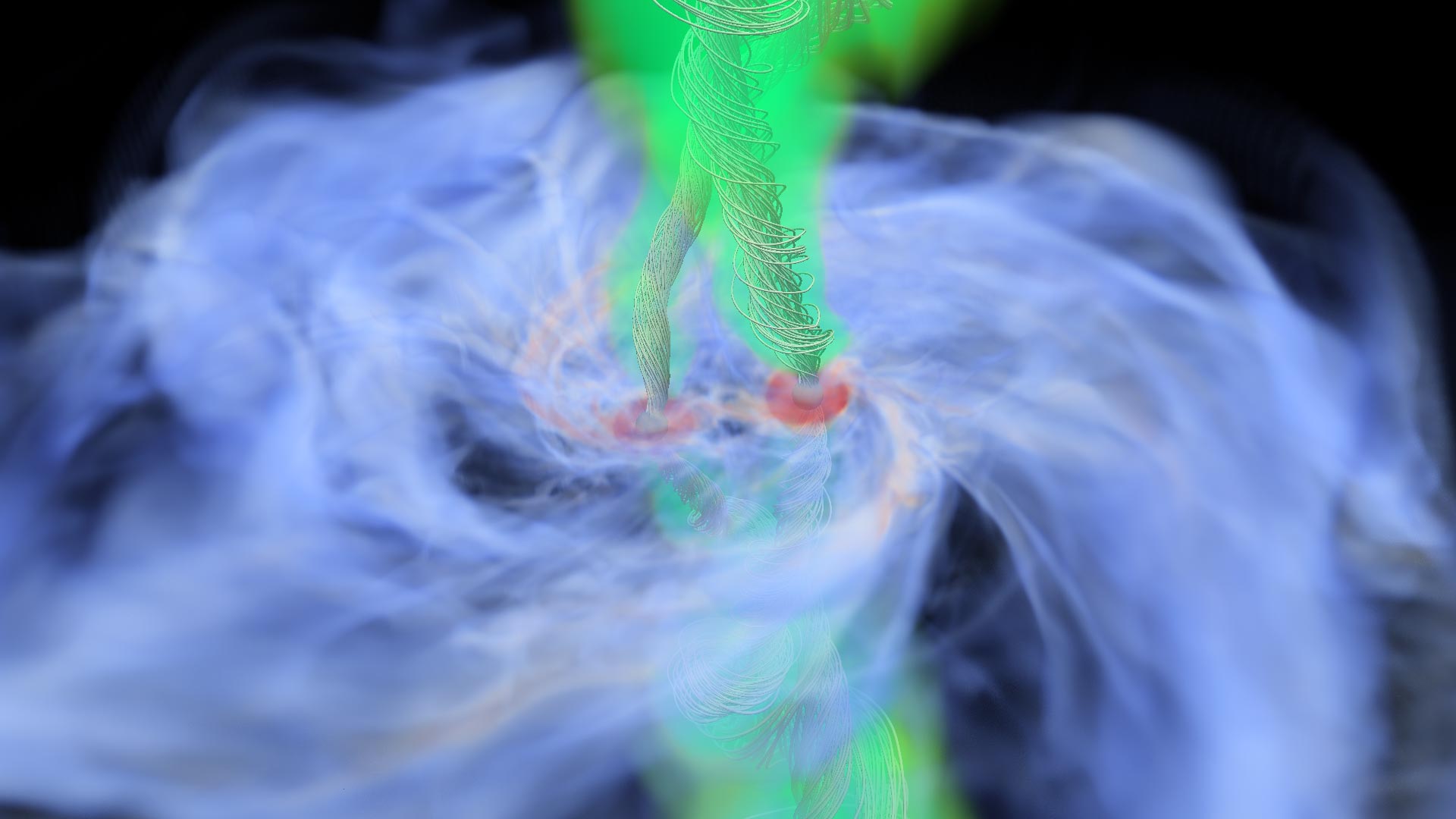
    Gas Flows Around Binary Protostar System Visualization
    Visualization of gas flows around a binary protostar system calculated by ATERUI III. The gas shown in red orbits around one of the two protostars. The gas shown in blue orbits around the combined binary system. The gas shown in green is being expelled from the system and is carrying away angular momentum. The present research shows that the magnetic field plays an important role in expelling gas and angular momentum. Credit: Matsumoto, Hotokezaka, Inayoshi 2026

    Magnetic fields may be the hidden force bringing both newborn stars and giant black holes together.

    New computer simulations suggest that magnetic fields play a crucial role in helping pairs of young stars form. The findings could explain why binary star systems are so common throughout the Milky Way and may even offer clues about how supermassive black holes grow.

    Stars are born when vast clouds of gas in space collapse under gravity, creating dense regions known as molecular cloud cores. Because multiple stars often form within the same cloud, some end up becoming gravitationally linked, creating binary star systems in which two stars orbit one another.

    Astronomers have long suspected that many binary systems begin taking shape very early in the star formation process, before the stars themselves are fully developed. However, explaining how these young protostars move close enough together to become a stable pair has remained a challenge.

    Magnetic Fields Bring Protostars Closer Together

    To investigate the problem, researchers carried out advanced simulations using several supercomputers, including the National Astronomical Observatory of Japan’s ATERUI III system and its predecessor, ATERUI II.

    The simulations revealed that interactions between magnetic fields in interstellar space and the gas surrounding young protostars can remove angular momentum from the pair. As angular momentum is reduced, the protostars are able to move closer together, allowing a binary system to form within a realistic timescale.

    The importance of magnetic fields became especially clear when researchers ran a comparison simulation with no magnetic field at all. In that scenario, the two protostars moved farther apart rather than closer together, highlighting magnetism’s key role in the formation process.

    Implications for Binary Black Holes

    The researchers also found evidence that a similar mechanism could operate on pairs of massive black holes.

    In the gas-rich central regions of a newly formed galaxy created when two smaller galaxies merge, magnetic fields may help massive binary black holes lose angular momentum and move closer together. Such a process could help explain how black holes eventually approach one another closely enough to merge, ultimately producing a supermassive black hole.

    Directly simulating massive binary black holes over the enormous timescales required for them to spiral inward remains computationally difficult. As a result, researchers say that a detailed investigation into the influence of magnetic fields on binary black hole evolution will require future study.

    Reference: “Magnetic-field-induced inspiral of binaries with circumbinary disc: black hole and protostellar systems” by Tomoaki Matsumoto, Kenta Hotokezaka and Kohei Inayoshi, 10 April 2026, Monthly Notices of the Royal Astronomical Society.
    DOI: 10.1093/mnras/stag669

    Never miss a breakthrough: Join the SciTechDaily newsletter.
    Follow us on Google and Google News.

    Astronomy Astrophysics Black Hole National Institutes of Natural Sciences
    Share. Facebook Twitter Pinterest LinkedIn Email Reddit

    Related Articles

    Across Time and Space: Mysterious Star’s Epic Journey to Heart of Milky Way

    Cosmic Alchemy – New Findings Demonstrate That Supermassive Black Holes Alter Galactic Chemistry

    M87’s Wobbling Jet: A Spin on Black Hole Mysteries

    Mysterious Cosmic Tadpole: A Strange Gas Cloud Dances With a Colossal Black Hole

    Massive Stellar Triples Leading to Sequential Binary Black-Hole Mergers

    Astronomers Discover Earliest Supermassive Black Hole and Quasar in the Universe – 1000x More Luminous Than the Milky Way

    Most Distant Quasar Discovered Sheds Light on How Supermassive Black Holes Grow

    Deepening Astronomical Mystery: On the Hunt for a Missing Giant Black Hole

    Supermassive Black Hole’s Dust Ring May Be Casting Shadows From Heart of a Galaxy

    Leave A Reply Cancel Reply

    • Facebook
    • Twitter
    • Pinterest
    • YouTube

    Don't Miss a Discovery

    Subscribe for the Latest in Science & Tech!

    Trending News

    Scientists Finally Uncover How a “Forever Chemical” Causes Birth Defects

    Scientists Uncover the Earliest Brain Changes That May Predict Alzheimer’s Decades Before Symptoms

    Surprising New Study Challenges a Century-Old Theory of Habit Formation

    Scientists Turn Seawater Into Drinking Water Without Toxic Brine

    Vitamin D Drug Shows Surprising Promise Against One of the Deadliest Cancers

    NASA’s X-59 Sonic Boom Killer Is Ready for Its Biggest Test Yet

    The Best Exercise Combination for Longevity, According to a 30-Year Study

    Popular Weight-Loss Drug Found To Slow Biological Aging in Landmark Human Trial

    Follow SciTechDaily
    • Facebook
    • Twitter
    • YouTube
    • Pinterest
    • Newsletter
    • RSS
    SciTech News
    • Biology News
    • Chemistry News
    • Earth News
    • Health News
    • Physics News
    • Science News
    • Space News
    • Technology News
    Recent Posts
    • Magnetic Fields May Solve a Longstanding Binary Star Mystery
    • NASA’s Latest Update on International Space Station Leak
    • The Probiotic Breakthrough for Natural Anxiety Relief and Better Mental Health
    • Animal vs. Plant Protein: Scientists Found a Surprising Nutritional Difference
    • Tiny Genetic Change Turns Female Mice Into Males, Scientists Discover
    Copyright © 1998 - 2026 SciTechDaily. All Rights Reserved.
    • Science News
    • About
    • Contact
    • Editorial Board
    • Privacy Policy
    • Terms of Use

    Type above and press Enter to search. Press Esc to cancel.