

Testing thousands of genes in living tumors revealed hidden drivers of aggressive basal-like breast cancer that cell cultures largely failed to detect.
Inside basal-like breast cancer cells, entire stretches of chromosomes may disappear while others are copied repeatedly. Each altered region can contain hundreds of genes, leaving researchers with a difficult question: which of those genetic changes actually help the cancer grow?
Researchers in Toronto have developed a way to investigate that confusion directly. Using a gene-editing system that can both disable genes and increase their activity inside living animals, they identified 81 previously unrecognized genes associated with the growth of basal-like breast cancer (BLBC), one of the most aggressive and difficult forms of the disease to treat.
The findings, published in Nature, provide a more detailed view of how abnormal chromosome numbers and rearrangements influence cancer. They could also help researchers identify vulnerabilities that may eventually be explored as treatment targets.
The study was led by Dr. Daniel Schramek, Deputy Director of Discovery Research at Sinai Health and Senior Investigator at the Lunenfeld-Tanenbaum Research Institute (LTRI), and Dr. Khalid Al-Zahrani, formerly a postdoctoral fellow at LTRI and now a faculty member at the Donnelly Centre for Cellular and Biomolecular Research at the University of Toronto (U of T).
Chromosomal chaos conceals key drivers
BLBC disproportionately affects younger women of color. It is frequently marked by aneuploidy, a condition in which cells contain abnormal numbers of chromosomes or chromosome segments because large sections have been lost or copied multiple times.
Healthy cells depend on carefully balanced amounts of genetic material. When that balance is disrupted, normal cellular functions can break down. Cancer cells, however, can exploit some of these changes to divide more rapidly, survive difficult conditions, and spread through the body.
The scale of the disruption has made it difficult to identify the genes that matter most. A single duplicated or deleted chromosome region can contain hundreds of genes, and each one may become more active, less active or disappear entirely. Researchers therefore faced the equivalent of searching through a crowded genetic neighborhood without knowing which address contained the cancer driver.
The treatment problem is especially urgent because BLBC is also called “triple-negative” breast cancer. Its tumors lack three receptors that clinicians commonly use to classify and target other breast cancers. Without those molecular targets, patients have fewer options for precision therapy.
“In many types of breast cancer that have been extensively researched, the five-year survival rate is around 95 percent. Most people survive because we were able to find the genes that drive the cancer,” says Dr. Schramek, who holds the Canada Research Chair in Functional Cancer Genomics. “In this one subset, we don’t know what the driver of the cancer is and therefore, it has some of the worst outcomes for patients.”
A tool tests losses and gains
To sort through the altered chromosome regions, the researchers built on years of work adapting CRISPR genome editing for the mouse mammary gland, a widely used model for studying breast cancer.
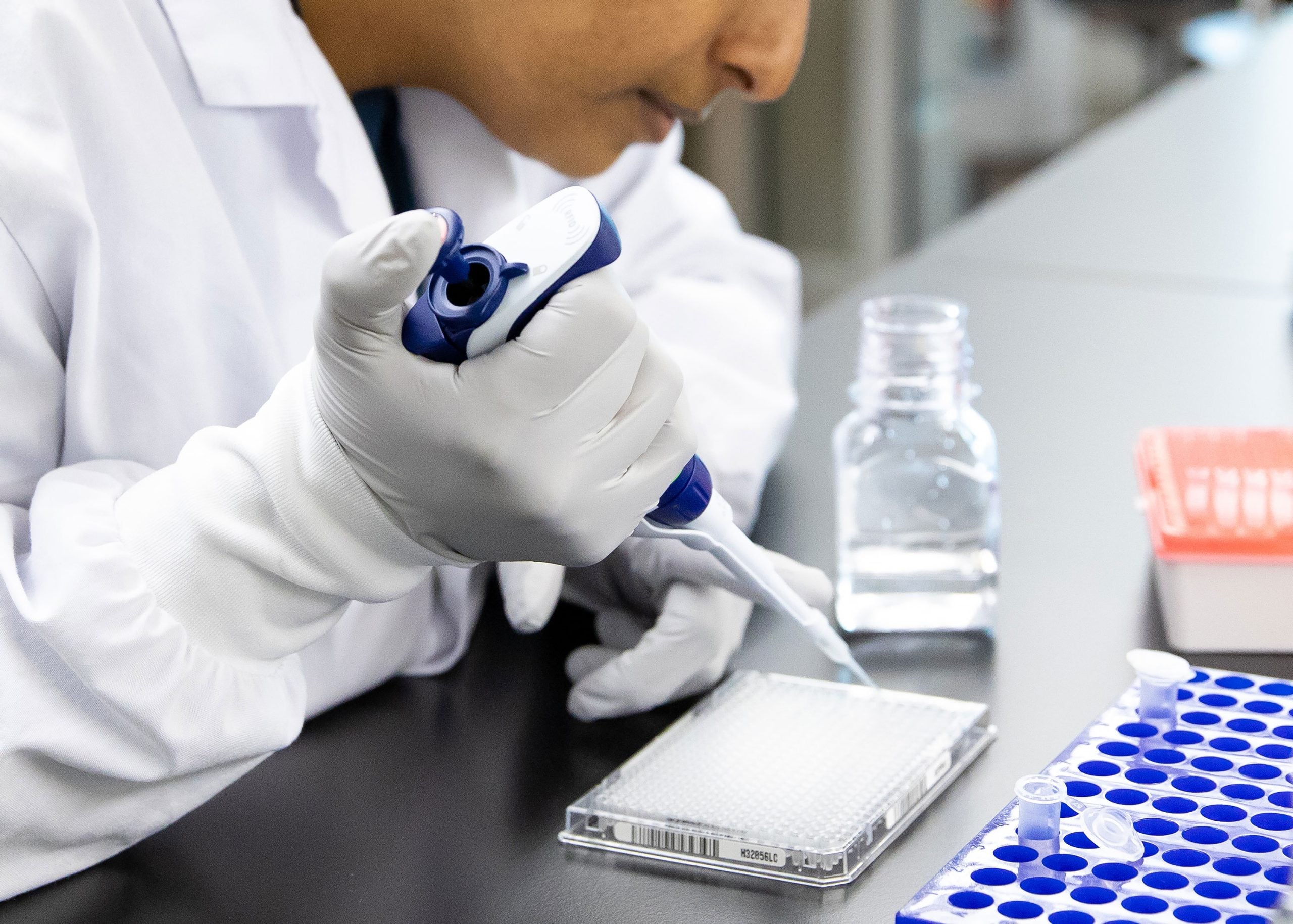
CRISPR allows researchers to make controlled changes to genes. In this case, it provided a way to test thousands of candidates inside a living animal and observe which changes encouraged or restrained tumor formation.
The existing platform could knock genes out, meaning it could silence them and simulate what happens when genetic material is lost. But aneuploidy can also create extra copies of genes, increasing their activity. The system could not reproduce that second half of the problem, preventing researchers from fully modeling the chromosome changes seen in BLBC.
Dr. Al-Zahrani addressed that limitation during his postdoctoral training with Dr. Schramek and Dr. Jeff Wrana, also a senior investigator at LTRI. He developed CRISPR-KOALA (Knockout and Activation Linked Assay), a system capable of turning some genes off while switching others on within the same mouse.
That dual function allowed researchers to imitate both deletion and duplication. They could test what happened when individual genes disappeared, as well as what happened when additional copies caused genes to become unusually active.
Living tumors expose hidden genes
The researchers used CRISPR-KOALA to examine more than 3,700 genes located on chromosomes commonly altered in BLBC. The screening identified 81 genes that had not previously been recognized as cancer drivers.
Most would have remained hidden using conventional laboratory methods. Ninety percent of the newly identified genes were not detected in standard cell culture experiments, where cancer cells are grown in dishes outside the body.
That difference showed why the living tumor environment mattered. Cancer cells inside a body interact with surrounding tissues, immune cells, blood vessels, nutrients, and changing oxygen levels. Those relationships can influence which genes become important, but many are absent or greatly simplified in cell culture.
“The reason we hadn’t found many of these driving genes before is that we were working in cell culture models,” says Dr. Schramek, who is also a professor in the Department of Molecular Genetics at U of T. “Now that we can study this cancer directly in a living system, we can observe the biological intricacies that only emerge in the context of a real tumor environment.”
One gene, PLGRKT, emerged as an especially powerful driver of BLBC. The researchers found that it helps cancer cells survive in areas deep inside a tumor where oxygen is limited.
Most cells use oxygen to extract energy efficiently from nutrients. When oxygen becomes scarce, cells must rely more heavily on alternative metabolic processes, similar to switching to a backup power source. PLGRKT helped cancer cells make that adjustment, allowing them to continue generating energy under conditions that might otherwise restrict their survival.
This ability did more than keep individual cells alive. The researchers found that it actively supported tumor growth, making PLGRKT a possible candidate for future targeted treatment research.
“This work brought together computational analysis, biotechnology development and functional genomics experiments across a range of mouse and human breast cancer models,” says Dr. Al-Zahrani, also an assistant professor in U of T’s Department of Molecular Genetics. “Combining all of that enabled us to uncover roles for many genes that we did not know were driving breast cancer and to start thinking about how to tackle BLBC in a targeted way.”
Reference: “Aneuploidy selects for the acquisition of driver genes in breast cancer” by Khalid N. Al-Zahrani, Ellen R. Langille, Jocelyn Nurtanto, Andreea Obersterescu, Katie Teng, Christopher Lowden, Julien Dessapt, Cynthia H. Chiu, Lauren V. Caldwell, David P. Cook, Miguel A. Pérez-Castro, Jacob M. Berman, Ricky Tsai, Alexander T. Bahcheli, Geraldine Mbamalu, Shifei Wu, Masahiro Narimatsu, Adele G. Lopes, Iosifina Fotiadou, Kin Chan, Linkang Zhang, K. W. Annie Bang, Michael J. Parsons, Larissa Mourao, E. Idil Temel, Liddy McCulla, Palavalasa Sravya, Li Zhang, Peter Sajjakulnukit, Costas A. Lyssiotis, Alexander D. Borowsky, Colinda L. G. J. Scheele, Daniel R. Wahl, Hartland W. Jackson, Katherine S. Stewart, Elaine Fuchs, Sean E. Egan, Miguel Angel Pujana, Jüri Reimand, Jeffrey L. Wrana and Daniel Schramek, 8 July 2026, Nature.
DOI: 10.1038/s41586-026-10752-9
Never miss a breakthrough: Join the SciTechDaily newsletter.
Follow us on Google and Google News.