
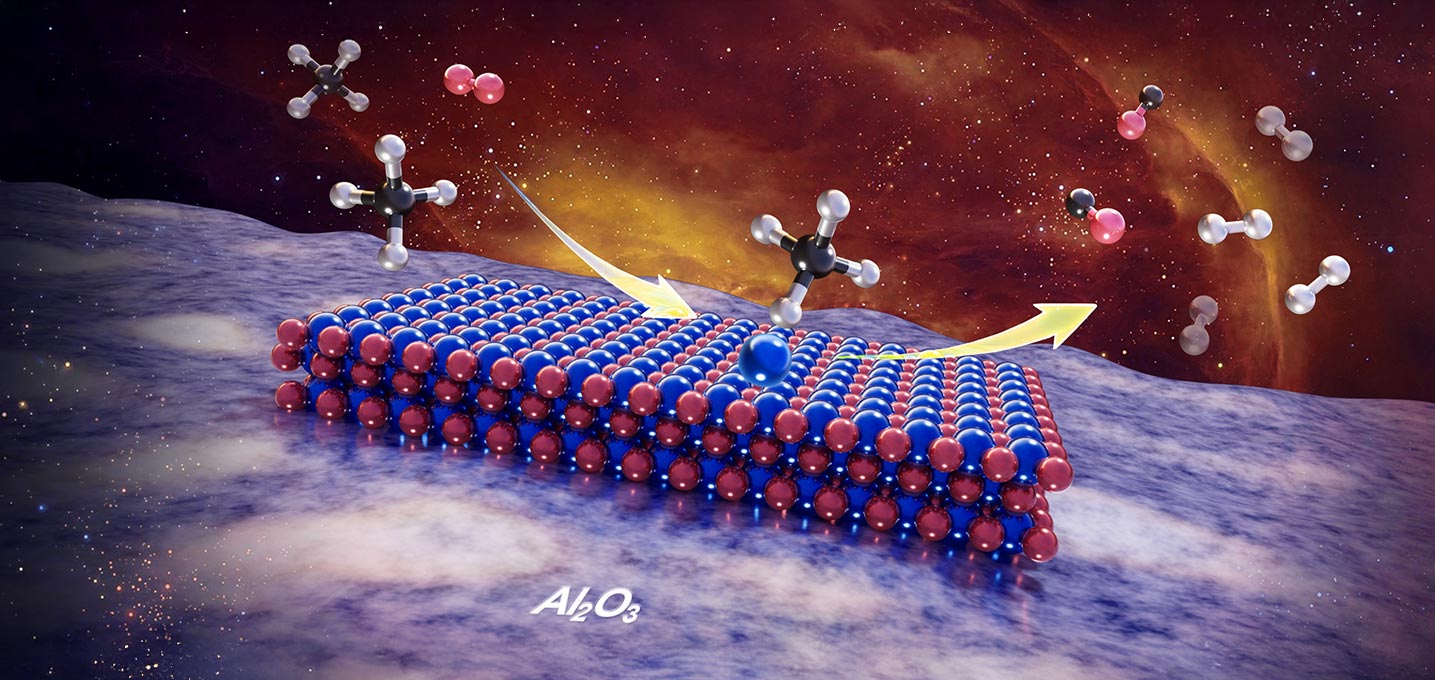
Producing syngas efficiently from methane could become easier with a better understanding of what actually drives the reaction at the atomic level. Partial oxidation of methane (POM) is considered a promising industrial method for making syngas, a mixture widely used as a starting material for fuels and chemicals.
For years, scientists have generally viewed metallic nickel (Ni) nanoparticles as the active catalytic centers responsible for the reaction. But there has been an important uncertainty. The metallic Ni found after the reaction may not be the material that actually performs the catalysis. Instead, it could form later when nickel oxide is reduced by syngas at high temperatures.
Nickel can also change dramatically while a reaction is underway. Under high-temperature redox conditions, its oxidation state can shift, and its atomic structure can reorganize. Because these transformations have been difficult to observe directly, researchers have struggled to determine which nickel structure is truly responsible for POM.
A Catalyst That Changes While It Works
In a recent study published in Nature Catalysis, scientists found that highly active atomic structures can form directly on the surface of NiO as the reaction proceeds. The results reveal the atomic origin of the catalytic activity and show why it is important to examine catalysts under realistic working conditions, when their structures may be constantly changing.
The research was led by Profs. Tao Zhang, Aiqin Wang and Xiaoyan Liu from the Dalian Institute of Chemical Physics (DICP) of the Chinese Academy of Sciences (CAS), together with Prof. Wei Liu from DICP, Prof. Tao Yang from Xi’an Jiaotong University, and Prof. Graham J. Hutchings from Cardiff University.
To investigate the process, the team created a low-loading Ni/Al2O3 catalyst containing 0.8 wt% Ni using a microemulsion method. Despite the small amount of nickel, the material showed strong POM performance. It converted 92% of the methane, while CO and H2 selectivities reached 87.0%. The H2/CO molar ratio also remained stable at about 2.0.
Ten Times Less Nickel, Similar Performance
One of the most striking findings was that researchers detected almost no metallic Ni in the catalyst after the reaction. Even so, the low-loading catalyst performed about as well as a high-loading 8.0 wt% Ni/Al2O3 catalyst prepared by impregnation.
Its performance was also far better than that of another low-loading 0.8 wt% catalyst produced by the same impregnation method. Under identical conditions, that material only promoted methane combustion rather than the desired partial oxidation reaction.
The team then examined how the nickel changed during POM. Metallic Ni nanoparticles that were present when the reaction began were quickly oxidized into the NiO phase. Yet NiO alone was not enough to explain the high activity. When researchers tested a pre-formed pure-phase NiO catalyst, it showed no POM activity and instead drove complete methane oxidation.
An Atomic Structure Emerges on Nickel Oxide
Closer examination revealed what was different. During the reaction, the surface of NiO reconstructed itself, producing a [Ni1O4Ni4] active structural unit on the NiO(100) surface.
DFT calculations indicated that this reconstructed atomic motif makes it much easier to break a C–H bond in methane. The calculated activation barrier was only 12.5 kcal·mol-1.
That barrier was far lower than the 38.5 kcal·mol-1 calculated for the intact NiO(100) surface. It was also lower than the 15.7 kcal·mol-1 barrier found for the metallic Ni(111) surface.
These comparisons show that the reconstructed structure offers a clear kinetic advantage for activating methane. Taken together, the experimental observations and theoretical calculations point to this dynamically formed motif as the true active center for POM.
Designing Better Catalysts With Less Metal
The findings suggest that catalyst performance cannot always be understood simply by examining a material before or after a reaction. In some cases, the most important active structures may appear only while the catalyst is operating.
“Our study highlights the critical role of in situ characterization in identifying dynamic active structures under reaction conditions,” said Prof. Liu. “Dynamic reconstruction enables low-loading catalysts to achieve high performance, offering new opportunities for the rational design of efficient catalysts while reducing reliance on high metal loadings.”
Reference: “In situ generation of active motifs on Ni/Al2O3 during partial oxidation of methane to syngas” by Yuanlong Tan, Qiao Zhao, Chen Liang, Chaobin Zeng, Hongwen Guo, Fengyuan Liu, Guang Xian Pei, James Hayward, Jingyuan Ma, Han Zhao, Xiao Yan Liu, Wei Liu, Tao Yang, Aiqin Wang, Graham J. Hutchings and Tao Zhang, 14 August 2026, Nature Catalysis.
DOI: 10.1038/s41929-026-01580-1
Never miss a breakthrough: Join the SciTechDaily newsletter.
Follow us on Google and Google News.