
Close Menu
    Facebook X (Twitter) Instagram
    SciTechDaily
    • Biology
    • Chemistry
    • Earth
    • Health
    • Physics
    • Science
    • Space
    • Technology
    Facebook X (Twitter) Pinterest YouTube RSS
    SciTechDaily
    Home»Space»A Cosmic Draw: Interacting Galaxies With Monumentally Energetic Cores
    Space

    A Cosmic Draw: Interacting Galaxies With Monumentally Energetic Cores

    By ESA/HubbleFebruary 6, 2022No Comments2 Mins Read
    Facebook Twitter Pinterest Telegram LinkedIn WhatsApp Email Reddit
    Share
    Facebook Twitter LinkedIn Pinterest Telegram Email Reddit
    Arp 282
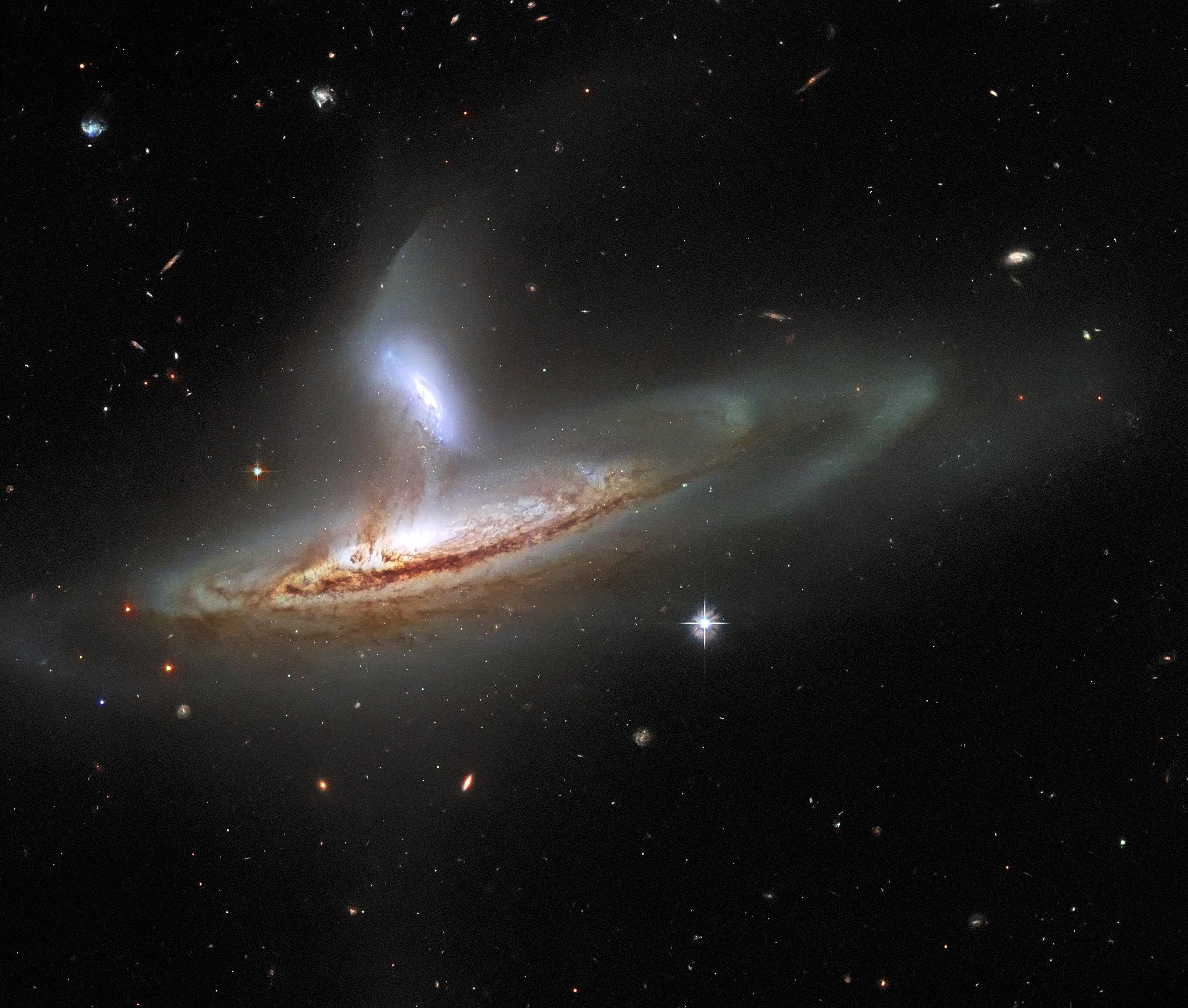
    Hubble Space Telescope of Arp 282, an interacting galaxy pair that is composed of the Seyfert galaxy NGC 169 (bottom) and the galaxy IC 1559 (top). Credit: ESA/Hubble & NASA, J. Dalcanton, Dark Energy Survey, DOE, FNAL/DECam, CTIO/NOIRLab/NSF/AURA, SDSS, Acknowledgement: J. Schmidt

    Galaxies NGC 169 and IC 1559, part of Arp 282, are interacting in a way that visibly showcases tidal forces, with streams of matter connecting them. This rare capture by the Hubble Space Telescope highlights the impact of gravitational interactions on galaxy evolution.

    It is now widely accepted amongst astronomers that an important aspect of how galaxies evolve is the way they interact with one another. Galaxies can merge, collide, or brush past one another — each of which has a significant impact on their shapes and structures. As common as these interactions are thought to be in the Universe, it is rare to capture an image of two galaxies interacting in such a visibly dynamic way. This image, from the NASA/ESA Hubble Space Telescope, feels incredibly three-dimensional for a piece of deep-space imagery.

    The subject of this image is named Arp 282, an interacting galaxy pair that is composed of the Seyfert galaxy NGC 169 (bottom) and the galaxy IC 1559 (top). If you’re interested in learning more about Seyfert galaxies, you can read about the Seyfert galaxy NGC 5728 here.

    Interestingly, both of the galaxies comprising Arp 282 have monumentally energetic cores, known as active galactic nuclei (AGN), although it is difficult to tell that from this image. This is actually rather fortunate, because if the full emission of two AGNs was visible in this image, then it would probably obscure the beautifully detailed tidal interactions occurring between NGC 169 and IC 1559.

    Tidal forces occur when an object’s gravity causes another object to distort or stretch. The direction of the tidal forces will be away from the lower-mass object and towards the higher mass object. When two galaxies interact, gas, dust and even entire solar systems will be drawn away from one galaxy towards the other by these tidal forces. This process can actually be seen in action in this image — delicate streams of matter have formed, visibly linking the two galaxies.

    Never miss a breakthrough: Join the SciTechDaily newsletter.
    Follow us on Google and Google News.

    Astronomy European Space Agency Hubble Space Telescope NASA
    Share. Facebook Twitter Pinterest LinkedIn Email Reddit

    Related Articles

    Hubble’s Newest Discovery Isn’t a Star, It’s a Window Into the Dark Universe

    This Nearby Galaxy Shows How Frozen Clouds Ignite Into Stars

    This Chaotic Spiral Galaxy Is Still Recovering From a Cosmic Collision

    This Strange Spiral Galaxy Is Hiding a Massive Black Hole

    Hubble Zooms In on a Galaxy That Maps the Universe’s Expansion

    Hubble Captures a Dazzling Spiral Galaxy Alive With Birth and Destruction

    Hubble Spots a Glowing “Ring of Fire” in a Distant Spiral Galaxy

    Dust, Light & Ancient Collisions: The Sombrero Galaxy Like You’ve Never Seen It

    Star Formation in Motion: Hubble Reveals Spiraling Stars and Sculpted Nebulae

    Leave A Reply Cancel Reply

    • Facebook
    • Twitter
    • Pinterest
    • YouTube

    Don't Miss a Discovery

    Subscribe for the Latest in Science & Tech!

    Trending News

    Largest-Ever Study Finds Medicinal Cannabis Ineffective for Anxiety, Depression, PTSD

    250-Million-Year-Old Egg Solves One of Evolution’s Biggest Mysteries

    Living With Roommates Might Be Changing Your Gut Microbiome Without You Knowing

    Century-Old Cleaning Chemical Linked to 500% Increased Risk of Parkinson’s Disease

    What if Your Memories Never Happened? Physicists Take a New Look at the Boltzmann Brain Paradox

    One of the Universe’s Largest Stars May Be Getting Ready To Explode

    Scientists Discover Enzyme That Could Supercharge Ozempic-Like Weight Loss Drugs

    Popular Sweetener Linked to DNA Damage – “It’s Something You Should Not Be Eating”

    Follow SciTechDaily
    • Facebook
    • Twitter
    • YouTube
    • Pinterest
    • Newsletter
    • RSS
    SciTech News
    • Biology News
    • Chemistry News
    • Earth News
    • Health News
    • Physics News
    • Science News
    • Space News
    • Technology News
    Recent Posts
    • Want Less Stress? Landmark Study Points to a Simple Habit
    • Scientists Reveal Eating Fruits and Vegetables May Increase Your Risk of Lung Cancer
    • AI Reveals Explosive Growth of Floating Algae Across the World’s Oceans
    • 5.5 Million Bees Discovered Living Beneath a New York Cemetery
    • Scientists Reverse Brain Aging With Simple Nasal Spray
    Copyright © 1998 - 2026 SciTechDaily. All Rights Reserved.
    • Science News
    • About
    • Contact
    • Editorial Board
    • Privacy Policy
    • Terms of Use

    Type above and press Enter to search. Press Esc to cancel.