
Close Menu
    Facebook X (Twitter) Instagram
    SciTechDaily
    • Biology
    • Chemistry
    • Earth
    • Health
    • Physics
    • Science
    • Space
    • Technology
    Facebook X (Twitter) Pinterest YouTube RSS
    SciTechDaily
    Home»Space»Widespread Megaripple Activity Detected Across the North Polar Region of Mars
    Space

    Widespread Megaripple Activity Detected Across the North Polar Region of Mars

    By Planetary Science InstituteFebruary 6, 20222 Comments4 Mins Read
    Facebook Twitter Pinterest Telegram LinkedIn WhatsApp Email Reddit
    Share
    Facebook Twitter LinkedIn Pinterest Telegram Email Reddit
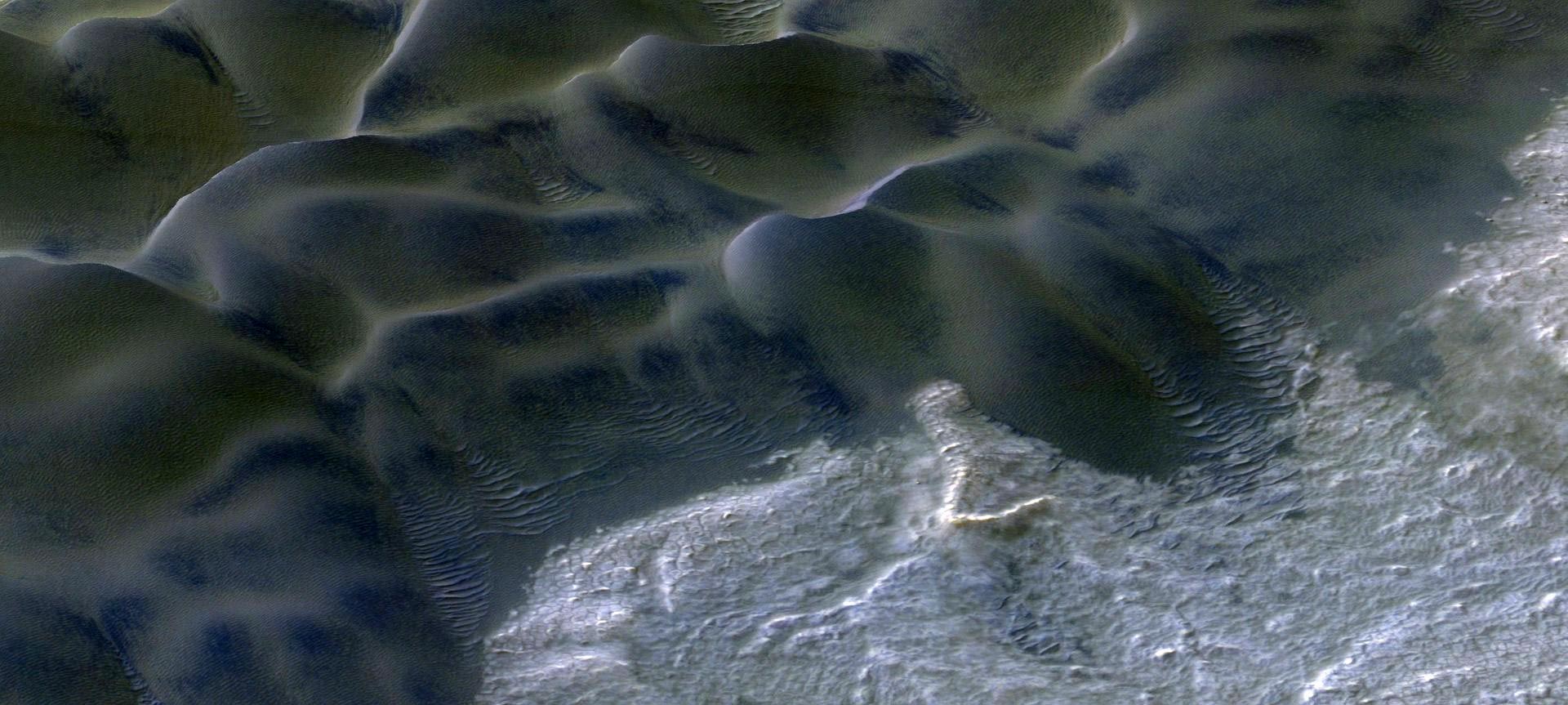
    Megaripples Mars
    “Megaripples” are distinct wind-driven bedforms that occur on the surface of Earth and Mars. Here, megaripples are shown at the bottom of center adjacent to the north polar sand dunes in this perspective view using data returned from the High Resolution Imaging Science Experiment (HiRISE). These northern polar megaripples and dunes yield the highest known sand fluxes on the planet, driven by summer katabatic winds modulated by the seasonal CO2 cap retreat. View is approximately 1 kilometer wide. Credit: HiRISE data are courtesy of NASA/JPL/University of Arizona

    New research has discovered that megaripples on Mars’ north polar region are actively migrating, challenging the belief that they were inactive relics. These movements are driven by strong summer winds, indicating ongoing surface activity on Mars.

    Megaripples, intermediate-scale bedforms caused by the action of the wind, have been studied extensively and thought to be largely inactive relics of past climates, save for a few exceptions. A new paper by Planetary Science Institute Research Scientist Matthew Chojnacki shows that abundant megaripple populations were identified across the north polar region of Mars and were found to be migrating with dunes and ripples.

    Megaripples on Mars are about 1 to 2 meters (3.3 to 6.6 feet) tall and have 5 to 40-meter (16 to 130-foot) spacing, where their size falls between ripples that are about 40 centimeters (16 inches) tall with 1 to 5-meter (3.3 to 16-foot) spacing and dunes that can reach hundreds of meters in height with spacing of 100 to 300 meters (330 to 1,000 feet). Whereas the megaripples migration rates are slow in comparison (average of 0.13 meters or 5 inches per Earth year), some of the nearby ripples were found to migrate an average equivalent of 9.6 meters (31.5 feet) per year over just 22 days in northern summer – unprecedented rates for Mars. These high rates of sand movement help explain the megaripple activity.
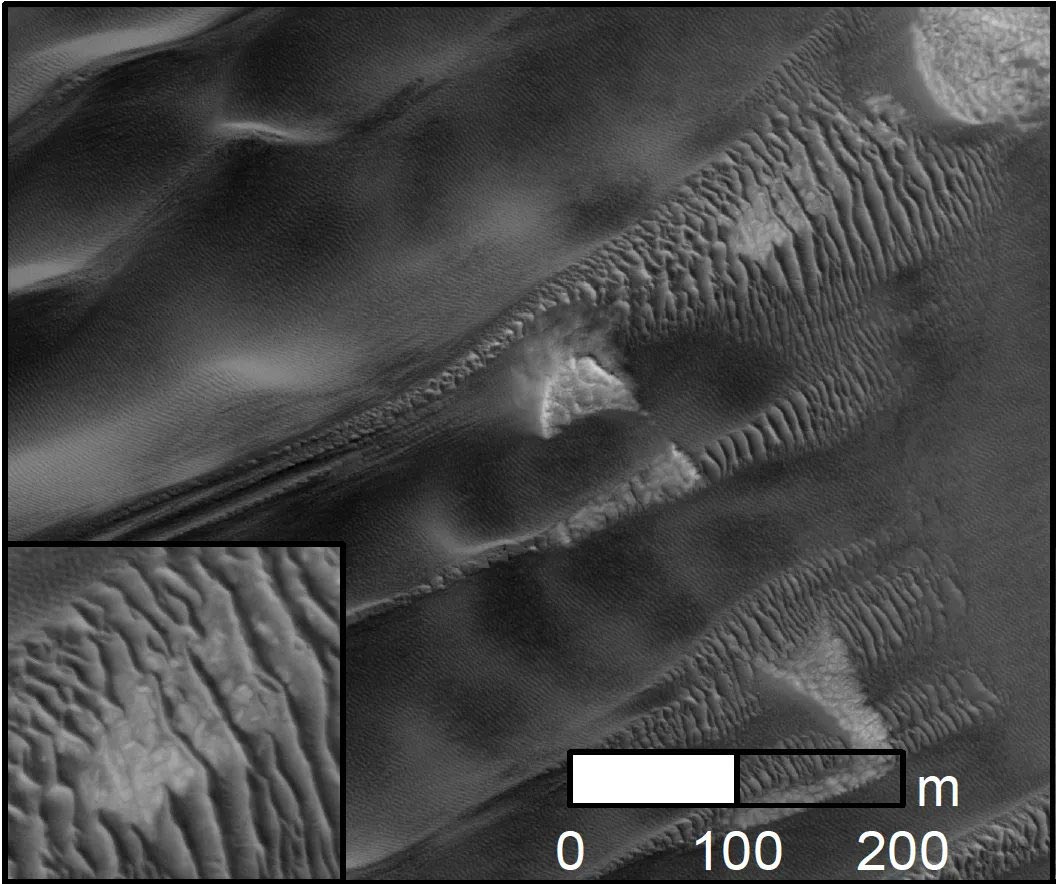
    Polar Bedform Sites With Active Megaripples
    Polar bedform sites with active megaripples, as viewed in HiRISE. Approximate transport direction is toward the lower left and the inset is 100 meters wide. Credit: HiRISE data are courtesy of NASA/JPL/University of Arizona

    “Using repeat HiRISE images acquired over long durations – six Mars years or 13 Earth years – we examined the dynamic activity of polar bedforms. We found the thin Martian atmosphere can mobilize some coarse-grained megaripples, overturning prior notions that these were static relic landforms from a past climate. We mapped megaripples and adjacent bedforms across the north polar sand seas, the most expansive collection of dune fields on Mars,” said Chojnacki, lead author of “Widespread Megaripple Activity Across the North Polar Ergs of Mars” that appears in Journal of Geophysical Research: Planets.

    Part of the uncertainty when studying planetary polar landforms is the long, cold polar winter that eventually covers the region in carbon dioxide and water ice. For wind-driven bedforms, such as megaripples, that means they are unable to migrate for nearly half of the year. “However, it appears the late spring and summer winds that descend off the polar cap more than make up for these other periods of inactivity,” Chojnacki said.

    “Megaripples were found to be widespread across the region and migrating at relatively high rates relative to other sites on Mars that are at lower latitudes. This enhanced activity is likely related to the greater sand fluxes found for neighboring dunes which are driven by summer-time seasonal winds when polar ice is sublimating. This supports the idea that much of the Martian surface is actively being modified and not just ancient or static.” Chojnacki said. “In contrast, other megaripples appear to be stabilized, a likely result of inter-granular ice within low wind areas.”

    Reference: “Widespread Megaripple Activity Across the North Polar Ergs of Mars” by Matthew Chojnacki, David A. Vaz, Simone Silvestro and David C. A. Silva, 12 November 2021, JGR: Planets.
    DOI: 10.1029/2021JE006970

    The project was funded by NASA Mars Data Analysis program grant 80NSSC20K1066.

    Never miss a breakthrough: Join the SciTechDaily newsletter.
    Follow us on Google and Google News.

    Aalto University Geophysics Mars Planetary Science Institute Planets Popular
    Share. Facebook Twitter Pinterest LinkedIn Email Reddit

    Related Articles

    Marsquakes: A New Way to Discover Hidden Water Deep Underground on Mars

    Massive Marsquake! Five Times Larger Than Previous Record Holder

    Why Did Mars Dry Out? Mystery Deepens As New Study Points to Unusual Answers

    Newly Discovered Carbon on Mars: Origin May Be Biologically Produced Methane

    SETI Researchers Have a New Theory About What Is Causing Landslides on the Surface of Mars

    Escape From Mars: Surprising Discovery in the Red Planet’s Atmosphere Helps Explain Martian Mystery

    Preserved Billion Year-Old Dune Fields on Mars Offer Insights Into Martian History

    Surprise on Mars – Unexpected Reaction to Solar Eclipses From Martian Moon Phobos

    NASA InSight Lander Takes Deep Mars Measurements: Seismograph Data Reveals Boundaries From Crust to Core

    2 Comments

    1. Luiz Antonio Mendes de Resende on February 8, 2022 4:49 am

      Como funcionam as bussolas em Marte ?

      Reply
    2. Trotting Bull Moose on February 8, 2022 5:53 pm

      How is here on earth the ocean currents are given credit for wind so what drives the wind on Mars ?

      Reply
    Leave A Reply Cancel Reply

    • Facebook
    • Twitter
    • Pinterest
    • YouTube

    Don't Miss a Discovery

    Subscribe for the Latest in Science & Tech!

    Trending News

    The Universe Is Expanding Too Fast and Scientists Can’t Explain Why

    “Like Liquid Metal”: Scientists Create Strange Shape-Shifting Material

    Early Warning Signals of Esophageal Cancer May Be Hiding in Plain Sight

    Common Blood Pressure Drug Shows Surprising Power Against Deadly Antibiotic-Resistant Superbug

    Scientists Uncover Dangerous Connection Between Serotonin and Heart Valve Disease

    Scientists Discover a “Protector” Protein That Could Help Reverse Hair Loss

    Bone-Strengthening Discovery Could Reverse Osteoporosis

    Scientists Uncover Hidden Trigger Behind Stem Cell Aging

    Follow SciTechDaily
    • Facebook
    • Twitter
    • YouTube
    • Pinterest
    • Newsletter
    • RSS
    SciTech News
    • Biology News
    • Chemistry News
    • Earth News
    • Health News
    • Physics News
    • Science News
    • Space News
    • Technology News
    Recent Posts
    • A Common Diabetes Drug May Hold the Key to Stopping HIV From Coming Back
    • Ancient “Syphilis-Like” Disease in Vietnam Challenges Key Scientific Assumptions
    • Drinking Alcohol To Cope in Your 20s Could Damage Your Brain for Life
    • Scientists Crack Alfalfa’s Chromosome Mystery After Decades of Debate
    • Ancient Ant-Plant Alliance Collapses As Predatory Wasps Move In
    Copyright © 1998 - 2026 SciTechDaily. All Rights Reserved.
    • Science News
    • About
    • Contact
    • Editorial Board
    • Privacy Policy
    • Terms of Use

    Type above and press Enter to search. Press Esc to cancel.